 MineArchive
Druid Mine
| Also known as | Arundell Mine, Devon New Copper Mine, New Victoria Mine |
|---|---|
| Location | Ausewell Hill, north-west of Ashburton, Devon — 50.5296, -3.8143 (exact) |
| Commodity | Copper |
| Type | Metal |
| Worked | 1852–1872 |
| Maximum depth | 96 fathoms (176 m) |
| Operators | Arundell United Copper Mines (1853–1856), Devon New Copper Mining Company (1860–1863) |
Overview
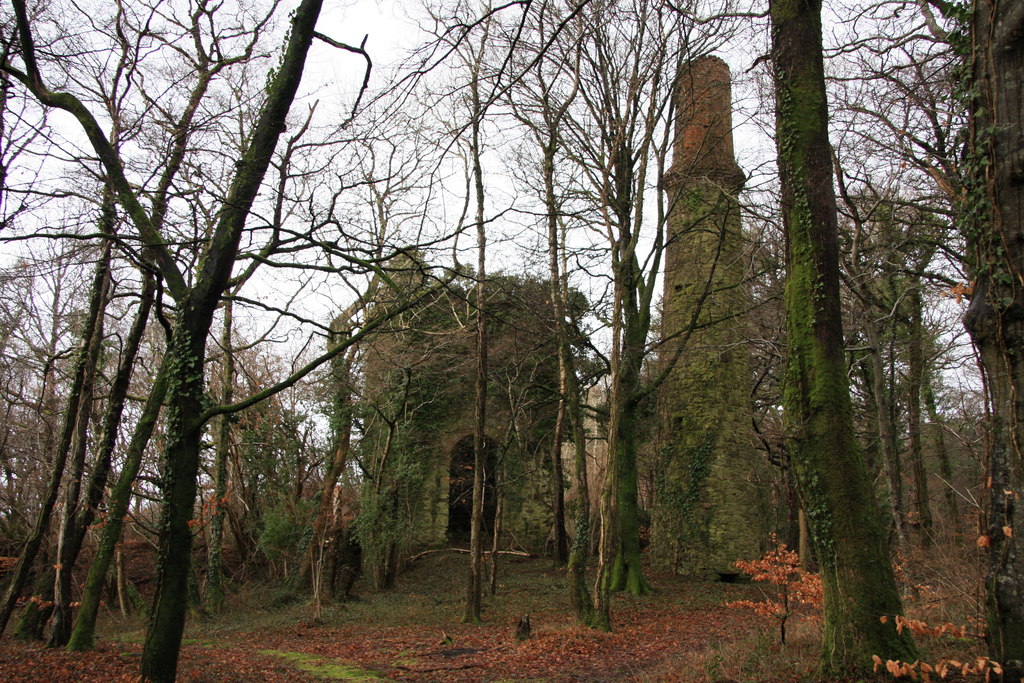
A small copper mine on Ausewell Hill north-west of Ashburton, worked by a succession of companies between 1852 and 1872 with heavy investment and little return; its engine house and red-topped stack stand largely undisturbed in woodland.
History
Druid Mine lies on the south-facing slope of Ausewell Hill, about a mile and a half north-west of Ashburton, on land of the former Druid estate. Its origin is unknown, and its recorded life lasted only twenty years, from 1852 to 1872, under a series of names: Arundell, Devon New Copper Mine and New Victoria Mine. In 1853 the estate's owner, John Sparke Amery, leased it to J. H. Arundell, who formed Arundell United Copper Mines on the cost-book system; the engine house was up that year, shafts were being sunk and the new Queen Victoria shaft was begun, an event celebrated with a gift to each miner and strong ale. The failure of the company's bankers, Strahan, Paul and Company, stopped work in the autumn of 1855.
Reorganised as the Arundell Copper Mining Company, the mine restarted in 1856. In 1860 the Devon New Copper Mining Company took a lease, but money ran short at the end of that year; work resumed in 1861, the pitwork reaching the 58-fathom level and the shaft 96 fathoms the next year, and in 1863 the company went into liquidation for want of sales. The Druid Mining Company bought the mine in 1866 and worked the shallower ground above the 68-fathom level, installing a larger engine in 1869, before giving way to the New Victoria (South Devon) Mine company; by 1870 its shares had dropped out of the Mining Journal. Two lodes were worked by adits and shafts, and crushing machinery was driven by a 60-foot waterwheel fed from a large earthwork reservoir. Apart from the removal of its machinery, the site has been left virtually undisturbed: the engine house and its red-brick-topped stack, the wheelpit and the reservoir survive in woodland, and an unusually full archive of the mine's papers survives with them.
Geology
Two copper lodes, worked by adits and shafts.
Workings
Shafts including Queen Victoria, Watson's and William's, and adits; a Cornish pumping engine (a larger one installed in 1869) and a 60-foot waterwheel driving crushing machinery, fed from a reservoir.
Closure
Abandoned around 1870-72 after repeated company failures; the machinery was then removed.
What remains
The engine house and stack stand, unstable, in mixed woodland on private land; the wheelpit, reservoir and other features survive.
Engine house and red-brick-topped stack, a 60-foot wheelpit and building remains, an earthwork reservoir and shafts.
Redevelopment
Unknown.
Related mines
- Brimpts Tin Mine — J. H. Arundell ran both: Arundell Mine and the Devon Tin Mines at Old Brimpts.
Nearby mines
- Ringleshutes Mine — 2.7 miles (4.3 km) SW
- Hemsworthy Mine — 3.4 miles (5.4 km) NE
- Hexworthy Mine — 3.6 miles (5.9 km) W
- Hooten Wheals — 4.5 miles (7.3 km) NW
- Bagtor Mine — 4.6 miles (7.4 km) NE
Straight-line distance, within 9 miles (15 km). Show on the map.
Recorded claims
Individual factual claims, each attached to the source(s) that support it below. Where sources disagree, both are kept.
- Recorded activity lasted twenty years between 1852 and 1872, with massive investment of cash and equipment by several companies. 1,2
- Leased to J. H. Arundell in 1853 by the owner of the Druid estate, John Sparke Amery, and renamed Arundell Mine. 3
- Work was suspended in 1855 when the company's bankers failed. 1,3
- Work resumed in 1861, the pitwork reaching the 58-fathom level and a depth of 96 fathoms the following year. 1
- The mine went into liquidation in 1863; the Druid Mining Company bought it in 1866. 1
- The engine house and stack still stand, and a 60-foot waterwheel's wheelpit and a large earthwork reservoir survive. 2
Sources
- (secondary) Druid Mine — Dartmoor Explorations
- (primary) Druid Mine, Ashburton: an archaeological and historical survey (English Heritage AI/8/2002, P. Newman) — Archaeology Data Service (English Heritage report)
- (secondary) Vignette on Druid Mine in Devon (R. von Arx, British Mining 55) — Northern Mine Research Society
Record created: 17 October 2026 · Last researched: 17 October 2026