 MineArchive
Mossfield Colliery
| Also known as | The Old Sal, Mossfields Colliery |
|---|---|
| Location | Outskirts of Longton, parish of Caverswall, Stoke-on-Trent, Staffordshire — 53.0059, -2.1305 (approximate) |
| Commodity | Coal |
| Type | Coal |
| Worked | By 1889–1963 |
| Maximum depth | The shafts were 440 yards deep, about 20 yards below the Cockshead seam. |
| Operators | Hawley and Bridgewood, Mossfield Colliery Company, Settle Speakman (?–1947), National Coal Board (1947–1963) |
Overview
A deep colliery on the edge of Longton in the Potteries, nicknamed 'The Old Sal', whose thick, dusty and fire-prone Cockshead seam brought a gob-fire explosion that killed 64 in 1889 and another that killed 11 in 1940; it closed in 1963.
History
Mossfield Colliery stood on the outskirts of Longton, in the parish of Caverswall, at the south-eastern end of the North Staffordshire coalfield. In 1889 it belonged to Hawley and Bridgewood Limited, and it was later known simply as Mossfield — to Longton miners, 'The Old Sal'. Two shafts fifteen yards apart, 10 feet 6 inches across, went down 440 yards; the Hardmine seam was worked at 250 yards, the Banbury at 363 and the Cockshead at 414. The Cockshead, eight feet of coal with ironstone above, was a very dusty seam and prone from its earliest days to spontaneous combustion. The colliery was served by the Longton, Adderley Green and Bucknall Railway, opened in 1875. On 16 October 1889 a gob fire in the Cockshead workings, which the manager James Potts had tried and failed to seal off, set off an explosion that coal dust carried into the Banbury seam, killing 64 men and boys (see Disasters, below); most were buried in a mass grave in Longton cemetery. Special methods of working the seam in isolated panels kept it safe for half a century, until on 21 March 1940 an explosion at the 15's longwall face of the Cockshead, now worked by the Mossfield Colliery Company, killed 11 of the 12 men there; only the fireman survived. Before nationalisation the colliery was owned, with nearby Park Hall, by Settle Speakman. It closed in 1963.
Geology
The Hardmine (250 yards), Seven Feet Banbury (363 yards) and Cockshead (414 yards) seams of the North Staffordshire coalfield. The Cockshead, dipping about 1 in 3, carried seven to eight feet of clean coal under an ironstone-banded roof; it was dusty, gave off firedamp freely and was liable to gob fires from spontaneous combustion.
Workings
Two shafts 15 yards apart, both used for winding; the Cockshead and Banbury reached by cruts from the downcast. In 1889 the Cockshead was worked in panels and the Banbury by longwall, ventilated by a 30-foot Waddle fan; by 1940 the Cockshead faces were mechanised with percussive cutters and shaker conveyors.
Closure
Closed in 1963.
What remains
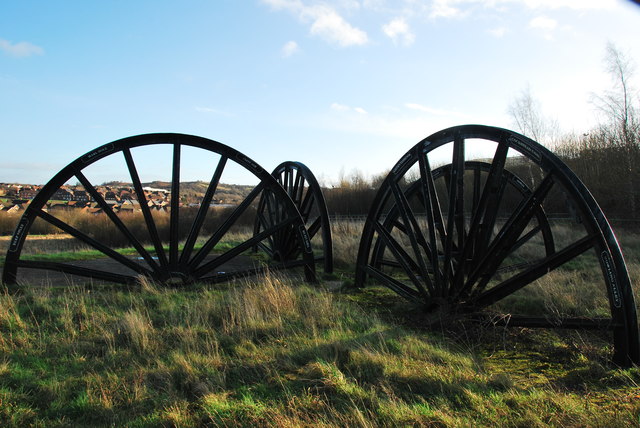
Four pithead wheels, their rims bearing the names of the colliery's seams, stand on top of the former spoil heap at Berryhill Fields.
Four pithead wheels on the former spoil heap at Berryhill Fields; a memorial in Longton cemetery over the mass grave of the 1889 dead.
Nearby mines
- Fenton Park Colliery — 1.3 km SW
- Ubberley Colliery — 1.5 km NW
- Parkhall Colliery — 1.8 km SE
- Kemball Colliery — 2.8 km SW
- Florence Colliery — 2.9 km S
Straight-line distance, within 15 km. Show on the map.
People
- James Potts · manager, 1883–1889 — Certificated manager for six years at the 1889 explosion; ordered stoppings round the gob fire the day before.
Recorded claims
Individual factual claims, each attached to the source(s) that support it below. Where sources disagree, both are kept.
- In 1889 Mossfield, owned by Hawley and Bridgewood, had two shafts 440 yards deep working the Hardmine at 250 yards, the Banbury at 363 and the Cockshead at 414. 1
- On 16 October 1889 an explosion initiated by a gob fire in the Cockshead seam killed 64. 1,2,3
- On 21 March 1940 an explosion at the 15's face of the Cockshead seam killed 11 of the 12 men at work there; only the fireman survived. 2,4
- Hawley and Bridgewood's colliery later became known as Mossfield, nicknamed 'The Old Sal', and closed in 1963; it was owned with Park Hall by Settle Speakman at nationalisation. 5
- It is distinct from the long-closed 'Old' Mossfield Colliery at Botteslow worked by the Chatterley Iron Company. 5
- Most of the 1889 dead were buried in a mass grave in Longton cemetery, where there is a memorial; five bodies were not recovered. 3
- Four pithead wheels bearing the names of the colliery's seams stand on top of its former spoil heap. 6
Photographs & further reading
The seams, workings and officials of the colliery and the inquest into the 1889 explosion.
View sourceThe inspector's report on the 1940 explosion in the Cockshead seam.
View sourceSources
- (secondary) Mossfield Colliery Explosion – Longton – 1889 — Northern Mine Research Society
- (secondary) Mossfield Colliery Explosion – Longton – 1940 — Northern Mine Research Society
- (secondary) Mossfield Explosion 1889, page 7 — healeyhero.co.uk
- (primary) Explosion, Mossfield Colliery, Longton (HC Deb 9 April 1940 vol 359 c473) — Hansard
- (secondary) The Longton, Adderley Green and Bucknall Railway (LMS Society Occasional Paper No. 5) — LMS Society
- (observational) Colliery pithead wheels at Berryhill Fields, Fenton Park (Geograph photo 4769094, 2015) — Geograph Britain and Ireland
Record created: 17 September 2026 · Last researched: 17 September 2026