 MineArchive
Morton Colliery
| Location | Morton, north of Alfreton, Derbyshire — 53.1390, -1.3812 (exact) |
|---|---|
| Commodity | Coal |
| Type | Coal |
| Worked | 1865–1965 |
| Maximum depth | Unknown. |
| Operators | Clay Cross Company (1865–?), National Coal Board (1947–1965) |
Overview
The Clay Cross Company's colliery at Morton, north of Alfreton, sunk in 1865 to the Blackshale and Tupton seams and worked for a century; the village grew up around it, and its shafts were kept pumping until 1990 to protect neighbouring pits.
History
George Stephenson's Clay Cross Company opened its first colliery at Morton, three miles north of Alfreton, in 1865, sinking a deep shaft to the Blackshale and Tupton seams. It turned a small farming village into a mining one: most of the houses in Morton were built for its workers.
The Durham Mining Museum returns the colliery as two pits of the Clay Cross Coal and Iron Company, later Clay Cross Co. Ltd. No. 5 worked the Silkstone, later with the Tupton, for gas and household coal, and No. 6 the Deep Hard for manufacturing coal. In 1894 they employed 262 and 448 people; by 1933 the two together had 932. The winding engine, recorded in 1966, was a horizontal twin-cylinder engine of 1860 by A. Handysides with a 16-foot drum.
The National Coal Board took the pit in 1947, when No. 5 alone raised 257,000 tons of coking, gas and household coal with 745 men. Employment peaked at 1,033 in 1956 and output at 390,472 tons in 1955. Fifty-five men died at the colliery in its working life. Pit-head baths in brick with Art Deco touches were built in 1936.
Morton closed in 1965, a hundred years after it was sunk. Water had always been its problem, and its shafts were kept open and pumped until 1990 to protect neighbouring working pits from flooding.
Geology
Derbyshire coal measures: the Blackshale and Tupton seams, the Silkstone (No. 5 pit) and the Deep Hard (No. 6 pit); water ingress was persistent.
Workings
A deep shaft of 1865 and two pits, Nos. 5 and 6, wound in 1966 by a horizontal twin-cylinder steam engine of 1860 by A. Handysides; the shafts were pumped until 1990.
Closure
Closed in 1965 after a hundred years of working; pumping continued until 1990 to protect neighbouring pits from flooding.
What remains
The old colliery buildings are occupied by engineering firms and the 1936 pit-head baths form part of an industrial estate; the spoil heap is now Morton Colliery Plantation, a country park.
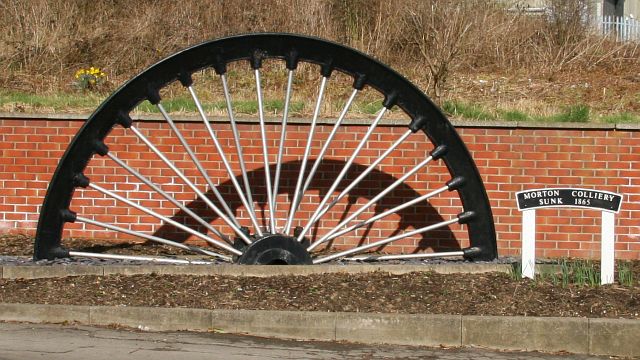
The 1936 pit-head baths and other colliery buildings; the spoil heap, planted as Morton Colliery Plantation; a memorial pit wheel with plaques on Main Road.
Redevelopment
Industrial estate on the colliery buildings; the spoil heap became Morton Colliery Plantation country park.
Related mines
- Clay Cross Colliery — Both were Clay Cross Company collieries.
- Parkhouse Colliery — Both were Clay Cross Company collieries, Parkhouse being its No. 7 at Danesmoor.
Nearby mines
- Pilsley Colliery — 1.6 miles (2.5 km) NE
- Shirland Colliery — 1.8 miles (2.9 km) SW
- Parkhouse Colliery — 1.9 miles (3.0 km) NW
- Blackwell Colliery — 2.0 miles (3.3 km) SE
- Clay Cross Colliery — 2.3 miles (3.7 km) NW
Straight-line distance, within 9 miles (15 km). Show on the map.
What's uncertain
Points where sources disagree or the record could not be settled; both accounts are kept. All open questions in the archive.
- Morton Colliery opened in 1866. (disputed) 4
- The colliery closed in 1965. (disputed) 4,1,3
- The shaft closed in 1964. (disputed) 2
Recorded claims
Individual factual claims, each attached to the source(s) that support it below. Where sources disagree, both are kept.
- The Clay Cross Company sank Morton Colliery in 1865 to work the Blackshale and Tupton seams. 1,2,3
- Morton Colliery opened in 1866. (disputed) 4
- The colliery closed in 1965. (disputed) 4,1,3
- The shaft closed in 1964. (disputed) 2
- The Durham Mining Museum returns the colliery as Nos. 5 and 6 pits, No. 5 working the Silkstone and Tupton and No. 6 the Deep Hard. 5
- Employment peaked at 1,033 in 1956 and output at 390,472 tons in 1955. 1
- The shafts were kept open and pumped until 1990 to protect neighbouring pits from flooding. 1
- In 1966 the colliery had a horizontal twin-cylinder winding engine of 1860 by A. Handysides. 2
- The Tupton or Low Main seam workings at Morton were abandoned on 6 December 1960. 6
Sources
- (secondary) Morton, Derbyshire — Wikipedia
- (primary) MDR9676 - Morton Colliery (site of), north of Main Road, Morton — Derbyshire Historic Environment Record
- (observational) MORTON COLLIERY – SUNK 1865 (memorial plaque) — Geograph
- (secondary) List of collieries in Derbyshire — Wikipedia
- (primary) Durham Mining Museum: Morton Colliery — Durham Mining Museum
- (primary) BGS mine plan EM646: MORTON, Tupton or Low Main, abandoned 6 December 1960 — British Geological Survey / Mining Remediation Authority
Record created: 24 October 2026 · Last researched: 24 October 2026