 MineArchive
Manton Colliery
| Location | Worksop, Nottinghamshire — 53.3000, -1.0700 (exact) |
|---|---|
| Commodity | Coal |
| Type | Coal |
| Worked | 1897 (sinking)–11 February 1994 |
| Maximum depth | 957 yards (Parkgate seam, No. 4 shaft) |
| Operators | Wigan Coal & Iron Co. (1897–1925) |
Overview
A Worksop-area colliery sunk from 1897 by the Wigan Coal & Iron Co., its purpose-built model village and near-century working life ending as one of 29 pits to close within a single year in the winter of 1993-94.

History
Manton Colliery was sunk from 1897 by the Wigan Coal & Iron Co., south-east of Worksop, aiming for the Top Hard seam (an extension of the Barnsley seam), found at 718 yards depth. The engine house was built in 1905, and coal-getting began that June; the pit was fully operational by around 1907, with the model village of Manton built specifically to house its workforce. Four main shafts, each 20 feet in diameter, were sunk over the colliery's life: No. 1 for pumping only, at 193 yards; Nos. 2 and 3, an upcast/downcast pairing, to 733 yards; and No. 4, sunk in the late 1940s, reaching the Deep Soft seam at 911 yards and the Parkgate seam at 957 yards.
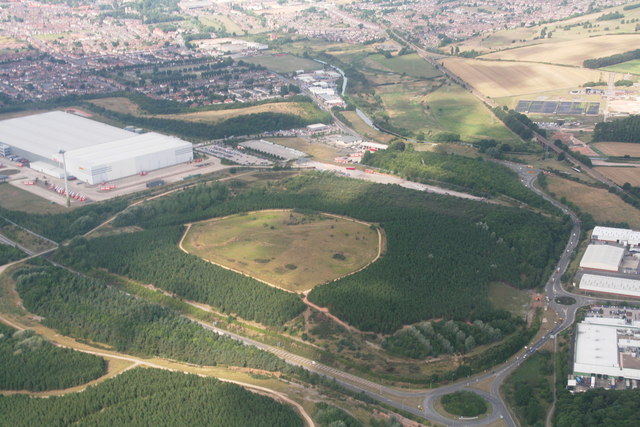
The Top Hard seam was worked from 1905 to 1964, the Parkgate from 1962 to 1994, and the Flockton seam from 1991. Ownership passed from the Wigan Coal & Iron Co. (to 1925) to the Wigan Coal Corporation Ltd (1930-1946), then the National Coal Board from 1947 and British Coal Corporation from 1987. Around 1,500 people worked at the pit when it closed on 11 February 1994, the 29th of many collieries to close across Britain within that single year. The spoil heaps were later restored, becoming Manton Pit Wood by 1997, while the colliery site itself is now occupied by a large B&Q distribution centre. The land was the Duke of Newcastle's — Henry Pelham-Clinton, the 7th Duke — when Wigan Coal and Iron sank the first shaft in 1897. Though the colliery stands in north Nottinghamshire, just east of Worksop, it worked the South Yorkshire coalfield and was placed under the National Coal Board's South Yorkshire region at nationalisation in 1947, and its men belonged to the Yorkshire area of the National Union of Mineworkers rather than to Nottinghamshire. That accident of boundaries put Manton at the centre of the 1984-85 strike's most consequential legal case. Manton's men had voted heavily against striking, but were called out with the rest of Yorkshire; two of them, Ken Foulstone and Bob Taylor, took the union to the High Court, which ruled that the area strike was unlawful under the union's own constitution because no national ballot had been held.
Geology
The shaft was sunk through Sherwood Sandstone and Lower Magnesian Limestone before reaching the Barnsley or Top Hard seam at 718 yards in 1905. The Deep Soft and Parkgate seams lie deeper, at around 957 yards, and were won from the 1940s. Though the colliery stands in Nottinghamshire it works the South Yorkshire coalfield.
Geological setting: Sedimentary Beds and Seams (well documented example)
Workings
Four shafts, each 20 feet in diameter: No. 1 (pumping only, 193 yards), Nos. 2 and 3 (733 yards, upcast/downcast), and No. 4, sunk in the late 1940s to 957 yards at the Parkgate seam. The fourth shaft of the 1940s went first to 911 yards and then to 957 to win the Deep Soft and Parkgate seams, and No. 2 shaft was deepened to the same level so that Parkgate could be worked from there too.
Closure
Closed 11 February 1994, the 29th colliery to close across Britain within that single year, with around 1,500 employed at the time.
What remains
The colliery buildings are gone and the spoil heaps were restored as Manton Pit Wood by 1997; an aerial photograph of 2013 shows the tip site green and wooded, with a distribution park on the colliery ground. One piece of the colliery survives underground: a 226-metre manway tunnel driven beneath the waste tips west of the pit, walked and photographed in July 2026 with its original light fittings, a railway-style refuge and a side room still in place.
Nothing of the headgear or surface plant stands. The manway tunnel under the former tips is the substantial survival, its date of construction undocumented but placed between 1953 and 1958 from the Ordnance Survey map series.
Nearby mines
- Shireoaks Colliery — 4.2 miles (6.7 km) W
- Steetley Colliery — 4.3 miles (6.9 km) W
- Bevercotes Colliery — 5.4 miles (8.7 km) SE
- Firbeck Colliery — 5.4 miles (8.7 km) NW
- Whitwell Colliery — 5.6 miles (9.1 km) W, Derbyshire
Straight-line distance, within 9 miles (15 km). Show on the map.
Culture
- Manton and the 1984 ballot case (Labour)
Two Manton Colliery miners brought the 1984 High Court case against the NUM's Yorkshire area strike (Wikipedia's strike article; a striking miner's diary on the Orgreave Truth and Justice site).
What's uncertain
Points where sources disagree or the record could not be settled; both accounts are kept. All open questions in the archive.
- A 226-metre manway tunnel runs under the colliery's former waste tips west of the site. Its construction is undocumented but falls between 1953 and 1958 on the Ordnance Survey map series, and a visit in July 2026 found it intact, with original light fittings, a refuge and a side room. (uncertain) 3
Recorded claims
Individual factual claims, each attached to the source(s) that support it below. Where sources disagree, both are kept.
- Manton Colliery was sunk from 1897 by the Wigan Coal & Iron Co., reaching the Top Hard seam at 718 yards; coal getting began in June 1905. 1,2
- Four main shafts, each 20 feet in diameter, were sunk over the colliery's life, the last (No. 4, late 1940s) reaching the Parkgate seam at 957 yards. 1
- The colliery closed on 11 February 1994 with around 1,500 employed, the 29th colliery to close across Britain within that single year. 2
- The former spoil heaps were restored as Manton Pit Wood by 1997; the colliery site is now occupied by a large B&Q distribution centre. 2
- Though Manton stands in north Nottinghamshire just east of Worksop, it worked the South Yorkshire coalfield, came under the National Coal Board's South Yorkshire region at nationalisation, and its men belonged to the Yorkshire area of the National Union of Mineworkers rather than to Nottinghamshire. 3,4
- Manton's men voted heavily against striking in 1984 but were called out with the Yorkshire area. Two of them, Ken Foulstone and Bob Taylor, took the National Union of Mineworkers to the High Court, which ruled the area strike unlawful under the union's own constitution for want of a national ballot. 4
- The first shaft was sunk from 1897 on land belonging to Henry Pelham-Clinton, 7th Duke of Newcastle, through Sherwood Sandstone and Lower Magnesian Limestone, reaching the Barnsley or Top Hard seam at 718 yards in 1905. 3
- A fourth shaft sunk in the 1940s reached 911 yards and then 957 yards to win the Deep Soft and Parkgate seams; No. 2 shaft was deepened to 957 yards so that Parkgate could be worked from there as well. 3
- A 226-metre manway tunnel runs under the colliery's former waste tips west of the site. Its construction is undocumented but falls between 1953 and 1958 on the Ordnance Survey map series, and a visit in July 2026 found it intact, with original light fittings, a refuge and a side room. (uncertain) 3
- Located at about 53.300 N, 1.070 W. 2
Photographs & further reading
A dated underground photographic record of the 226-metre manway tunnel that survives beneath the colliery's former spoil tips.
View sourceSources
- (secondary) Manton Colliery — Northern Mine Research Society
- (secondary) Manton Colliery — Wikipedia
- (observational) Manton Colliery Manway Tunnel, Worksop, Nottinghamshire, July 2026 — 28DaysLater
- (secondary) Manton, Nottinghamshire — Wikipedia
- (primary) BGS/Mining Remediation Authority mine plans — Manton — British Geological Survey / Mining Remediation Authority
Record created: 27 August 2026 · Last researched: 23 September 2026