 MineArchive
Lion Salt Works
| Also known as | Marston Salt Works |
|---|---|
| Location | Marston, near Northwich, Cheshire — 53.2753, -2.4952 (exact) |
| Commodity | Salt |
| Type | Mineral |
| Worked | 1894–June 1986 |
Overview
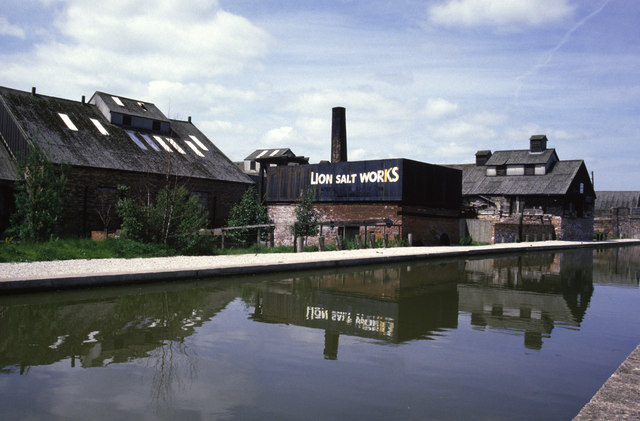
The UK's last open-pan salt works, founded in 1894 at Marston near Northwich by Henry Ingram Thompson, whose family had worked salt on neighbouring ground since 1856. It produced salt by evaporating pumped brine over open pans until 1986, and survives today as a restored museum — the last complete example of a production method once common across the Cheshire salt district.
History
The Thompson family's involvement in Cheshire salt predated the Lion works by decades: John Thompson senior and his son John Thompson junior built the neighbouring Alliance Salt Works in 1856, later selling it to the Salt Union before its closure around 1900. In 1894 Henry Ingram Thompson founded his own works on adjoining land named after the Red Lion Inn that had stood there, sinking a brine shaft and building an engine house and the first of what would grow into five pan and stove houses. By this date Cheshire's underground rock-salt reserves close to the surface had largely been exhausted (mining of solid rock salt in the district had effectively ended by the mid-19th century), and the whole district had shifted to 'wild brine' pumping — drawing naturally saturated brine up from underground and evaporating it at the surface, rather than mining rock salt directly.
At Lion, brine was boiled in open pans and the resulting salt raked out and dried in stove houses, a slower and more labour-intensive process than the enclosed vacuum evaporation used at larger, more industrialised works, but one that produced a distinctively light, flaky-grained salt. This 'Lagos salt' proved especially prized in West African markets for its ability to withstand humid tropical conditions without caking, and by the 1950s around 90% of the works' output was being exported there, alongside further markets in North America and Canada. Six generations of the Thompson family were involved in running the business across its life.
The West African trade that had sustained Lion Salt Works for decades collapsed with the Nigerian Civil War of 1967-70, and the works never fully recovered the lost market; competition from cheaper Brazilian solar-evaporated salt imports added further pressure in its final years. The works closed in June 1986, the last open-pan salt works operating anywhere in Britain. The site then stood increasingly derelict for over two decades before Cheshire West and Chester Council acquired it in 2009; a £10.2 million restoration project, backed by a lottery grant, reopened the site to the public as a museum in June 2015.
Geology
Not a mine: brine pumped from the Cheshire saltfield and evaporated in open pans.
Workings
Brine pumped from underground and evaporated in open pans within purpose-built pan houses, with the resulting salt raked out and dried in adjoining stove houses — the last surviving complete example of the open-pan process that once dominated Cheshire salt production, before the district shifted to enclosed vacuum evaporation at larger works.
Closure
Unknown.
What remains
Restored and reopened as a museum in June 2015 following a £10.2 million project led by Cheshire West and Chester Council, preserving the pan and stove houses, engine house and brine shaft as the country's last surviving open-pan salt works.
Related mines
- Crystal Mine, Marston — The Crystal Mine came into the Thompson family's hands and stood immediately west of the plot where Henry Ingram Thompson built the Lion Salt Works in 1894.
- Marston Pool Mine — Both Thompson family properties: Henry Ingram Thompson held the Pool Mine before the 1888 sale and built the Lion Salt Works in 1894.
Nearby mines
- Crystal Mine, Marston — 0.1 miles (0.1 km) W
- New Zealand Mine, Marston — 0.1 miles (0.1 km) S
- Adelaide Mine — 0.1 miles (0.2 km) N
- Marston Old Mine — 0.2 miles (0.4 km) NW
- Marston Pool Mine — 0.5 miles (0.7 km) NW
Straight-line distance, within 9 miles (15 km). Show on the map.
Recorded claims
Individual factual claims, each attached to the source(s) that support it below. Where sources disagree, both are kept.
- Henry Ingram Thompson founded the works in 1894 on land named after the Red Lion Inn, adjoining the earlier Alliance Salt Works his father and grandfather had run from 1856. 1,2
- Brine was pumped from underground and evaporated in open pans, producing a light, flaky-grained salt known as 'Lagos salt' for its West African export market. 1
- By the 1950s around 90% of the works' output was exported to West Africa, valued there for withstanding tropical humidity without caking. 1
- The West African export trade collapsed with the Nigerian Civil War of 1967-70, and competition from cheaper Brazilian solar-evaporated salt further undermined the works in its final years before closure in June 1986. 1,2
- Cheshire West and Chester Council acquired the derelict site in 2009, and a £10.2 million restoration project reopened it as a museum in June 2015. 1
- Located at about 53.275 N, 2.495 W. 1
Sources
- (secondary) Lion Salt Works — Wikipedia
- (secondary) History of Lion Salt Works — Lion Salt Works Trust / West Cheshire Museums
Record created: 26 August 2026 · Last researched: 26 August 2026