 MineArchive
Knockshinnoch Castle Colliery
| Location | Connel Park, New Cumnock, East Ayrshire — 55.3872, -4.1962 (exact) |
|---|---|
| Commodity | Coal |
| Type | Metal |
| Worked | 1942–1968 (closure) |
Overview
Knockshinnoch Castle Colliery, sunk at Connel Park near New Cumnock in 1942, became the site of one of the most dramatic mine rescues in British history on 7 September 1950, when a sudden inrush of liquefied peat trapped 129 miners underground — 116 of whom were led to safety over the following three days, while 13 died.
History
The shaft at Knockshinnoch Castle Colliery was sunk in 1942 on the site of an earlier pit that had been abandoned some 60 years before. On the evening of 7 September 1950, a waterlogged field above the workings collapsed into ground where mining had followed a coal seam to within about 15 metres (50 feet) of the surface; a large volume of liquefied peat and moss broke through into the No. 5 Heading of the Main seam and rushed down the incline, flooding the workings and sealing off the normal escape routes (see Disasters, below). The colliery recovered from the disaster and continued working for nearly two more decades, reaching peak employment in 1956, before finally closing in 1968 and being formally abandoned in 1969.
Geology
The mine worked coal seams close to the surface, in places within about 15 metres of overlying waterlogged peat and moss — proximity that directly caused the 1950 inrush disaster.
Geological setting: Sedimentary Beds and Seams (well documented example)
Workings
Underground workings included the No. 5 Heading of the Main seam and the connecting, disused Bank No. 6 workings, through which rescuers eventually led trapped miners to safety in 1950.
Closure
The colliery closed in 1968 and was formally abandoned in 1969, nearly two decades after recovering from the 1950 disaster.
What remains
The colliery had two shafts, 187 metres and 128 metres deep; the site is now managed by the Scottish Wildlife Trust as a wetland nature reserve with public paths, with no colliery structures surviving above ground.
Nearby mines
- Lanemark Colliery — 0.8 miles (1.3 km) W
- Afton Colliery — 2.0 miles (3.1 km) SW
- Coalburn Colliery, New Cumnock — 2.5 miles (4.0 km) NW
- Hindsward Colliery — 5.1 miles (8.3 km) NW
- Knockterra Colliery — 5.6 miles (9.0 km) NW
Straight-line distance, within 9 miles (15 km). Show on the map.
Disasters & major incidents
-
Knockshinnoch Castle Colliery Inrush
7 September 1950 · Flooding / Inundation · 13 fatalities
A sudden inrush of liquefied peat and moss flooded Knockshinnoch Castle Colliery on the evening of 7 September 1950, trapping 129 miners underground; 116 were led to safety over the following three days in one of the most dramatic rescues in British mining history, but 13 died.
Culture
- The Brave Don't Cry (Screen)
The film dramatises the inrush of September 1950 at Knockshinnoch Castle Colliery, New Cumnock, and the rescue of the trapped men through the old Bank workings.
Recorded claims
Individual factual claims, each attached to the source(s) that support it below. Where sources disagree, both are kept.
- The colliery closed in 1968 and was formally abandoned in 1969, having reached its peak workforce in 1956, six years after the disaster. 1,2
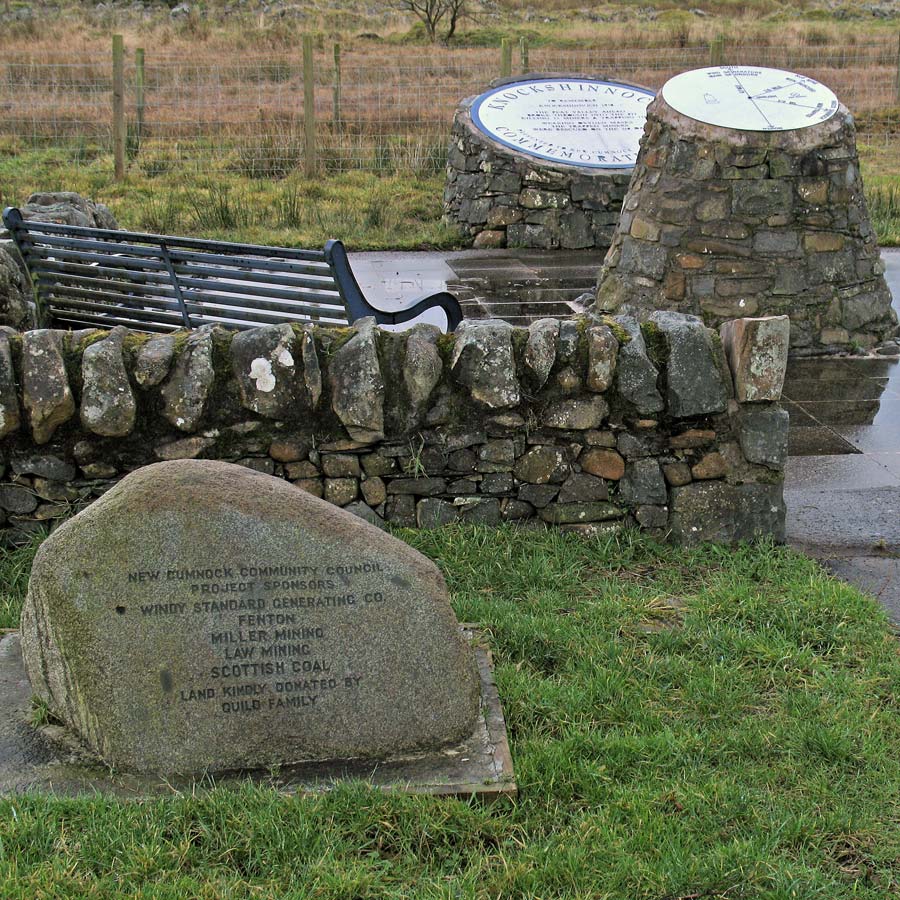
- A memorial overlooking the site of the 1950 inrush has stood since 1999, funded by New Cumnock Community Council and designed by local secondary school pupils: a walled enclosure shaped like a miner's shovel, its paved area marked out with 13 red slabs (for those who died) and 116 grey slabs (for those rescued). 3
- The colliery was reached by two shafts, 187 metres and 128 metres deep, sunk in 1942 on the site of an earlier pit that had itself been abandoned around sixty years before. 4
Sources
- (secondary) Knockshinnoch disaster — Wikipedia
- (primary) Knockshinnoch Castle Colliery — Canmore (Historic Environment Scotland)
- (secondary) Knockshinnoch Memorial — New Cumnock History
- (primary) Knockshinnock Castle Colliery Inrush - New Cumnock - 1950 — Northern Mine Research Society
Record created: 23 August 2026 · Last researched: 28 August 2026