 MineArchive
Huntingdon Mine
| Also known as | Avon Consols, Devon Wheal Vor, Devon Consols Tin Mines, Huntingdon New Mine |
|---|---|
| Location | Western Wella Brook valley, by Huntingdon Warren, southern Dartmoor, Devon — 50.4877, -3.8786 (exact) |
| Commodity | Tin |
| Type | Metal |
| Worked | About 1839–1865 |
| Maximum depth | Unknown. |
Overview
A Victorian tin mine in the Western Wella Brook valley on southern Dartmoor, worked under four names between about 1839 and 1865 with waterwheels up to 40 feet across, and never worked again after its last sale.
History
Huntingdon Mine lay about a kilometre up the Western Wella Brook from its junction with the River Avon, where late medieval openworks had drawn Victorian adventurers. The sett is thought to have been worked first from about 1839 to 1843, as Huntingdon Mine: a miner from it was arrested for sheep stealing in 1839, and in July 1843 it was advertised for sale, drained by a waterwheel 30 feet across.
It was worked next as Avon Consols from 1851 to 1854, when a 200-fathom adit was driven and an engine shaft sunk, with a 40-foot wheel for drainage, and work seems to have started again by November 1857, when the death of a miner named Hawk there was reported. A new company, Devon Wheal Vor, took the sett around 1858 and was in financial trouble by November 1860, and the mine seems to have stopped in 1861 or 1862. Another company formed in 1863 was in court by May 1865, and in July 1865 the mine, now called Devon Consols Tin Mines (late Huntingdon Mine), was to be sold with its two 40-foot waterwheels. Abandonment plans are dated 1866, and it was never worked again. Another account has it worked on and off between 1851 and 1868.
Leats from the Western Wella Brook fed the wheelpit, and the shafts included the engine shaft and Lukey's and Bishop's. Huntingdon Cross, a boundary cross of Brent manor, was used again in 1759 to mark the limits of the Huntingdon Mine. Kit's Stone, on the way to Huntingdon Warren, is named in a local tale after a lad who worked at the mine.
Geology
Tin lodes beneath late medieval openworks.
Workings
Shafts including the engine shaft and Lukey's and Bishop's, a 200-fathom adit, and leats feeding waterwheels of 30 and 40 feet.
Closure
Offered for sale in July 1865 with its two 40-foot waterwheels and not worked again; plans dated 1866.
What remains
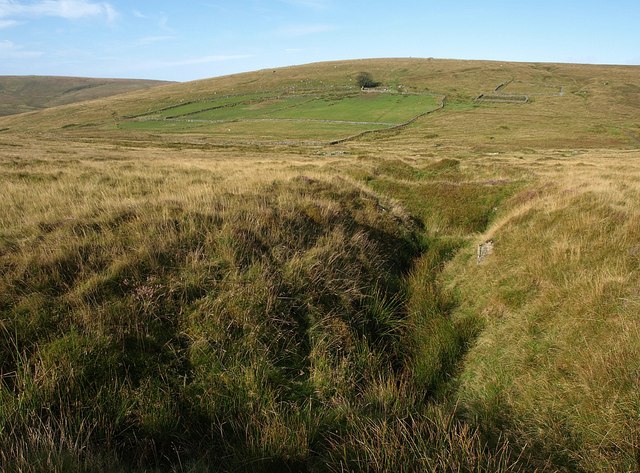
Shaft hollows, a wheelpit, leats and ruined buildings remain on the open moor.
Shaft hollows, wheelpit, launder bank, leats and building ruins.
Redevelopment
Unknown.
Nearby mines
- Ringleshutes Mine — 1.8 miles (3.0 km) N
- Leftlake Clay Works — 2.6 miles (4.2 km) SW
- Hexworthy Mine — 2.7 miles (4.3 km) N
- Druid Mine — 4.0 miles (6.5 km) NE
- Eylesbarrow Mine — 4.4 miles (7.1 km) W
Straight-line distance, within 9 miles (15 km). Show on the map.
What's uncertain
Points where sources disagree or the record could not be settled; both accounts are kept. All open questions in the archive.
- The Huntingdon Mine was worked on and off between 1851 and 1868. (disputed) 2
- By an old tale, Kit of Kit's Stone worked at the Huntingdon Mine. (uncertain) 5
Recorded claims
Individual factual claims, each attached to the source(s) that support it below. Where sources disagree, both are kept.
- The sett was first worked from about 1839 to 1843 as Huntingdon Mine, and was advertised for sale in July 1843 with a 30-foot waterwheel. 1
- As Avon Consols in 1851-54 a 200-fathom adit was driven and an engine shaft sunk, with a 40-foot waterwheel. 1
- Devon Wheal Vor worked the sett from about 1858; a company formed in 1863 failed, and in July 1865 the mine, then Devon Consols Tin Mines (late Huntingdon Mine), was to be sold. 1
- The Huntingdon Mine was worked on and off between 1851 and 1868. (disputed) 2
- Abandonment plans of Devon Wheal Vor, or Devon Consols, or Huntingdon New, in tin ore, are dated 1866. 3
- In 1759 Huntingdon Cross became a boundary point marking the limits of the Huntingdon Mine. 4
- By an old tale, Kit of Kit's Stone worked at the Huntingdon Mine. (uncertain) 5
Sources
- (secondary) Huntingdon Mine and its leat systems — Dartmoor Explorations
- (secondary) Snowdon Stroll — Legendary Dartmoor
- (primary) BGS mine plan: Devon Wheal Vor or Devon Consols or Huntingdon New, tin ore, abandoned 1866 — British Geological Survey / Mining Remediation Authority
- (secondary) Huntingdon Cross — Legendary Dartmoor
- (secondary) Huntingdon Warren — Legendary Dartmoor
Record created: 18 October 2026 · Last researched: 18 October 2026