 MineArchive
Holmbush Mine
| Also known as | Callington United Mines, Holmbush |
|---|---|
| Location | North of Kelly Bray, Stoke Climsland, Cornwall — 50.5251, -4.3186 (exact) |
| Commodities | Arsenic, Copper, Lead, Silver, Tin |
| Type | Metal |
| Worked | Probably early 1600s–1892 |
| Maximum depth | No overall depth figure located; of the five copper-tin lodes only Holmbush and Flopjack were developed to any depth |
| Operators | Callington United Mines (1876–1892) |
Overview
The oldest mine in the Callington district, north of Kelly Bray, probably at work in the early 1600s on a north-south lead lode carrying silver, and later much the larger producer of copper: 42,900 tons of copper ore between 1822 and 1892. It was also one of the county's chief producers of arsenical pyrites. In 1844 a hundred men and boys worked underground and as many again on the surface. From the late 1830s it was drawn into a succession of amalgamations with Redmoor and Kelly Bray, latterly as Callington United Mines, and closed in 1892.
History
Holmbush is old for the district and was probably working in the early seventeenth century, most likely on the lead lode, when lead and silver were what the ground was valued for. It was at work again in the late 1700s. Copper became the main object through the nineteenth century, and between 1822 and 1892 the mine raised 42,900 tons of copper ore. In 1844 there were a hundred men and boys below ground and about the same number on the surface.
From about the late 1830s the mines of the area began combining under a succession of names, Holmbush being usually worked in conjunction with Redmoor and Kelly Bray, with the smaller West Holmbush, East Holmbush — also called Lady Beam — and South Kelly Bray occasionally taken in as well. Hichen's Shaft dates from the restart of 1876 under the name Callington United; the building at the centre of that complex housed the Cornish rolls that crushed the copper ore. The mine showed at the Great Exhibition of 1851, sending single specimens of silver-lead ore and of copper ore each weighing between one and one and a half tons.
Arsenic was the other trade. Holmbush was a major producer of arsenical pyrites, and in the late 1870s and early 1880s it was one of the three mines leading the county's pyrite output — with New Great Consols and Okel Tor — all three of which also sold refined arsenic. Working ended with the final closure in 1892.
Geology
Holmbush worked two sets of lodes running at right angles to one another, which is why it produced such different things at different dates. Five copper-tin lodes course east-north-east to west-south-west, of which only Holmbush and Flopjack were developed to any depth; a separate lead lode runs north to south, and the lead and silver occur together in the north-south lodes lying above the east-west copper and tin. The ground is at the eastern end of the Cornubian orefield, near the Devon border and the granite of Kit Hill.
Geological setting: Veins and Lodes (well documented example)
Workings
A group of shafts working the two lode systems, the best recorded being Hichen's Shaft, sunk or re-equipped at the 1876 restart as Callington United. The Hichen's Shaft complex survives as a very good example of the range of features and structures grouped around a shaft head at a mid to later nineteenth-century non-ferrous metal mine, with an engine house, chimneys, and the building that held the Cornish rolls for crushing copper ore.
Closure
The amalgamations that began in the late 1830s ran on under various names to the final closure in 1892, by which time the copper trade that had sustained the mine for seventy years was long past its peak and arsenic had become the more reliable product.
What remains
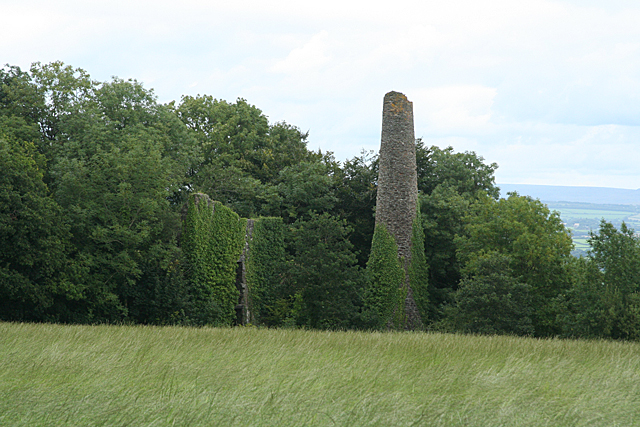
Substantial surface remains stand in fields and plantation north of Kelly Bray, seen from the A388: an engine house ruin with its stack, a second chimney, and further engine houses still standing. The Hichen's Shaft complex and the Windsor Lane rotative engine house with its boiler house and loadings are separately scheduled. A circular walk runs through the site.
An engine house ruin with its stack, a second chimney and further standing engine houses in fields and plantation north of Kelly Bray; the Hichen's Shaft complex and the Windsor Lane engine house with its boiler house and loadings are scheduled.
Related mines
- East Holmbush Mine — Worked with Holmbush, Kelly Bray and Redmoor as part of Callington United.
- Kelly Bray Mine — Joined with Holmbush and Redmoor in 1843 as the Callington Mining Company; Holmbush lies just north of Kelly Bray.
Nearby mines
- Kelly Bray Mine — 0.4 miles (0.6 km) S
- Kit Hill Mine — 1.2 miles (1.9 km) E
- Great Sheba Consols — 1.3 miles (2.1 km) NE
- Excelsior Mine — 1.5 miles (2.4 km) NW
- Redmoor Mine — 1.8 miles (2.8 km) NW
Straight-line distance, within 9 miles (15 km). Show on the map.
What's uncertain
Points where sources disagree or the record could not be settled; both accounts are kept. All open questions in the archive.
- The BGS mine-plans catalogue holds a BGS plan titled 'Holmbush' (catalogue MP24157, undated in the catalogue); the catalogue gives no location and the plan's details do not clearly tie it to this working, so it may belong to another of the same name. (uncertain) 3
Recorded claims
Individual factual claims, each attached to the source(s) that support it below. Where sources disagree, both are kept.
- 42,900 tons of copper ore were raised between 1822 and 1892. 1
- In 1844 a hundred men and boys worked underground at Holmbush, with the same number again employed on the surface. 1
- Five east-north-east to west-south-west copper-tin lodes were developed, of which only Holmbush and Flopjack went to any depth, and a separate north-south lead lode was worked; lead and silver occur together in the north-south lodes above the east-west copper and tin. 2
- Holmbush was a major producer of arsenical pyrites and, with New Great Consols and Okel Tor, led the county's pyrite output in the late 1870s and early 1880s; all three also sold refined arsenic. 2
- The mine exhibited at the Great Exhibition of 1851, showing single specimens of silver-lead ore and of copper ore each weighing between one and one and a half tons. 2
- The BGS mine-plans catalogue holds a BGS plan titled 'Holmbush' (catalogue MP24157, undated in the catalogue); the catalogue gives no location and the plan's details do not clearly tie it to this working, so it may belong to another of the same name. (uncertain) 3
Photographs & further reading
An account of the mine's lodes, its arsenic trade and the amalgamations that took it into Callington United, with notes on the neighbouring East and West Holmbush.
View sourceSources
- (observational) Stoke Climsland: Holmbush Mine — Geograph Britain and Ireland
- (secondary) Holmbush Mine, Cornwall — Cornwall Calling
- (primary) BGS / Mining Remediation Authority mine plans: HOLMBUSH — British Geological Survey / Mining Remediation Authority
- (observational) Holmbush Mine, view across the field from the A388 — Geograph Britain and Ireland
- (primary) Holmbush Mine: Hitchen's Shaft complex, Stokeclimsland — National Heritage List for England 1020435 — Historic England
Record created: 9 September 2026 · Last researched: 9 September 2026