 MineArchive
Excelsior Mine
| Location | Kit Hill, near Callington, Cornwall — 50.5359, -4.3487 (approximate) |
|---|---|
| Commodities | Tin, Copper, Tungsten |
| Type | Metal |
| Worked | early 1850s–1946 (mining) |
| Operators | George Moor (1938–1946) |
Overview
Excelsior, on Kit Hill near Callington, was a modest tin and wolfram mine best known today not for what it produced, but for what happened to its abandoned drainage tunnel in 1959-60 — a secret Cold War experiment testing whether an underground nuclear explosion could be hidden from seismic detection.
History
Mining on the Excelsior sett, part of the wider mineral-rich ground of Kit Hill, is recorded working in the early 1850s before closing in 1856; it reopened in 1870 and was worked intermittently under the Excelsior name between 1873 and 1884, raising a modest 5 tons of tin ore from older workings. The mine's more ambitious project was the Excelsior Tunnel (also called Kit Hill Tunnel), begun in 1877 to drive south-south-west from an entrance in Deerpark Wood toward the North Engine Shaft of Kit Hill Mine, 660 feet below the summit — intended both to drain that mine and to explore for tin and copper lodes believed to lie undiscovered beneath the hill. Driven on and off for sixty years by a series of undercapitalised ventures, the tunnel was finally abandoned in 1938 still around 1,000 feet short of its target, though by then it ran almost a kilometre, dead straight, into the hill. Captain George Moor, a local chemist and tin miner, then turned attention to reworking old mine dumps near the tunnel entrance for wolfram (tungsten ore), driven by wartime demand; that dump was worked out by 1941, after which a small shaft sunk nearby yielded further wolfram, with at least two tons recovered by 1942 using newly installed plant. All mining had ceased by 1946.
Geology
The mine worked tin- and copper-bearing lodes on Kit Hill, part of the same Cornubian granite-related orefield responsible for the wider mineral wealth of east Cornwall; the Excelsior Tunnel's underground geology was later surveyed and mapped by the British Geological Survey.
Geological setting: Hydrothermal Deposits (well documented example), Veins and Lodes (well documented example)
Workings
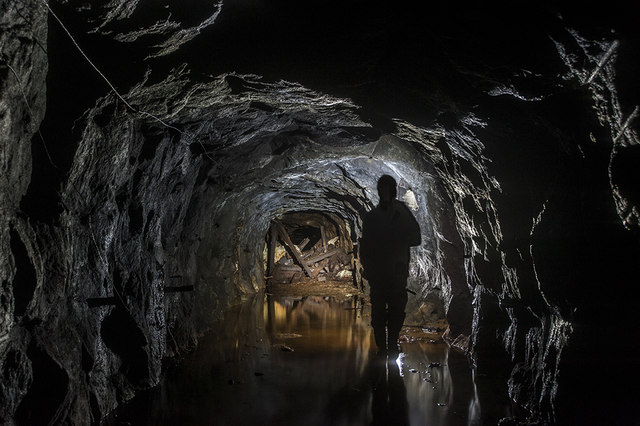
The Excelsior Tunnel, roughly 8 feet square in section, was driven almost a kilometre into Kit Hill without ever reaching its intended objective, the North Engine Shaft. In 1959-60 the disused tunnel was leased to the Atomic Weapons Research Establishment for Phase A of Operation Orpheus, a Cold War experiment into underground nuclear-test detection: around 75 small conventional explosive charges were fired in a six-foot cavity at depths of 100-300 feet to test how far rock could mask the seismic signal of an underground blast.
Closure
Mining ceased in 1946, and the Excelsior Tunnel itself was abandoned as a mining prospect after 1938, over a thousand feet short of its intended objective.
What remains
The Excelsior Tunnel survives, gated for safety but still substantially intact and explored periodically; surface structures from the wolfram-processing era survive in reduced form near the tunnel entrance in Deerpark Wood.
Kit Hill more broadly retains extensive surface evidence of centuries of tin, copper, arsenic and wolfram working, alongside the hill's separate history of granite quarrying.
Related mines
- Kit Hill Mine — Excelsior was driven in 1877 specifically to drain Kit Hill's North Engine Shaft and explore for its tin and copper lodes.
Nearby mines
- Redmoor Mine — 0.3 miles (0.4 km) NW
- Holmbush Mine — 1.5 miles (2.4 km) SE
- Kit Hill Mine — 2.7 miles (4.3 km) SE
- New Consols Mine — 3.0 miles (4.8 km) NE
- Caradon Hill Medieval and Post-Medieval Mines — 4.2 miles (6.8 km) W
Straight-line distance, within 9 miles (15 km). Show on the map.
Recorded claims
Individual factual claims, each attached to the source(s) that support it below. Where sources disagree, both are kept.
- The Excelsior Tunnel, begun in 1877, was driven almost a kilometre into Kit Hill over sixty years of intermittent work before being abandoned in 1938 roughly a thousand feet short of its intended target, the North Engine Shaft. 1
- Kit Hill Mine's North Engine Shaft, the tunnel's original target, was further developed from the shaft end by New Consols Mine at Luckett in the late 1940s or early 1950s; when the site was inspected in 1954 it was found abandoned, and no further mining has taken place there since. 2
- A January 2018 visit report documents the tunnel still substantially explorable at that date, with photographs taken throughout its length. 3
Sources
- (secondary) Kit Hills Secret — saltash.org
- (secondary) Excelsior Tunnel — Subterranea Britannica
- (observational) Excelsior Tunnel, Kit Hill, Cornwall - January 2018 — 28DaysLater Urban Exploring Forums
- (primary) Excelsior Mine (incl. Excelsior Tunnel), Stokeclimsland, Cornwall Plan (BGS Mine Plans Catalogue) — British Geological Survey
Record created: 22 August 2026 · Last researched: 28 August 2026