 MineArchive
Operation Orpheus
| Category | Later Uses & Research |
|---|
A 1959-60 British Cold War experiment that used two disused or nearly-abandoned mine workings — never a nuclear device — to test whether an underground nuclear explosion could be hidden from seismic detection, at a time when verifying compliance with a future nuclear test-ban treaty depended on being able to tell a genuine test from an earthquake.
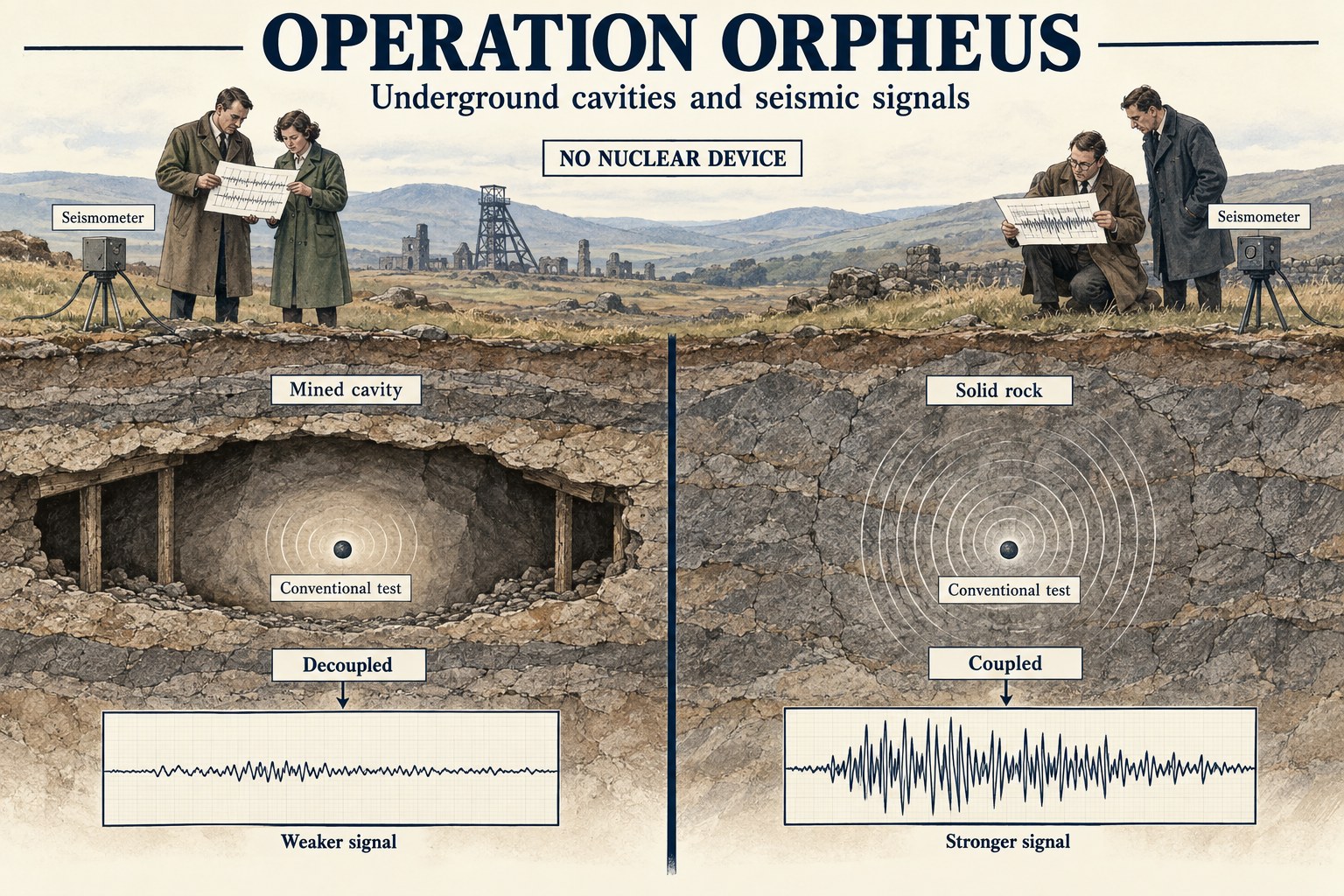
Historical usage
Operation Orpheus was carried out by scientists from the Atomic Weapons Research Establishment (AWRE) in three phases, testing the 'Latter decoupling theory' — the idea that detonating a nuclear device inside a sufficiently large underground cavity could muffle its seismic signal well below what the same explosion would produce in solid rock, potentially letting a test go undetected. Phase A, in 1959-60, fired around 75 small conventional explosive charges in a six-foot cavity at depths of 100-300 feet within the disused Excelsior Tunnel on Kit Hill, Cornwall. Phase B saw AWRE scientists take part in the American Operation Cowboy, firing 3,000lb charges in a 30-foot cavity 800 feet down a Louisiana salt mine. Phase C, the programme's main test, took place at Greenside Mine in Cumbria's Lake District, still a working lead mine at the time: a public announcement on 25 November 1959 confirmed the mine's selection, a preliminary 100lb charge was fired on 15 December 1959, a large 3,010lb decoupled charge followed on 19 December 1959, and a comparison 1,160lb charge fired without any decoupling cavity went off on 29 April 1960 — the results confirming that decoupling could reduce a blast's seismic signal by a factor of 10 to 30.
How it worked
Explosive charges — always conventional high explosive, never a nuclear device — were fired inside mined cavities at controlled depths, with a network of seismometers at increasing distances (six stations around Greenside, from half a mile to 47.5 miles away) recording the resulting signal. Comparing a charge fired inside a large cavity ('decoupled') against a similar-sized charge fired with little or no cavity around it ('coupled') let scientists measure directly how much a cavity could weaken the detectable signal for a given explosive yield — the practical question a test-ban verification regime would eventually need to answer for real underground nuclear tests, not just small conventional stand-ins.
Why it was used
Understanding decoupling mattered because a Comprehensive Nuclear-Test-Ban Treaty, then under serious international discussion, would only be verifiable if signatories could reliably detect underground tests by their seismic signature; if a hostile state could muffle that signature simply by testing inside a large enough cavity, seismic monitoring alone could never fully confirm compliance. Operation Orpheus supplied Britain's own experimental evidence on how serious that loophole really was, feeding directly into the seismological verification work later centred on AWE Blacknest, which remains active in nuclear-test monitoring today.
Risks & limitations
The tests themselves caused no injuries, but Greenside's period under AWRE control was marked by an unrelated, genuinely tragic accident: on the night before the programme's second major test, two of the mine's own surface workers died after entering old abandoned stopes without authorisation and being overcome by bad air — a reminder that a mine leased out for one purpose still carried all its ordinary underground hazards for the men who kept working it day to day. Decoupling research itself also proved a double-edged result for arms control: confirming the effect worked meant a comprehensive test ban risked being unverifiable by seismology alone, one reason a full underground test ban was never achieved even as the 1963 Partial Test Ban Treaty banned atmospheric, space and underwater testing.
Mines associated with this term
Included only where MineArchive's own research gives a reasonable evidential basis — not every mine where this might plausibly apply.
- Excelsior Mine — Cornwall (well documented example)
The mine's own recorded workings explicitly describe hosting Phase A of Operation Orpheus in the disused Excelsior Tunnel. - Greenside Mine — Cumbria (well documented example)
The mine's own recorded closure notes explicitly describe the Atomic Weapons Research Establishment's underground seismic trials, Operation Orpheus.
Disasters associated with this term
Included only where MineArchive's own research gives a reasonable evidential basis, with the nature of the relationship stated — not every disaster where this term might plausibly apply.
- Greenside Mine gas exposure, 1960 (contextual relationship)
The fatal accident happened during Greenside's lease to AWRE for Operation Orpheus, though it was unrelated to the tests themselves.
Sources
- (primary) Sixty years of forensic seismology at AWE Blacknest — Astronomy & Geophysics / Oxford Academic
- (secondary) Excelsior Tunnel — Subterranea Britannica
- (secondary) Operation Orpheus — Subterranea Britannica
Record created: 22 August 2026 · Last researched: 22 August 2026