 MineArchive
Harwood Colliery
| Location | Pates Hill, near West Calder, West Lothian — 55.8407, -3.5753 (exact) |
|---|---|
| Commodity | Coal |
| Type | Coal |
| Worked | 1945 or 1946–1959 |
| Maximum depth | Unknown. |
| Operators | Glasgow Iron & Steel Company Ltd (?–1947), National Coal Board (1947–1959) |
Overview
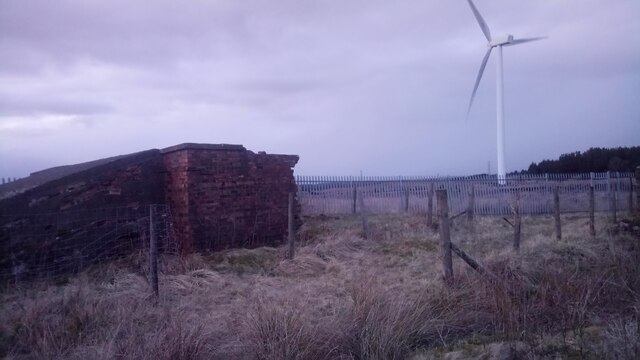
A post-war drift mine on Pates Hill, near West Calder, worked by the Glasgow Iron and Steel Company and then the National Coal Board from about 1946 until 1959; its two fenced drift mouths now stand inside a wind farm.
History
Harwood Colliery was opened on Pates Hill, a moorland hill near West Calder in West Lothian, at the end of the Second World War, in 1945 or 1946. It was a drift mine, two drifts driven into the hill, and its owners were the Glasgow Iron and Steel Company, from whom the National Coal Board took it in 1947.
In 1947 it raised 27,000 tons of steam coal with a hundred men, eighty of them underground. By 1954 it was working the Hurlet seam with 178, and at its peak it employed nearly two hundred. Its coal was sold as steam, manufacturing and house coal.
Workings in the Hurlet seam were abandoned in 1955, and the colliery closed in 1959. The site was planted with conifers in the 1970s, and in 2010 the seven turbines of Pates Hill Wind Farm, West Lothian's first, were built around it.
Geology
The Hurlet seam, worked by 1954 and abandoned in 1955.
Workings
Two drift mines into Pates Hill.
Closure
Closed in 1959; the Hurlet seam workings were abandoned in 1955.
What remains
The two drift mouths survive in fenced enclosures inside Pates Hill Wind Farm, with colliery spoil at the farm entrance slowly colonised by trees and heather.
Two fenced drift entrances; a spoil heap at the entrance to the wind farm.
Redevelopment
Conifer plantation in the 1970s; Pates Hill Wind Farm, seven turbines, from 2010.
Nearby mines
- Burngrange Oil Shale Mine — 0.6 miles (0.9 km) E, Midlothian
- Baads Colliery — 1.0 miles (1.5 km) SW
- Polbeth No. 26 Mine — 1.4 miles (2.3 km) NE
- Addiewell Oil Works — 1.5 miles (2.5 km) W
- Loganlea Colliery — 2.4 miles (3.9 km) W
Straight-line distance, within 9 miles (15 km). Show on the map.
What's uncertain
Points where sources disagree or the record could not be settled; both accounts are kept. All open questions in the archive.
- The colliery worked from 1945 to 1959. (disputed) 2
- The colliery worked from 1946 to 1959. (disputed) 3
Recorded claims
Individual factual claims, each attached to the source(s) that support it below. Where sources disagree, both are kept.
- Harwood Colliery belonged to the Glasgow Iron and Steel Company before passing to the National Coal Board in 1947. 1
- In 1947 Harwood raised 27,000 tons of steam coal and employed 100 people, 80 of them underground. 1
- The colliery worked two drift mines on Pates Hill and employed nearly two hundred men at its peak. 2,3
- The colliery worked from 1945 to 1959. (disputed) 2
- The colliery worked from 1946 to 1959. (disputed) 3
- Workings in the Hurlet seam were abandoned in 1955. 1,4
Sources
- (primary) Durham Mining Museum: Harwood Colliery — Durham Mining Museum
- (observational) Colliery spoil at Pates Hill (M J Richardson, 2015) — Geograph
- (observational) Harwood Colliery Mine Entrance (Ian Dodds, 2021) — Geograph
- (primary) BGS mine plan S273: HARWOOD, Hurlet seam, abandoned 1955 — British Geological Survey / Mining Remediation Authority
Record created: 24 October 2026 · Last researched: 24 October 2026