 MineArchive
Deep Navigation Colliery
| Location | Treharris, Merthyr Tydfil — 51.6678, -3.3007 (exact) |
|---|---|
| Commodity | Coal |
| Type | Coal |
| Worked | From October 1873–29 March 1991 |
| Maximum depth | South shaft, 760 yards (695 m) |
| Operators | Harris's Navigation Steam Coal Company (1872–1893), Ocean Coal Company (1893–1947) |
Overview
A Treharris colliery that was, on completion, the deepest in the South Wales Coalfield by some 200 yards — site of South Wales's first pithead baths, two serious shaft accidents decades apart, and, in 1991, one of the coalfield's last closures before the industry's near-total collapse.
History
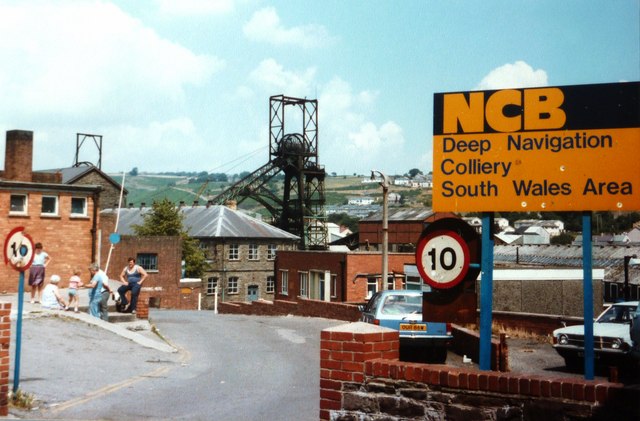
Sinking at what became Deep Navigation Colliery began in October 1873, funded by Frederick W. Harris's Harris's Navigation Steam Coal Company (the source of the adjoining village's name, Treharris) and initially known as Harris's Navigation Colliery. It was slow and dangerous work: by May 1878 the sinking had cost over £300,000 and seven men their lives. Two shafts were sunk 180 feet apart, the North reaching 649 yards and the South 760 yards — about 200 yards deeper than any other colliery then working in the South Wales Coalfield, giving access to the rich Nine Feet Seam alongside the Seven Feet and Yard seams. The North Pit began production in 1879, with both shafts fully operational by 1881.
Ownership passed in 1893 to David Davies's Ocean Coal Company, under whom the colliery was generally known as Ocean Colliery; employment peaked at 2,500 in 1897, producing 590,000 tons that year. In 1913 Davies sent a delegation to study continental European welfare provision, leading to an £8,000 investment in pithead baths built by Nicholls & Nicholls of Gloucester — opened on 1 November 1913 (extended and reopened 1933 with capacity for 1,824 miners), the first such facility built for miners anywhere in South Wales. The colliery was renamed Deep Navigation by the National Coal Board following nationalisation in 1947, and worked on for over four decades more, marking its centenary in 1979 with 2,000 visitors taken down to the pit bottom. British Coal announced closure in January 1991, effective Good Friday, 29 March 1991, after an autumn 1990 geological report concluded structural problems would exhaust workable reserves by 1994 — despite the pit still turning a profit of around £1 million through August 1990 and recent investment in new machinery. The last shift ended with a Salvation Army band and commemorative Davy lamps distributed to more than 800 workers and retirees; 766 men remained on the books at closure. The former colliery site, alongside the neighbouring Taff Merthyr Colliery and Trelewis Drift Mine, was redeveloped into Parc Taff Bargoed, a wildlife and leisure park opened around the Millennium and now used by local rugby and football teams.
Geology
Coal of the South Wales field at Treharris, reached by two shafts 649 and 760 yards deep — about 200 yards deeper than any other colliery then working in the coalfield. A 1990 geological report on structural problems is what closed it.
Geological setting: Sedimentary Beds and Seams (well documented example)
Workings
Worked from twin shafts sunk 180 feet apart — North (649 yards) and South (760 yards) — the deepest in the South Wales Coalfield on completion, reaching the Nine Feet, Seven Feet and Yard seams.
Closure
Closed on Good Friday, 29 March 1991, after a 1990 geological survey found structural problems that would exhaust workable reserves by 1994.
What remains
The colliery was fully cleared; by 1995 all three shafts had been filled with rubble from the demolished pit-head structures. The former mining complex, together with the neighbouring Taff Merthyr Colliery and Trelewis Drift Mine sites, was redeveloped into Parc Taff Bargoed, a wildlife and leisure park opened around the Millennium and now home to local rugby and football clubs.
No colliery surface structures survive; the site is now Parc Taff Bargoed.
Related mines
- Lady Windsor Colliery — David Davies bought Deep Navigation from its Harris owners in 1893, partly on the strength of the maritime market Lady Windsor's steam coal had opened, and from 1914 Deep Navigation supplied Lady Windsor with electricity for a period. Both were Ocean Coal Company pits.
- Navigation Colliery — Two distinct South Wales collieries sharing the same name (Treharris and Crumlin, 20km apart) -- explicitly disambiguated in both records to prevent confusion.
- Taff Merthyr Colliery — The two former colliery sites, together with Trelewis Drift Mine, were jointly redeveloped into Parc Taff Bargoed.
- Trelewis Drift Mine — Both were in the National Coal Board's Number 4 Area group, which by 1961 was the most productive in South Wales and turned out more than a million tons a year between Trelewis Drift, Deep Navigation, Taff Merthyr and Merthyr Vale.
Nearby mines
- Llancaiach Colliery — 1.0 miles (1.6 km) SE, Caerphilly
- Taff Merthyr Colliery — 1.3 miles (2.1 km) N
- Trelewis Drift Mine — 1.3 miles (2.1 km) N
- Gelligaer Colliery — 1.6 miles (2.6 km) SE, Caerphilly
- Nantwen Colliery — 2.0 miles (3.2 km) N
Straight-line distance, within 9 miles (15 km). Show on the map.
Disasters & major incidents
-
Deep Navigation Colliery shaft accident, 1884
12 December 1884 · Winding / Shaft Accident · 4 fatalities
A corroded winding rope snapped as five men were lowered in a bowk at Harris's Navigation Colliery, Treharris, on 12 December 1884; four fell 700 yards and one clung to a guide rope and survived. -
Deep Navigation Colliery shaft accident, 1902
11 November 1902 · Winding / Shaft Accident · 5 fatalities
A fractured cast-iron pump pipe fell from the shaft wall onto an ascending, double-decked cage carrying 32 men at Deep Navigation Colliery on 11 November 1902, killing five and injuring two. -
Deep Navigation Colliery roof fall, 1914
25 June 1914 · Collapse / Roof Fall · 2 fatalities
A fall of roof 28 feet long on a double parting at Deep Navigation Colliery, Treharris, on 25 June 1914 killed one man outright and fatally injured another.
Recorded claims
Individual factual claims, each attached to the source(s) that support it below. Where sources disagree, both are kept.
- Sinking began in October 1873, funded by Frederick W. Harris's Harris's Navigation Steam Coal Company; it cost over £300,000 and seven lives by May 1878. The North (649 yards) and South (760 yards) shafts, 180 feet apart, made this the deepest colliery in the South Wales Coalfield on completion, with the North Pit in production from 1879 and both shafts operational by 1881. 1,2
- Ownership passed to David Davies's Ocean Coal Company in 1893; employment peaked at 2,500 in 1897, producing 590,000 tons that year. 1,2
- Following a 1913 study visit to continental Europe, Davies invested £8,000 in pithead baths built by Nicholls & Nicholls of Gloucester, opened 1 November 1913 and later extended (capacity 1,824 by 1933) — the first pithead baths built for miners anywhere in South Wales. 1
- British Coal announced closure in January 1991, effective 29 March 1991, after an autumn 1990 geological report found structural problems that would exhaust workable reserves by 1994; 766 men remained on the books at closure. 1
- Located at about 51.668 N, 3.301 W. 1
Sources
- (secondary) Deep Navigation Colliery — Wikipedia
- (secondary) Deep Navigation Colliery, Treharris — welshcoalmines.co.uk
Record created: 27 August 2026 · Last researched: 27 August 2026