 MineArchive
Taff Merthyr Colliery
| Location | Trelewis, Treharris, Merthyr Tydfil — 51.6870, -3.3004 (exact) |
|---|---|
| Commodity | Coal |
| Type | Coal |
| Worked | 1922-24 (sinking)–1992 |
| Maximum depth | Shafts reached around 1,900ft (630-633 yards) |
| Operators | Powell Duffryn Steam Coal Company (1922–1947) |
Overview
One of the last deep mines sunk in South Wales under private ownership, opened by the Powell Duffryn Steam Coal Company in the shadow of the 1926 General Strike on condition that its workforce join a company union rather than the miners' federation — a decision that made it a flashpoint of violent industrial unrest in the mid-1930s.
History
Taff Merthyr's twin shafts, North and South, were sunk between 1922 and 1924 to a depth of around 1,900ft — 630 yards, later deepened to 633 — each 21ft in diameter, reaching the Four Feet seam a short distance north of the existing Deep Navigation Colliery. Sunk and developed by the Powell Duffryn Steam Coal Company through the very years of the 1926 General Strike and coal lockout, Taff Merthyr was, when it opened for production that year, one of the last deep mines to be sunk in South Wales by a private company. Its owners used the strike's collapse to impose a highly unusual condition of employment: no member of the South Wales Miners' Federation could work there, and instead miners were required to join a company union, the South Wales Miners' Industrial Union, formally adopted at a meeting of 500 Taff Merthyr men at the Bontnewydd Hotel, Trelewis, once the 1926 dispute ended.
That arrangement made Taff Merthyr, alongside a handful of other South Wales pits run on the same non-federation basis, a focus of sustained industrial and political conflict through the late 1920s and early 1930s — torchlight processions, mass meetings and underground 'stay-down' strikes as miners' federation supporters campaigned to break the company union's hold. That campaign came to a head in the strike of 1934-35, when strikebreakers were escorted into the colliery under police protection and fought underground with stay-down strikers occupying the workings; forty men were injured in the clash, and the violence spilled onto the streets of Trelewis in the days that followed, with a police sergeant, Gooding, struck by a thrown stone during what became known locally as the Taff Merthyr riots.
Despite this troubled start, the colliery went on to a long working life. Employment peaked at over 1,600 men in the early 1930s, when the pit was producing more than 600,000 tons of coal a year; nationalisation in 1947 brought the mine under National Coal Board control, with the workforce standing at 1,027 by 1945 and, as reserves accessible from the original shafts thinned, the National Coal Board drove Trelewis Drift into the Brithdir seam from the surface here in 1954 to work additional ground (it has its own record), the shaft workings themselves turning out some 340,000 tons a year from the Seven Feet seam. Taff Merthyr finally ceased production on 30 October 1992; sources differ on the very last operational date, with one account placing a final shift as late as 11 June 1993 before winding gear was brought down by controlled demolition on 22 July 1994, after hopes of a miners' buyout of the pit came to nothing.
Geology
Taff Merthyr worked the South Wales Coalfield's productive Upper Carboniferous Coal Measures, its shafts reaching the Four Feet seam at depth and later working the Seven Feet seam, part of the same folded and faulted sequence exploited across the wider Merthyr Tydfil and Rhymney valley coalfield.
Workings
A conventional deep shaft colliery worked through twin 21ft-diameter shafts sunk to around 1,900ft, supplemented from 1954 by the separate Trelewis Drift, which accessed additional reserves not reachable from the original shafts.
Closure
The Trelewis Drift closed in 1989; Taff Merthyr's main shaft workings ceased production on 30 October 1992 (one account gives a final shift as late as 11 June 1993), and the colliery's winding gear was demolished by controlled explosion on 22 July 1994 after a proposed miners' buyout failed to materialise.
What remains
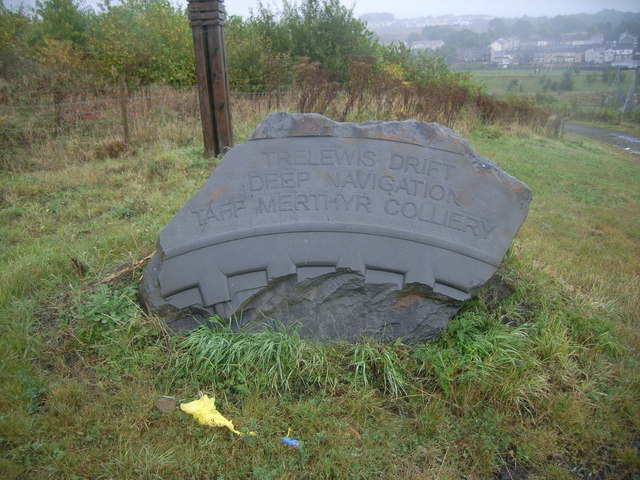
A commemorative stone now marks the site of the former colliery at Trelewis; little else of the surface plant survives following the 1994 demolition of the winding gear.
A commemorative stone at the former colliery entrance is the principal visible marker of the site today.
Related mines
- Bedlinog Colliery — Bedlinog belonged to the Taff Merthyr Steam Coal Co. Ltd by 1945, which kept it for pumping; the two pits worked the same Taff Bargoed valley.
- Deep Navigation Colliery — The two former colliery sites, together with Trelewis Drift Mine, were jointly redeveloped into Parc Taff Bargoed.
- Trelewis Drift Mine — The drift was driven in 1954 to take the Brithdir seam from near the surface at Taff Merthyr, shared its baths, canteen and washery for thirty years, and sent its coal through the Taff Merthyr washery to the end. The Royal Commission's record links the two sites directly.
Nearby mines
- Trelewis Drift Mine — 0.0 miles (0.0 km) W
- Nantwen Colliery — 0.7 miles (1.1 km) N
- Nantyffin Colliery — 0.9 miles (1.5 km) NE
- Coly Colliery — 1.2 miles (1.9 km) NE
- Bedlinog Colliery — 1.3 miles (2.1 km) N
Straight-line distance, within 9 miles (15 km). Show on the map.
What's uncertain
Points where sources disagree or the record could not be settled; both accounts are kept. All open questions in the archive.
- Production ceased on 30 October 1992 according to one account, though another gives a final shift as late as 11 June 1993; the winding gear was demolished by controlled explosion on 22 July 1994 after a proposed miners' buyout fell through. (disputed) 1,2
Recorded claims
Individual factual claims, each attached to the source(s) that support it below. Where sources disagree, both are kept.
- Twin shafts were sunk 1922-24 to around 1,900ft by the Powell Duffryn Steam Coal Company, opening for production in 1926 on condition that its workforce join the company-sponsored South Wales Miners' Industrial Union rather than the South Wales Miners' Federation. 1,2
- During the 1934-35 strike, strikebreakers entered the colliery under police protection and fought underground with stay-down strikers, injuring forty men; violence spread into the streets of Trelewis, becoming known locally as the Taff Merthyr riots. 1
- Employment peaked at over 1,600 men in the early 1930s with annual output above 600,000 tons; a new drift mine opened at Trelewis in 1954 to access additional reserves, employing around 300 men and closing in 1989. 1,2
- Production ceased on 30 October 1992 according to one account, though another gives a final shift as late as 11 June 1993; the winding gear was demolished by controlled explosion on 22 July 1994 after a proposed miners' buyout fell through. (disputed) 1,2
Sources
- (secondary) Taff Merthyr Colliery — Merthyr Tydfil's History and Culture (The Melting Pot)
- (secondary) Taff Merthyr Colliery — Welsh Coal Mines
Record created: 27 August 2026 · Last researched: 27 August 2026