 MineArchive
Cwmbrwyno Mine
| Also known as | Cwm Brwyno Mine, Cefn Brwyno Mine, Cefnbrwyno Mine |
|---|---|
| Location | Cwmbrwyno, Melindwr, east of Goginan, Ceredigion — 52.4074, -3.8918 (exact) |
| Commodities | Lead, Silver, Zinc |
| Type | Metal |
| Worked | c. 1840–1892 |
| Maximum depth | About 104 fathoms (Taylor's shaft, about 190 m) |
| Operators | John Taylor & Sons (?–1866) — Took the first lease from Sir Pryse Pryse about 1840, later bought the mine from the Evans brothers, drove the deep adit and worked it until 1866. Cefn Brwyno Mining Co. Ltd (1867–1875) — Floated by J. H. Murchison, its London manager and secretary; work began in February 1868 under Captain James Paull; liquidated 1875. |
Cwmbrwyno was a lead and zinc mine on Cefn Brwyno hill, east of Goginan and half a mile from the Aberystwyth to Llanidloes road. Found about 1840, it did best under John Taylor and Sons, who had raised four-fifths of its 6,095 tons of lead ore by the time they gave it up in 1866. A London company floated by the share dealer J. H. Murchison then deepened the shaft to 104 fathoms and went into liquidation in 1875.
Location
Recorded location. The large pin is this mine; the small round markers are the nearest mines on record. Click one for its page. View on full map
History
Lead ore was found on Cefn Brwyno hill about 1840, on land belonging to Sir Pryse Pryse of Gogerddan, who leased it to the London mining engineers John Taylor and Sons. The Taylors did not work it, and the lease passed to two brothers named Evans, from Llanbadarn Fawr, who had made a good discovery near the surface. They drove an adit and raised several hundred tons of ore. Their success brought the Taylors back: they bought the mine from the brothers, drove a deep adit from near the main road and worked it until 1866. Returns of lead ore begin in 1845, and the best year was 1854, with 630 tons.
In 1866 the mine was bought by John Henry Murchison, a London share dealer with interests in mines from the Isle of Man to Shropshire. A year later he floated the Cefn Brwyno Mining Company Ltd with a capital of £15,000, keeping the posts of London manager and secretary for himself. The purchase price was £6,000, half of it in shares. Work began in February 1868 under Captain James Paull, with Thomas Staunton in the chair.
Paull's reports were hopeful throughout. The engine shaft reached 104 fathoms in October 1870, and a new 48-foot waterwheel, built by M. Ellis and Son for £210, was pumping by January 1872, its wheelpit cut out of solid rock and its rods running 215 fathoms to the shaft. In March 1873 more than 40 men were working on bargains underground. The accounts told a different story. Drought, and then frost, stopped the pumping wheel in 1869, and the year to 1872, with 190 tons of lead ore and 82 and a half tons of blende sold, still ended in a loss of £1,722.
The trouble was that the Taylors had already taken the large, rich ore bodies. They had averaged 314 tons of ore a year, against 158 for their successors, and had been paid for some 466 ounces of silver a year, where the company got 400 ounces in seven years. The company was wound up in 1875. Ore was returned until 1878, and again in 1880 to 1882 and 1888, with a last parcel of blende in 1892. In all the mine returned 6,095 tons of lead ore and 796 tons of blende.
Geology
The lode trends west-south-west and dips south at about 55 degrees, with a marked swerve near the main workings that probably favoured the deposition of ore. The ore body was 120 to 160 fathoms long in each level down to the 68-fathom, and fairly continuous, with some sign of shoots dipping steeply west. The mine lies in the lower part of the Frongoch formation, about midway between two anticlinal axes. The part worked by the Taylors yielded nearly a ton of ore to the square fathom.
Geological setting: Veins and Lodes (well documented example)
Workings
The first workings were drained by shallow adits, the upper of them serving as the 20-fathom level. The Taylors' deep adit, the 56-fathom level, was driven east from near the Aberystwyth road and met the lode near the western shaft. Most of the work was done from Taylor's shaft, sunk on the lode to the 44-fathom level; below that the lode lies south of the shaft and was reached by cross-cuts. Levels were driven every 12 fathoms below the 20. After the Taylors left, the shaft was deepened to about 104 fathoms, with levels at 80, 92 and 104. Pumping was by waterwheel and flat rods, from 1872 by a 48-foot wheel some 215 fathoms from the shaft.
Closure
The Cefn Brwyno Mining Company was liquidated in 1875. Lead ore was returned until 1878 and again in 1880-82 and 1888, and the last return of any kind was blende in 1892.
What remains
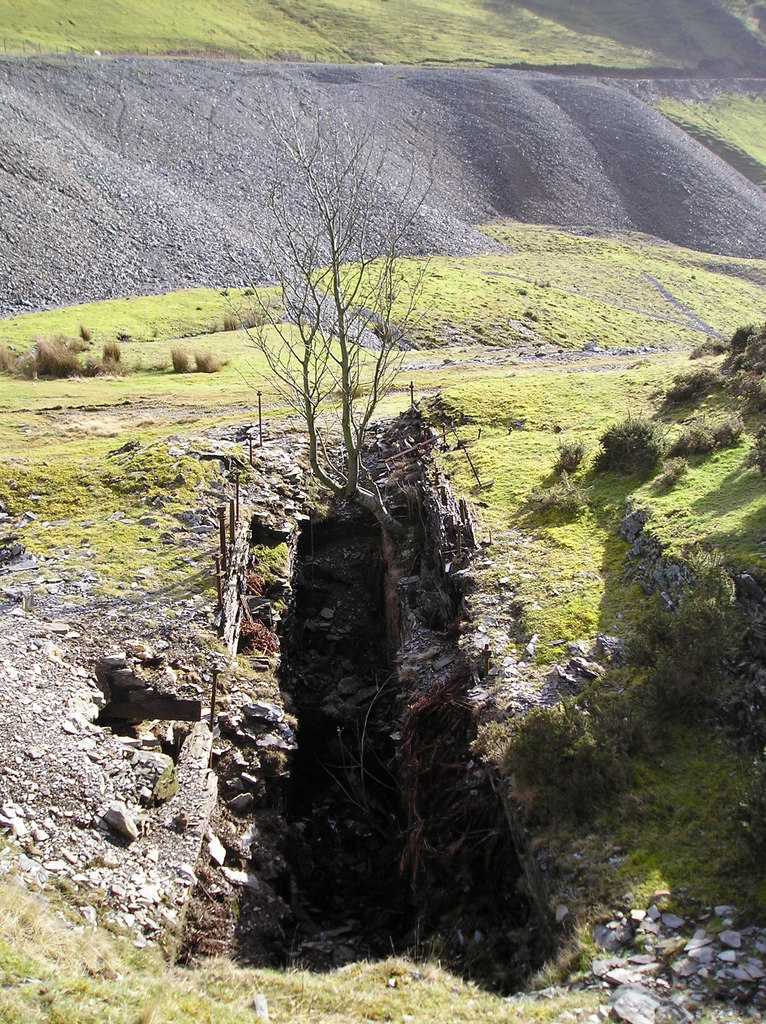
Extensive remains: a reservoir, wheelpits, a leat, level mouths and shaft mouths, the ruins of several buildings and large tips on the hillside.
Related mines
- Goginan Mine — John Taylor and Sons worked both mines, and Captain James Paull of Goginan managed Cwmbrwyno for the Cefn Brwyno company.
- Silver Stream Mine — Silver Stream was supplied with water by a watercourse brought from Cwmbrwyno Mine across Blaendyffryn farm (county court, 1887).
- South Darren Mine — John Henry Murchison held South Darren as J. H. Murchison and Co. from 1858 to 1881 and floated the Cefn Brwyno Mining Company that worked Cwmbrwyno from 1868.
Nearby mines
- Bwa-Drain Mine — 0.5 miles (0.9 km) S
- Silver Stream Mine — 0.8 miles (1.3 km) NW
- Gellireirin Mine — 0.9 miles (1.4 km) SW
- Llywernog Mine — 1.1 miles (1.8 km) E
- Pengraigddu Mine — 1.2 miles (1.9 km) N
Straight-line distance, within 9 miles (15 km). Show on the map.
Further reading
Rolf von Arx's account of the Cefn Brwyno Mining Company from its company papers, 1867 to 1875.
View sourceThe Royal Commission's site record, with the working periods and photographs of the remains.
View sourceSources
- (primary) Lead and Zinc: The Mining District of North Cardiganshire and West Montgomeryshire (Special Reports on the Mineral Resources of Great Britain, vol. XX), O. T. Jones, 1922 — Memoirs of the Geological Survey
- (primary) Cwmbrwyno Lead Mine; Cefn-Cwm-Brwyno; Cefnbrwyno (NPRN 33825) — Coflein, Royal Commission on the Ancient and Historical Monuments of Wales
- (secondary) A Glimpse at Cwm Brwyno Mine, by R. von Arx (British Mining No. 41, 1990, pp. 64-67) — Northern Mine Research Society
- (primary) Mine plan: Cwmbrwyno Mine, SN78SW 43 (KP16982) — British Geological Survey
Record created: 18 November 2026 · Last researched: 18 November 2026