 MineArchive
Goginan Mine
| Also known as | Goginan Lead and Silver Mine |
|---|---|
| Location | Goginan, Melindwr valley, seven miles east of Aberystwyth, Ceredigion — 52.4176, -3.9247 (exact) |
| Commodities | Lead, Silver, Zinc |
| Type | Metal |
| Worked | before 1640–1886 |
| Maximum depth | 70 fathoms below the deepest adit |
| Operators | Company of Mines Royal (?–1640), Thomas Bushell (1640–1642), Company of Mine Adventurers (1698–1744), John Taylor & Sons (1836–1868), Goginan Company (1868–1875), Sir Hugh Myddelton |
Overview
A silver-lead mine on a vein running two miles east-north-east from Old Goginan in the Melindwr valley, seven miles east of Aberystwyth, worked by the Mines Royal and Thomas Bushell in the seventeenth century and most profitably by John Taylor and Sons from 1836 to 1886. It produced about 25,000 tons of lead ore and 500,000 ounces of silver.
History
Goginan Mine worked a vein running east-north-east for two miles from Old Goginan, in Silurian and Ordovician grits, shales and mudstones, in the valley of the Afon Melindwr seven miles east of Aberystwyth. It was already working when the Society of Mines Royal took it over; Coflein names Myddelton among its early workers. Thomas Bushell worked it from 1640 and drove several adits, but as a royalist he had to leave it in the Civil War. It lay idle until the late 1660s, when the Company for the Undertaking of Mines worked it with Bwlch, reaching 120 feet below the outcrop. Between 1698 and 1708 William Waller, for the Company of Mine Adventurers, cleaned out and enlarged Bushell's adits and drove new ones, working Goginan with Bwlch, Bryn Pica and Pencraigddu, whose ores were claimed to carry 44 ounces of silver a ton; the company worked in the area until at least 1744.
For nearly a century the mine was worked only spasmodically, until John Taylor and Company took it in 1836. Shares issued at £5 that year were worth £420 two years later and still £250 in 1850. Shafts were sunk 70 fathoms below the deepest adit, and in the 1840s an inclined haulage, Taylor's inclined level, was driven from near the dressing floors to 60 fathoms below adit. As lead prices fell the Taylors floated the Goginan Company, which worked it from 1868 to 1875, and after further reorganisations it closed in 1886. Its recorded output from 1836 to 1886 was about 25,000 tons of lead ore and 500,000 ounces of silver.
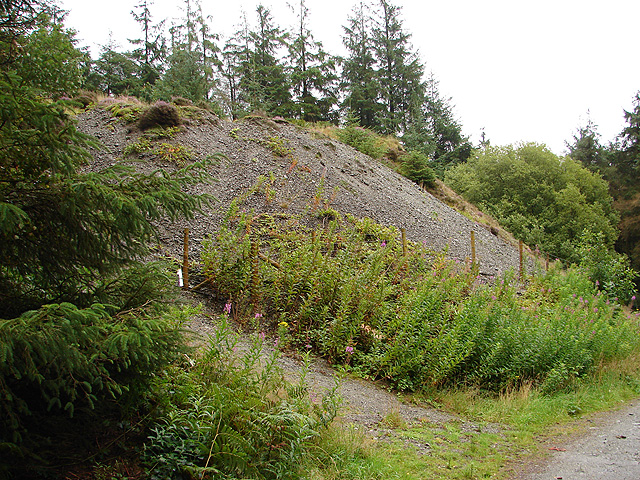
The village of Goginan grew with the mine. Traces of level entrances, stopes, shafts and tips remain, with the outfall of the Deep Adit by Pont Ysgubor-newydd and miners' cottages; the arched entrance of Taylor's inclined level has been restored, and a tablet and pillar mark one of the shafts. A listed house east of the village was probably the mine manager's.
Geology
A lead-zinc vein with silver running east-north-east for two miles in Silurian and Ordovician grits, shales and mudstones.
Workings
Seventeenth-century adits by Bushell and Waller; shafts sunk 70 fathoms below the deepest adit; Taylor's inclined level of the 1840s, driven to 60 fathoms below adit; a Deep Adit draining to Pont Ysgubor-newydd.
Closure
Worked by the Goginan Company from 1868 to 1875 as lead prices fell; after further reorganisations it closed in 1886.
What remains
Traces of levels, stopes, shafts and tips survive with miners' cottages; the arched entrance of Taylor's inclined level has been restored, and at least one shaft is fenced.
Restored arched entrance of Taylor's inclined level, the Deep Adit outfall, tips, shafts, a commemorative tablet and pillar, miners' cottages.
Redevelopment
Partly landscaped; the village of Goginan.
Nearby mines
- Cwmsymlog Mine — 1.4 miles (2.2 km) N
- Gwaith Yr Afon Mine — 1.4 miles (2.2 km) N
- Bwa-Drain Mine — 1.7 miles (2.8 km) SE
- Llywernog Mine — 2.5 miles (4.1 km) E
- Cwm Rheidol Mine — 2.6 miles (4.2 km) SE
Straight-line distance, within 9 miles (15 km). Show on the map.
People
- Thomas Bushell · proprietor, 1640–1642 — via the operator record
- Sir Hugh Myddelton (d. 1631) · proprietor — via the operator record
What's uncertain
Points where sources disagree or the record could not be settled; both accounts are kept. All open questions in the archive.
- Operation began in 1660. (disputed) 2
- A listed nineteenth-century house east of the village is probably the mine manager's house. (uncertain) 3
Recorded claims
Individual factual claims, each attached to the source(s) that support it below. Where sources disagree, both are kept.
- Thomas Bushell worked Goginan from 1640 and drove several adits. 1,2
- John Taylor and Company acquired the mine in 1836. 1,2
- Shares issued at £5 in 1836 were worth £420 two years later. 1
- From 1836 to 1886 it produced about 25,000 tons of lead ore and 500,000 ounces of silver. 2
- The mine closed in 1886. 1,2
- Operation began in 1660. (disputed) 2
- A listed nineteenth-century house east of the village is probably the mine manager's house. (uncertain) 3
Photographs & further reading
The mine's history from the Mines Royal to its closure in 1886, with a photograph of Taylor's incline.
View sourceThe Welsh national monuments record entry, with output and surviving remains.
View sourceSources
- (secondary) NMRS: Goginan Mine — Northern Mine Research Society
- (secondary) Coflein: Goginan Lead and Silver Mine (NPRN 33875) — Royal Commission on the Ancient and Historical Monuments of Wales
- (secondary) Wikipedia: Goginan — Wikipedia
- (primary) BGS / Mining Remediation Authority mine plan: GOGINAN BRYN PICA FRANCIS GILBERTSON'S TAYLOR'S (lead ore, abandoned 1846) — British Geological Survey
- (primary) BGS / Mining Remediation Authority mine plan: GOGINAN WEST (lead ore, abandoned 1882) — British Geological Survey
Record created: 11 October 2026 · Last researched: 11 October 2026