 MineArchive
Cornsay Colliery
| Location | Cornsay, west of Durham, County Durham — 54.7869, -1.7386 (exact) |
|---|---|
| Commodities | Coal, Fireclay |
| Type | Coal |
| Worked | 1868–September 1953 |
| Maximum depth | Worked entirely by drifts into the hillsides; no shaft depth is recorded. |
| Operators | Ferens and Love (1868–1947), National Coal Board (1947–1953) |
Overview
Opened in 1868 by Ferens and Love west of Durham, and worked not by shafts but by four drifts driven into the hillsides — the Low, High, Colpike and Ford Drifts — taking the Harvey, Ballarat, Five Quarter and Main coals, none of them more than three feet six. In the 1890s it was raising 750 tons a day, about half of which was coked on the spot in 270 ovens, and it employed around 700 people across all its departments. Its other product mattered more in the long run: the pit yielded a splendid fireclay that supplied its own brick, tile and sanitary pipe works, and by 1948 the Coal Board was describing Cornsay as mainly a fireclay mine. It closed in September 1953.
History
Cornsay was first opened out in 1868 and worked by Ferens and Love, and it is under their name that the official list of collieries at work returns it in 1880. Whellan’s Directory of County Durham described it in 1894 in terms that make the whole operation legible: four seams, all worked by drifts into the hillsides, the Harvey two feet eight inches thick, the Ballarat one foot nine, the Five Quarter two feet two to three feet six and the Main coal three feet; a daily output of 750 tons, about half converted into coke on the spot in 270 ovens; and a splendid fireclay supplying the colliery’s own brick, tile and sanitary pipe works, with plant for glazed and sanitary ware then being contemplated. Between them the departments employed an average of 700 men and boys. The royalties were leased from Ushaw College, the Ecclesiastical Commissioners and Miss Taylor-Smith, besides a large freehold the owners held themselves.
The mine inspectors’ returns show the colliery at its height around 1910, employing 587 people including Colepike, and then falling away sharply: 386 in 1915, 76 in 1921, 81 in 1925. It recovered to 187 in 1930 and 162 in 1940 but never approached its Victorian size again. What shifted was the product. Coal, coking and fireclay run together through the returns from 1894 onwards, and by 1948 the Guide to the Coalfields was recording Cornsay as mainly a fireclay mine that also produced coking, household and steam coal — the same note repeated in 1949, 1950 and 1955. The company was still Ferens and Love, reconstituted as Ferens & Love (1937) Ltd, when nationalisation came.
A village grew with the colliery and outlived it. Cornsay Colliery once had several terraces, two schools, an institute and a chapel on ground that is now fields and woodland west of Commercial Street.
Geology
The Durham coalfield west of the city, where the seams outcrop on the valley sides and could be reached by drift rather than shaft. Cornsay worked the Harvey, Ballarat, Five Quarter and Main coals, later adding the Three Quarter and, by 1948, the Victoria; none of them was thick and the Ballarat was under two feet. Beneath the coal lay the fireclay that made the colliery’s brickworks possible and eventually became its principal product — a reminder that in this coalfield the seatearth under a seam was sometimes worth more than the seam.
Geological setting: Sedimentary Beds and Seams (well documented example)
Workings
Four drifts driven into the hillsides — Low Drift, High Drift, Colpike Drift and Ford Drift, with a Chapelflat Drift also recorded — rather than a winding shaft, which is why the colliery could be opened cheaply and worked on a small scale to the end. Coke was made on site in 270 beehive ovens, and a brick, tile and sanitary pipe works alongside took the fireclay. Colepike is counted with Cornsay in the returns from 1905.
Closure
Cornsay closed in September 1953, by which time it was described in the official guides as mainly a fireclay mine employing under fifty people. Its coal seams were thin and its coke trade long gone; what had kept it open through the 1940s was the clay.
What remains
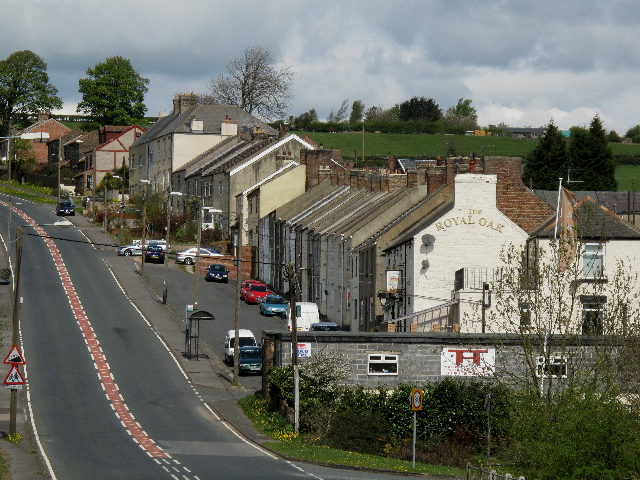
The colliery is gone and the village much reduced. Photographs from 2010 onwards show Cornsay Colliery as a small settlement in open country, with fields and woodland west of Commercial Street where the terraces, schools, institute and chapel once stood.
The village of Cornsay Colliery, which keeps the colliery’s name, and the surviving terraces along Commercial Street. Nothing of the drifts, coke ovens or brickworks is known.
Nearby mines
- Hamsteels Colliery — 0.9 miles (1.5 km) E
- Hedleyhill Colliery — 1.5 miles (2.4 km) S
- Malton Colliery — 1.7 miles (2.8 km) NE
- Esh Winning Colliery — 1.8 miles (2.9 km) SE
- Waterhouses Colliery — 1.8 miles (2.9 km) SE
Straight-line distance, within 9 miles (15 km). Show on the map.
Recorded claims
Individual factual claims, each attached to the source(s) that support it below. Where sources disagree, both are kept.
- The official list of collieries at work in 1880 returns the pit as "Cornsay, Durham, Ferens and Love". 1
- Whellan’s 1894 Directory of County Durham records the colliery as first opened out in 1868 by Ferens and Love, with four seams all worked by drifts into the hillsides — the Harvey 2 ft 8 in, the Ballarat 1 ft 9 in, the Five Quarter 2 ft 2 in to 3 ft 6 in and the Main coal 3 ft — named Low, High, Colpike and Ford Drifts. 2
- The drifts gave a daily output of 750 tons, about half of which was converted into coke on the spot in 270 ovens. 2,3
- A great feature of the pit was that it yielded a splendid fireclay supplying the colliery’s own extensive brick, tile and sanitary pipe works; by 1948 the official guides recorded Cornsay as mainly a fireclay mine. 2
- The colliery in its various departments employed an average of 700 men and boys in the 1890s, and the inspectors’ returns record 587 in 1910 including Colepike, falling to 76 by 1921 and 47 by 1955. 2
- Besides a large freehold the owners held themselves, the royalties were leased from Ushaw College, the Ecclesiastical Commissioners and Miss Taylor-Smith. 2
- The BGS mine-plans catalogue holds a Mining Remediation Authority abandonment plan titled 'Cornsay' (catalogue D391, Three Quarter [Tilley 'P'], dated 1951). 4
Photographs & further reading
The compiled record: the drift names and locations, the seams worked at five-year intervals from 1905, employment figures from 1883 to 1955, the full Whellan’s 1894 description of the colliery, and the names of those killed there.
View sourceSources
- (secondary) List of coal mines UK 1880 — Coalmining History Resource Centre
- (primary) Cornsay Colliery — Durham Mining Museum
- (secondary) Cornsay Colliery — Wikipedia
- (primary) BGS / Mining Remediation Authority mine plans: CORNSAY — British Geological Survey / Mining Remediation Authority
- (observational) Cornsay Colliery (photographed 2010) — Trevor Littlewood, Geograph Britain and Ireland
Record created: 6 September 2026 · Last researched: 6 September 2026