 MineArchive
Cilely Colliery
| Location | between Edmondstown and Tonyrefail, Rhondda Cynon Taf — 51.5970, -3.4285 (exact) |
|---|---|
| Commodity | Coal |
| Type | Coal |
| Worked | 1872–1950 |
| Maximum depth | 404 yards (No. 1 pit, to the Five Feet seam) |
| Operators | National Coal Board (1947–1950), Blindell Brothers and Co., Locket's Merthyr Collieries (1894) Ltd |
Overview
Cilely was opened between Edmondstown and Tonyrefail by David Davies in 1872 and bought by the Great Western Railway two years later. Its two shafts were unequal in every way: the No. 1 upcast ten feet across and 404 yards down to the Five Feet seam, the No. 2 downcast thirteen to fourteen and a half feet across but only 156 yards to the Abergorki, from which the steam coal was won by a cross-measures drift through a sixty-yard fault. It raised nearly 214,000 tons in 1905 and 95,000 tons for the National Coal Board in 1947, and worked until 1950.
History
David Davies opened Cilely in 1872 on the ground between Edmondstown and Tonyrefail, and the Great Western Railway Company bought it in 1874. Blindell Brothers and Co. were the owners when the Inspector of Mines listed 304 people in 1897; the colliery then passed to Locket's Merthyr Collieries (1894) Ltd and later to Cilely Collieries Ltd, and to the National Coal Board in 1947. Employment ran from 218 in 1894 to 718 in 1900 and 769 in 1905, with a separate level and, by 1915, a Fforest Fach working returned alongside the pits. The Atlantic Merthyr Collieries prospectus of 26 February 1906 describes the property: two pits, the No. 1 or upcast ten feet in diameter and 404 yards to the Five Feet seam, and the No. 2 or downcast varying from thirteen feet to fourteen feet six inches and 156 yards to the Abergorki seam, where the steam coals had been won by a cross-measures drift through a sixty-yard fault. The output for 1905 is given there as 213,998 tons. In 1947 the colliery raised 95,000 tons of bunker and steam coal with the National Coal Board.
Geology
Cilely worked the steam and house coals of the Rhondda measures, the Five Feet seam at 404 yards in the No. 1 pit and the Abergorki at 156 yards in the No. 2. A sixty-yard fault lay between the No. 2 pit and its steam coal, which had to be won by driving a cross-measures drift through it — the kind of expense faulting imposes on a South Wales pit.
Geological setting: Faults and Fractures (well documented example), Sedimentary Beds and Seams (well documented example)
Workings
Two shafts of very different size, the No. 1 upcast at ten feet and the No. 2 downcast at thirteen to fourteen and a half feet, and a separate level and a Fforest Fach working returned alongside them in the Inspector's lists. A cross-measures drift carried the steam coal through the sixty-yard fault.
Closure
The colliery worked from 1872 until 1950 and the site has been cleared. The concrete supports believed to be those of the winding house are the most substantial thing left.
What remains
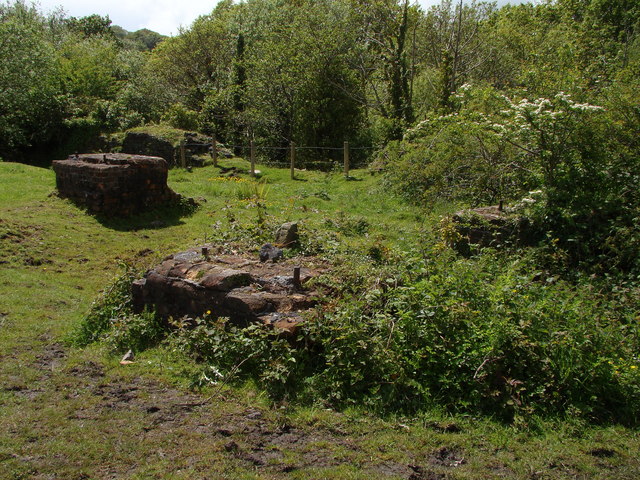
The site above Edmondstown has been cleared and grassed. What survives is a set of concrete supports believed to be those of the winding house that carried the miners up and down the shaft in cages.
Concrete supports believed to be those of the winding house, on the cleared and grassed site.
Nearby mines
- Rhiwgarn Colliery — 0.4 miles (0.6 km) SE
- Collena Colliery — 0.4 miles (0.7 km) S
- Dinas Isha Colliery — 0.5 miles (0.8 km) E
- Caerlan Colliery — 0.7 miles (1.1 km) SW
- Cymmer Colliery — 1.3 miles (2.1 km) NE
Straight-line distance, within 9 miles (15 km). Show on the map.
Recorded claims
Individual factual claims, each attached to the source(s) that support it below. Where sources disagree, both are kept.
- Cilely was opened by David Davies in 1872 and purchased by the Great Western Railway Company during 1874. 1
- The No. 1 or upcast pit was ten feet in diameter and 404 yards to the Five Feet seam; the No. 2 or downcast varied from thirteen feet to fourteen feet six inches and was 156 yards to the Abergorki seam, where the steam coals were won by a cross-measures drift through a sixty-yard fault. 1
- The output in 1905 was 213,998 tons; in 1947 the colliery raised 95,000 tons of bunker and steam coal. 1,2
- Blindell Brothers and Co. owned the colliery in 1897, and it passed to Locket's Merthyr Collieries (1894) Ltd, then Cilely Collieries Ltd, then the National Coal Board in 1947. 2
- The colliery worked from 1872 to 1950. 3
- The BGS mine-plans catalogue holds a Mining Remediation Authority abandonment plan titled 'Cilely' (catalogue SW116, Four Feet, dated 1952). 4
Photographs & further reading
The opening by David Davies, the Great Western Railway purchase, and the 1906 prospectus description of both shafts, their diameters and depths and the drift through the fault.
View sourceOwners, output and employment pit by pit for each Lists of Mines year, with the names of those killed at the colliery.
View sourceSources
- (primary) Cilely Colliery — Welsh Coal Mines, quoting the Atlantic Merthyr Collieries prospectus of 1906 and the Inspector of Mines lists
- (primary) Durham Mining Museum: Cilely Colliery — Durham Mining Museum, from the Lists of Mines
- (observational) Colliery remains at Cilely (photographed 2009) — Geograph Britain and Ireland, David Locke
- (primary) BGS / Mining Remediation Authority mine plans: CILELY — British Geological Survey / Mining Remediation Authority
Record created: 10 September 2026 · Last researched: 10 September 2026