 MineArchive
Carricks Mine
| Also known as | Carricks Iron Mine, Carricks or Craigs Mine |
|---|---|
| Location | Ireshopeburn, Weardale, County Durham — 54.7363, -2.2166 (approximate) |
| Commodities | Iron, Lead |
| Type | Iron |
| Worked | 1860s (Craigs Level)–May 1949 |
| Maximum depth | At least 222 feet 6 inches (shaft section) |
| Operators | Weardale Steel, Coal and Coke Co. Ltd (owner) — Owners from the 1900s (Mines Department lists); the Weardale Iron Co. Ltd held it in the 1890s |
A siderite iron ore mine above Ireshopeburn in Weardale, worked by the Weardale Iron and Weardale Steel, Coal and Coke companies from 1880 and abandoned in May 1949.
Location
Approximate location. The large pin is this mine; the small round markers are the nearest mines on record. Click one for its page. View on full map
History
Carricks was an iron ore mine on the hillside above Ireshopeburn in upper Weardale, about 1,374 feet above sea level. Its workings take in Groveheads Level, worked for lead in the late eighteenth century, and Craigs Level, begun in the 1860s, and the Weardale Iron Company took the mines over in 1880. Its ore was one of the few Weardale deposits rich enough in primary siderite to be worked as it came, rather than only where weathering had enriched it.
Under the Weardale Iron Co. Ltd in the 1890s and the Weardale Steel, Coal and Coke Co. Ltd from the 1900s, it employed 67 people in 1896 and 61 in 1900, and raised between 16,000 and 21,000 tons of iron ore a year from 1895 to 1902, worth around £7,000 a year at the mine. Output fell away after 1902, to about 3,000 tons in 1912 and 36 tons in 1913. Lead ore was raised with the iron ore from 1915, and the mine stood idle from 1920. The lead and ironstone workings, as Carricks or Craigs, were abandoned in January 1939. By 1945 Carricks was working again, with 59 people, and it was abandoned in May 1949; the county's historic environment record gives the iron ore mine at Grove Heads as working until 1942.
Five deaths are recorded there. Thomas Hodgson in 1894 and George Robinson in 1902 were killed by falls of ore from the roof; Hugh Fairless died of blood poisoning in 1895 after crushing his little finger between a prop and a tub; Thomas Wilkinson, the mine foreman, was killed by debris from a shot in 1909; and William Thompson died of natural causes in 1906 as he was about to enter the mine.
Geology
Carboniferous rocks of the North Pennine Orefield. The shaft passed through freestone, the Little Limestone, the High and Low Coal Sills and 72 feet of the Great Limestone. The ore was rich in primary siderite (iron carbonate); lead ore was raised with it from 1915.
Workings
Groveheads Level and Craigs Level, and a shaft whose recorded section goes down through the Great Limestone to 222 feet 6 inches. An incline ran down from the mine to Ireshopeburn, and a haulage engine served it on Ireshope Plains.
Closure
Abandoned in May 1949.
What remains
Spoil heaps and traces of several shafts and a level remain on the hillside.
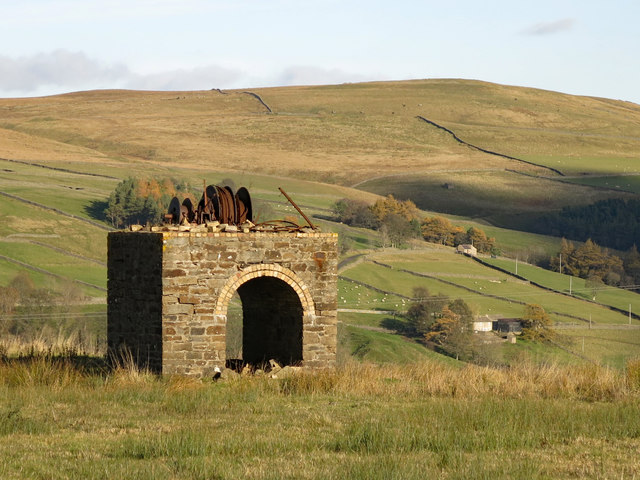
The spoil heaps, the head of the incline down to Ireshopeburn and traces of shafts and a level survive, and the remains of an old haulage engine from the mine lie on Ireshope Plains.
Nearby mines
- Blackdene Mine — 0.8 miles (1.3 km) NE
- Greenlaws Mine — 1.8 miles (3.0 km) E
- Burtree Pasture Mine — 1.9 miles (3.1 km) N
- Sedling Rake Mine — 1.9 miles (3.1 km) N
- High Sedling Mine — 2.8 miles (4.5 km) N
Straight-line distance, within 9 miles (15 km). Show on the map.
Further reading
The museum's page for the mine: owners, output, employment from 1888 to 1950, abandonment and the names of men killed.
View sourceIron ore output and value from the Mineral Statistics, 1894 to 1913.
View sourceThe national catalogue entry for the mine's final abandonment plan.
View sourceThe national catalogue entry for the 1939 abandonment plan.
View sourceA survey of the northern orefields naming Carricks among the workable primary siderite deposits of Weardale.
View sourceThe county historic environment record for the lead and iron ore workings at Grove Heads.
View sourceSources
- (observational) Carricks Mine: head of the incline down to Ireshopeburn (Geograph 5998462) — Geograph
- (primary) Metalliferous and associated minerals, geology and man, Northern England — British Geological Survey (Earthwise)
- (primary) Carricks (Iron Ore) mineral statistics (Durham Mining Museum) — Durham Mining Museum
- (primary) Carricks (Iron Ore) (Durham Mining Museum) — Durham Mining Museum
- (primary) BGS mine plans: Carricks or Craigs, lead ore and ironstone, abandoned 16 January 1939 — British Geological Survey
- (primary) BGS mine plans: Carricks, iron ore, abandoned 11 May 1949 — British Geological Survey
- (secondary) Ironstone Mine at Grove Heads aka Groove Heads Mine, Ireshopeburn (Keys to the Past, D4204) — Durham County Council and Northumberland County Council (Keys to the Past)
- (primary) Carricks (Iron Ore) shaft details (Durham Mining Museum) — Durham Mining Museum
Record created: 19 November 2026 · Last researched: 19 November 2026