 MineArchive
Broxburn Oil Works
| Also known as | Albyn Oil Works |
|---|---|
| Location | Broxburn, West Lothian — 55.9343, -3.4694 (approximate) |
| Commodity | Oil Shale |
| Type | Mineral |
| Worked | 1860s–26 April 1927 |
| Operators | Broxburn Oil Company Ltd (1877–1927) |
Overview
For half a century the industrial heart of a small West Lothian town — an integrated complex of shale mines, retorts, a refinery, a candle works and an acid plant, built to turn ordinary-looking rock into paraffin, wax and fertiliser, and left behind as some of the largest artificial hills in Scotland.
History
Small-scale oil shale working around Broxburn began in the 1860s and 70s under Robert Bell, who held the local mineral rights and ran several scattered operations including the Albyn Oil Works from about 1865. The Broxburn Oil Company Ltd, formed in 1877 with £180,000 of capital, bought out Bell's interests and set about building an integrated works to rival James Young's pioneering operation at nearby Addiewell. Construction of the crude oil works at the Albyn site began in 1878, fitted with 340 of manager Norman Henderson's own patent retorts alongside 36 older vertical retorts inherited from the original Albyn works; by 1879 it could produce four and a half million gallons of crude oil a year, plus nearly a thousand tons of ammonium sulphate for fertiliser. A separate refinery, built west of Greendykes Road and deliberately sited apart from the crude works for safety, was processing all the company's crude oil by 1882, alongside a candle works making wax products and, from 1884, a vitriol works making sulphuric acid. Falling oil prices as cheaper imported liquid petroleum reached Britain eventually made the business unviable, and the crude oil works and refinery closed for good on 26 April 1927. The candle works outlasted them, run afterwards by Prices Patent Candles Ltd until 1957, and the acid works continued until about 1962.
Geology
Broxburn's shale belongs to the same West Lothian oil shale field mined at Pumpherston, Tarbrax and across the Bathgate hills — organic-rich Carboniferous mudstones that release oil and gas when heated, or retorted, in the absence of air. The Dunnet Mine was among those that supplied the Albyn works with raw shale.
Workings
Shale was mined underground and brought to the retort houses, where at peak the works could process some 700 tons of shale a day. The retorting process broke the shale down into crude oil, ammoniacal liquor for making sulphate of ammonia fertiliser, and spent shale waste — roughly 80 per cent of the original rock by volume — which was hauled up steep inclines by cable and tipped to form the huge conical and ridged waste heaps, known locally as bings, that came to dominate the West Lothian skyline.
Closure
The crude oil and refining side of the business closed on 26 April 1927 in the face of cheap imported oil; the crude oil works were demolished around 1937 and the refinery around 1960, while the associated candle works and acid works survived for decades afterwards.
What remains
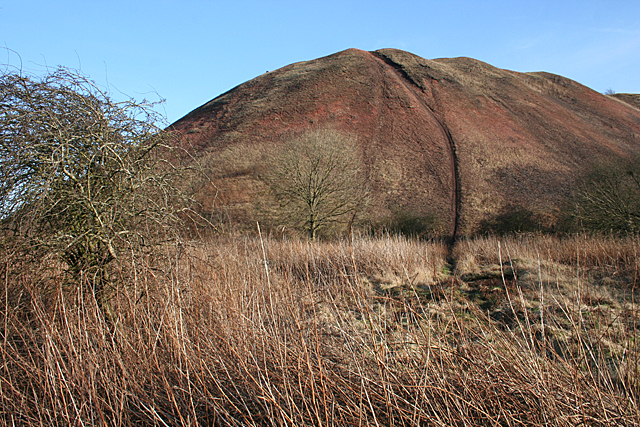
Industrial units and waste ground now occupy much of the original works site, with one former refinery office building surviving. The area's real monument is the Greendykes Bing, a scheduled ancient monument on the edge of the town formed from spent shale tipped by Broxburn and neighbouring works over decades, its complex lobed shape reflecting successive phases of tipping from more than one works.
A surviving former refinery office building, and the large scheduled Greendykes shale bing on the edge of Broxburn.
Redevelopment
Industrial estates and waste ground occupy the former crude oil works and refinery sites.
Nearby mines
- Pumpherston Oil Works — 2.7 miles (4.4 km) S
- Hilderston Silver Mine — 6.1 miles (9.8 km) W
- Fairykirk Quarry — 6.8 miles (11.0 km) NE, Fife
- Bridgeness Colliery — 7.1 miles (11.4 km) NW, Falkirk
- Charlestown Limeworks — 7.2 miles (11.5 km) N, Fife
Straight-line distance, within 9 miles (15 km). Show on the map.
Recorded claims
Individual factual claims, each attached to the source(s) that support it below. Where sources disagree, both are kept.
- The Broxburn Oil Company Ltd was formed in 1877 with £180,000 capital, buying out Robert Bell's earlier scattered workings including the Albyn Oil Works of about 1865. 1
- The crude oil works, built from 1878, used 340 Henderson patent retorts plus 36 older vertical retorts, reaching 4.5 million gallons of crude oil and about 950 tons of ammonium sulphate a year by 1879; a separate refinery, candle works and 1884 vitriol works completed the integrated site. 1
- At peak the works processed about 700 tons of shale a day, with spent shale waste — roughly 80 per cent of the original volume — tipped by cable haulage to form the district's characteristic bings. 2
- The crude oil works and refinery closed on 26 April 1927 as cheaper imported oil made the business unviable; the candle works continued to 1957 and the acid works to about 1962. 1
- The Greendykes Bing, formed from spent shale tipped over decades by Broxburn and neighbouring works, survives as a scheduled monument on the edge of the town. 2
Sources
- (primary) Broxburn Oil Works — Scottish Shale
- (secondary) Bings, Bings are Wonderful Things — Scottish Shale
Record created: 24 August 2026 · Last researched: 24 August 2026