 MineArchive
Billy Bank Mine
| Also known as | Billy Banks Copper Mine |
|---|---|
| Location | Billy Bank Wood, River Swale, Richmond (Hudswell parish), North Yorkshire — 54.4019, -1.7466 (exact) |
| Commodity | Copper |
| Type | Metal |
| Worked | 1905 (levels)–1912 |
| Maximum depth | Unknown. |
| Operators | Boulder Flint Co. Ltd. (1905–1910), Yorkshire Minerals Limited (1910–1912) |
Overview
A small copper mine in Billy Bank Wood on the River Swale near Richmond, found by the Boulder Flint Company while seeking chert and worked from 1906 to 1912, the last attempt to win copper in Richmondshire; earlier miners had worked the same vein.
History
Billy Bank Mine lies in Billy Bank Wood, on the steep outer bank of a meander of the River Swale a short way upstream of Richmond, in the parish of Hudswell. A copper vein is cut and partly exposed there by the river. The bank is so sheer that the mine could only be reached at river level, along an elevated cart road built of limestone slabs over the water's edge.
The vein had been worked before: a fifteenth-century reference to a copper mine near Richmond may be this one, the historian Clarkson wrote in 1814 that it had been worked occasionally, and twentieth-century miners found a maze of old galleries driven by 't'owd man', who worked the vein from the top by a shaft and used blasting powder. The modern work began in 1905-06, when the Boulder Flint Company, which mined chert in Arkengarthdale for the pottery industry, drove two levels, probably finding the copper while looking for chert. Yorkshire Minerals Limited took the mine over from 1910 to 1912 and then gave up. In all the two companies produced 92 tons of copper ore, worth £3,019, worked with so little capital that the ore was not even washed; it was the last attempt to mine copper in the district. Green and blue copper carbonates can still be found in its spoil.
Geology
A copper vein exposed in the river bank; green and blue carbonate ores occur in the spoil.
Workings
Two levels of 1905-12 driven at river level, and older galleries and a shaft worked from the top of the vein.
Closure
Given up by Yorkshire Minerals Ltd in 1912 as unprofitable.
What remains
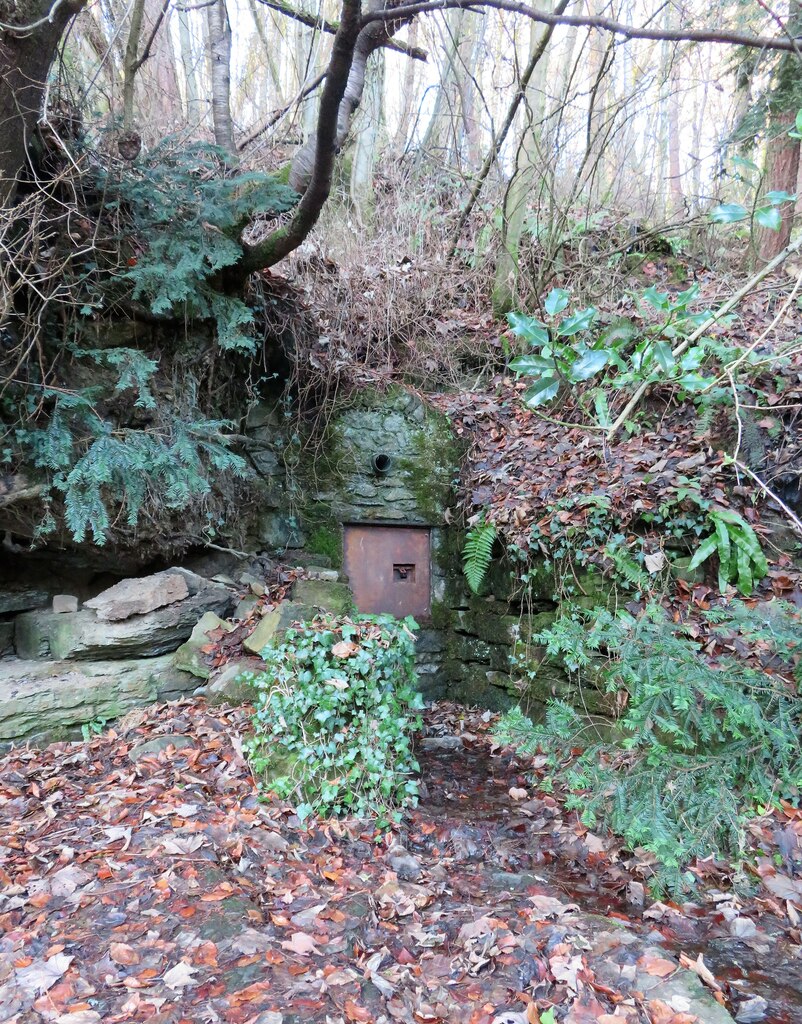
A walled-up level entrance with a small iron door survives in the wood.
A masonry level portal with an iron door, and spoil with copper carbonates.
Redevelopment
Unknown.
Related mines
- Fremington Edge Quarry — The Boulder Flint Company worked both: chert from Fremington Edge, and copper at Billy Bank found while seeking chert.
- Middleton Tyas Copper Mine — Richmondshire copper mines; Billy Bank was the district's last.
Nearby mines
- Middleton Tyas Copper Mine — 4.2 miles (6.7 km) NE
- Merrybent Copper Mine — 5.1 miles (8.2 km) NE
- Marrick Lead Mines — 6.4 miles (10.2 km) W
- Grinton Smelt Mill — 7.7 miles (12.4 km) W
- Whiteside Mine — 7.9 miles (12.8 km) W
Straight-line distance, within 9 miles (15 km). Show on the map.
What's uncertain
Points where sources disagree or the record could not be settled; both accounts are kept. All open questions in the archive.
- The Boulder Flint Company operated the mine from 1906 to 1910. (disputed) 2
Recorded claims
Individual factual claims, each attached to the source(s) that support it below. Where sources disagree, both are kept.
- Two levels were driven at Billy Banks from 1905 by the Boulder Flint Company, which was mining chert in Arkengarthdale for the pottery industry. 1,2
- The Boulder Flint Company and Yorkshire Minerals Ltd produced 92 tons of copper ore, worth £3,019. 1
- Yorkshire Minerals Ltd worked the mine from 1910 to 1912 and then gave up. 1,2
- The last attempt to win copper in the area was carried on with minimal capital at Billy Banks between 1906 and 1912; the ore was not even washed. 2
- Earlier miners had worked the vein from the top by a shaft, using blasting powder. 2
- The Boulder Flint Company operated the mine from 1906 to 1910. (disputed) 2
- The entrance to Billy Bank mine survives as a stone portal with a small iron door. 3
Sources
- (secondary) Billy Bank Mine — Northern Mine Research Society
- (secondary) Copper mining in Richmondshire in the eighteenth and nineteenth centuries (Hornshaw, MA thesis) — Durham E-Theses
- (observational) Entrance to Billy Bank mine — Geograph
Record created: 17 October 2026 · Last researched: 17 October 2026