 MineArchive
Ystumtuen Mine
| Location | Ystumtuen, Blaenrheidol, Ceredigion — 52.3925, -3.8634 (exact) |
|---|---|
| Commodities | Lead, Zinc |
| Type | Metal |
| Worked | Working by 1698–1882 |
| Maximum depth | Unknown. By 1708 Waller had driven and sunk some 349 fathoms of workings for a recorded 594 tons of ore. |
| Operators | Company of Mine Adventurers (1704–1709), John Taylor & Son (1844–1845) |
Overview
A lead and zinc mine at the heart of a closely worked cluster of mines around the village of Ystumtuen in the Cambrian Mountains, worked on and off from at least 1698 to 1882, whose earliest industrial operator collapsed amid fraud allegations after only five years.
History
Ystumtuen Mine is really a complex of workings clustered around the village of the same name, in the mid-Wales silver-lead orefield of the Cambrian Mountains. The earliest definite reference to mining here comes from 1698, when the engineer William Waller described driving a fifty-yard crosscut into the South Lode -- known locally as the Sun Vein -- for the leaseholder Sir Humphrey Mackworth, striking a rich bunch of ore fifty yards below the surface. In 1704 the Nanteos estate, which owned the ground, re-let the mine to the Company of Mine Adventurers, and by 1708 Waller had driven and sunk some 349 fathoms of workings at a cost of £1,173, yielding 594 tons of ore. The Company fell into disrepute in 1709 over fraudulent accounting, Waller was dismissed, and by 1720 the Nanteos estate was complaining of unpaid royalties; the lease expired in 1727 and the outgoing agent destroyed the pumps and infilled the workings. It was reopened in 1746, when a Flintshire company sank a new whim shaft to intersect the lode, and continued intermittently -- noted in 1806 under Sir Thomas Bonsall, and again in 1824, when Thomas and George Alderson began a deep adit from the Rheidol valley before going bankrupt on its cost. Activity from the 1850s to 1880s centred on the resulting Aldersons' Adit, which met the lode 78 fathoms below surface, deepened further by 1874 to 118 fathoms; a final phase from 1900-12 raised substantial quantities of zinc blende. From 1844 the Nanteos estate let Ystumtuen jointly with the neighbouring Penrhiw and Bwlchgwyn mines to the reputable firm of John Taylor & Son, and from 1844 the focus of activity shifted to an adit mouth that developed into the separate Cwm Rheidol mine; Ystumtuen itself appears to have closed in 1882, though a later revival of Cwm Rheidol from 1910-17 may have reworked some of its ground.
Geology
Lead and zinc in the mid-Wales silver-lead orefield, a complex of workings clustered around the village of Ystumtuen.
Workings
Worked via a succession of shafts and adits, most significantly Aldersons' Adit from the Rheidol valley, which met the lode 78 fathoms below surface in the mid-19th century and was deepened to 118 fathoms by 1874.
Closure
Appears to have closed in 1882; a later revival centred on the adjoining Cwm Rheidol mine, 1910-17, may have included some of this ground.
What remains
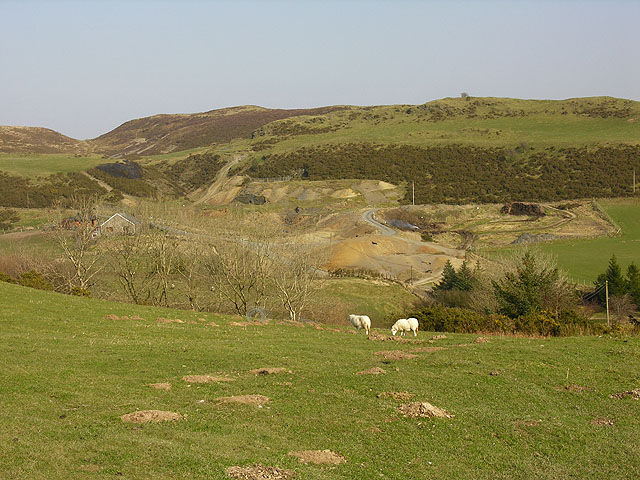
Surface remains include the mouth of an open level, shaft craters, opencuts, crusher houses, wheelpits, an engine shaft collar with an arched bob pit, and areas of tipping.
An open level mouth, shaft craters, opencuts, crusher houses, wheelpits, an engine shaft collar with an arched bob pit, and spoil tips.
Related mines
- Bwlchgwyn Mine — One of the four mines of the Ystumtuen group, connected underground with Ystumtuen by the late nineteenth century and draining with it to the Rheidol through adits No. 6 and No. 9.
- Cwm Rheidol Mine — Activity shifted from Ystumtuen into an adit that developed into Cwm Rheidol mine from 1844, and Cwm Rheidol's 1910-17 revival may have reworked some of Ystumtuen's own ground.
- Penrhiw Mine — Penrhiw began as a chance discovery around 1727 when Ystumtuen's own miners, following the lode east as its lease expired, found ore on the neighbouring ground.
Nearby mines
- Penrhiw Mine — 0.3 miles (0.4 km) E
- Bwlchgwyn Mine — 0.4 miles (0.6 km) E
- Cwm Rheidol Mine — 1.0 miles (1.5 km) W
- Llywernog Mine — 1.3 miles (2.2 km) N
- Bwa-Drain Mine — 1.4 miles (2.3 km) W
Straight-line distance, within 9 miles (15 km). Show on the map.
Recorded claims
Individual factual claims, each attached to the source(s) that support it below. Where sources disagree, both are kept.
- William Waller drove and sunk some 349 fathoms of workings for the Company of Mine Adventurers by 1708, yielding 594 tons of ore, but the Company fell into disrepute over fraudulent accounting in 1709, Waller was dismissed, and the lease was allowed to lapse by 1727. 1
- Reopened in 1746 with a new whim shaft, the mine was worked intermittently through the 19th century, most substantially via Aldersons' Adit from the 1850s to 1880s, which met the lode 78 fathoms below surface and was deepened to 118 fathoms by 1874; a final phase around 1900-12 raised substantial quantities of zinc blende. 2,3
- From 1844 the Nanteos estate let Ystumtuen jointly with the neighbouring Penrhiw and Bwlchgwyn mines to John Taylor & Son, and the mine's own working history is closely bound up with both. 1
Photographs & further reading
The fullest account available of Ystumtuen's working life, from its earliest 1698 reference through its various 18th- and 19th-century operators.
View sourceSources
- (secondary) A brief history of the Ystumtuen Mines — Simon J.S. Hughes / Welsh Mines Preservation Trust, 1993 (via RCAHMW)
- (primary) Ystumtuen Lead Mine (Coflein NPRN 33909) — RCAHMW
- (secondary) Ystumtuen (Buddlepit Mine Database) — Buddlepit Mine Database
Record created: 31 August 2026 · Last researched: 31 August 2026