 MineArchive
Witton Park Colliery
| Location | Witton Park, near Witton-le-Wear and Bishop Auckland, County Durham — 54.6711, -1.7394 (exact) |
|---|---|
| Commodity | Coal |
| Type | Coal |
| Worked | June 1819–April 1925 |
| Maximum depth | Unknown. The coal here lay close enough to the surface to be reached at first by shallow working and by drift. |
| Operators | William Chaytor (1816–1855), Bolckow, Vaughan and Company (1855–1860), Kirsopp & Co. (1860–1869) |
Overview
A County Durham colliery opened in 1819 on the Witton Castle estate, whose commercial success set off the development of nearly a hundred pits within five miles over the next century and a half. Its coal was coked for the Witton Park Ironworks that Bolckow and Vaughan built alongside it in 1845 — the first ironworks in the north-east of England. The colliery outlived the ironworks and closed in April 1925.
History
Coal in the Witton Park area was known to lie close to the surface and could be reached by shallow working. Exploratory boreholes were drilled on the Witton Castle estate from 1756, when it belonged to the Stobart family, but found nothing commercially worthwhile. In 1816 William Chaytor of Croft Hall in Yorkshire bought the estate for £78,000 and put down more trial bores; it was the development of the Jane Pit in 1819 that finally began commercial extraction. That success led to the Mary Ann drift being redeveloped as a deep colliery, and then to the George Pit, the Corving Pit and finally the William Pit. Etherley's parish history gives the Mary Ann, Jane and George pits to the Stobart family, its principal landowners, in the early nineteenth century. In 1832 a sinking below the Main Coal in the Corving Pit met no workable seam. In 1825 the Stockton and Darlington Railway began at Witton Park Colliery: George Stephenson's Etherley incline, worked by a stationary engine, took the wagons over the hill, and only from the foot of the Brusselton incline were they drawn by a locomotive.
The colliery's importance was not only its own output. Its commercial success spurred the sinking of pit after pit nearby, and nearly a hundred were established within a five-mile radius over the next 150 years. In 1845 the partnership of Henry Bolckow and John Vaughan, having secured suitable leases, began building the Witton Park Ironworks — the first in the north-east of England — and erected four blast furnaces there in 1846. The works used coal from the colliery to make coke, with ironstone brought from Whitby on the coast and from Weardale, and limestone from Stanhope; in 1846 Bolckow Vaughan consumed 62,400 tons of ironstone, 104,000 tons of coke and coal and 20,800 tons of limestone.
Ownership of the colliery changed hands repeatedly: Bolckow and Vaughan are recorded as owners in 1855, Kirsopp & Co. from 1860 to 1869, and Henry Chaytor from 1875 to 1880. Witton Firebrick Company held the Corving and William pits from the 1880s, raising fireclay with a handful of men. After the ironworks partly closed in 1878 and shut on 19 May 1884, the pits lost their local market and sent their coal away by the North Eastern Railway. With reserves failing and many skilled miners gone to the First World War, the George Pit, later called Old Etherley Colliery, closed in 1917, and the Jane Pit closed in April 1925 with the loss of 255 jobs, almost 106 years after the colliery opened. Working of the Corving and William pits ended in June 1923, with a short revival from 1927 until the Busty and Brockwell were abandoned on 9 March 1929, and a small working under the Old Etherley Coal Company in the 1940s.
Geology
Part of the Durham coalfield, and unusual in it for how shallow the coal lay: the deposits at Witton Park were known to be close enough to the surface to be reached by shallow methods, which is why a drift — the Mary Ann — was among the first workings and only later deepened. The coal was of coking quality, which is what made the ironworks beside it possible.
Geological setting: Sedimentary Beds and Seams (well documented example)
Workings
A succession of pits rather than a single shaft: the Jane Pit of 1819, the Mary Ann drift subsequently redeveloped as a deep colliery, and then the George, Corving and William pits. Coal was coked on site for the adjoining ironworks, which took ironstone from Whitby and Weardale and limestone from Stanhope.
Closure
The Jane Pit closed in April 1925, the George Pit having closed in 1917. The Corving and William pits ended in June 1923, were worked again from 1927 until the Busty and Brockwell were abandoned on 9 March 1929, and saw a small working in the 1940s.
What remains
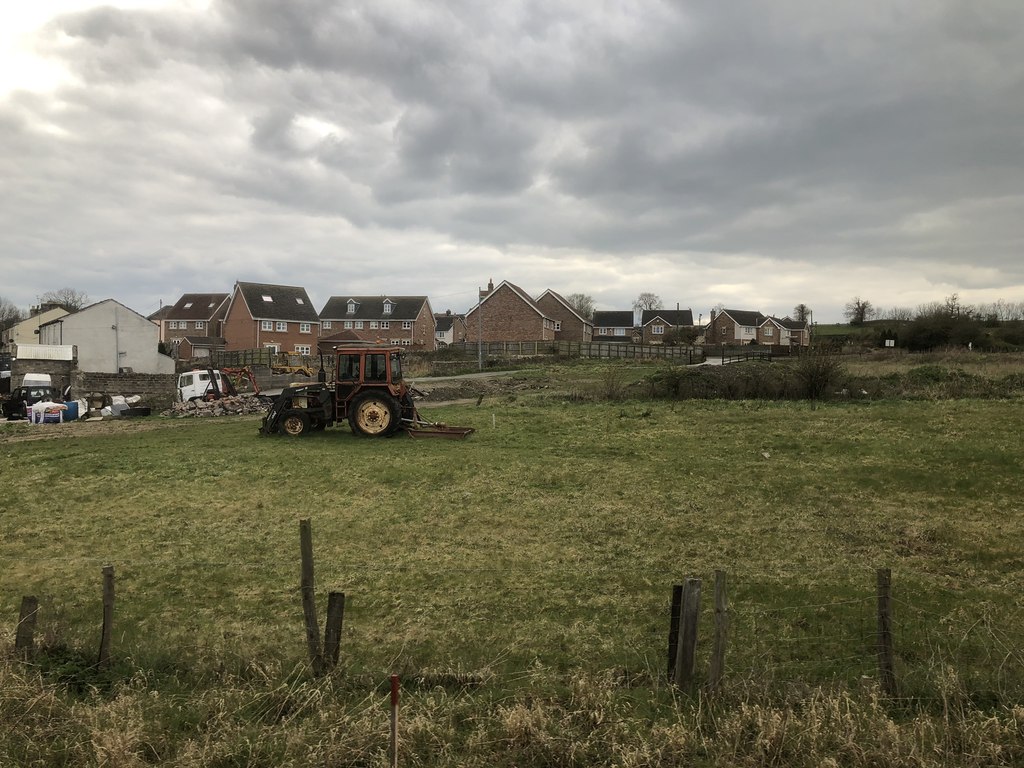
The colliery has gone and the ironworks site has been cleared, except for the shells of the No. 5 and No. 6 blast furnaces; the ground at the foot of the Etherley incline was used by British Railways as a ballast tip until 1989. Witton Park survives as a village, its origins in the works that once stood there.
The shells of the No. 5 and No. 6 blast furnaces of the adjoining ironworks.
Related mines
- Old Etherley Colliery — The George Pit, later called Old Etherley Colliery, was one of the Witton Park pits.
Nearby mines
- Marshall Green Colliery — 1.0 miles (1.6 km) NW
- North Bitchburn Colliery — 1.2 miles (2.0 km) N
- Howden Colliery — 1.8 miles (3.0 km) N
- Ramshaw Colliery — 2.1 miles (3.4 km) S
- Toronto Colliery — 2.1 miles (3.4 km) E
Straight-line distance, within 9 miles (15 km). Show on the map.
What's uncertain
Points where sources disagree or the record could not be settled; both accounts are kept. All open questions in the archive.
- In the early nineteenth century the Mary Ann, Jane and George pits were owned by the Stobart family. (disputed) 4
Recorded claims
Individual factual claims, each attached to the source(s) that support it below. Where sources disagree, both are kept.
- Exploratory boreholes were drilled on the Witton Castle estate from 1756 without finding significant coal; William Chaytor bought the estate for £78,000 in 1816 and extended the trial boring. 1
- Commercial extraction began with the development of the Jane Pit in 1819, which led to the Mary Ann drift being redeveloped as a deep colliery and then to the George, Corving and William pits. 1
- The colliery's commercial success spurred the development of further mines nearby, with nearly a hundred pits established within a five-mile radius over the following 150 years. 1
- Bolckow and Vaughan began building the Witton Park Ironworks in 1845 — the first ironworks in the north-east of England — and erected four blast furnaces there in 1846, using coal from the colliery to make coke. 1,2
- In 1846 Bolckow Vaughan used 62,400 tons of ironstone, 104,000 tons of coke and coal and 20,800 tons of limestone, the ironstone coming mainly from Weardale and from Whitby and the limestone from Stanhope. 1,2
- Ownership records show Bolckow & Vaughan in 1855, Kirsopp & Co. from 1860 to 1869, and Henry Chaytor from 1875 to 1880. 1
- The Jane Pit closed in April 1925, the colliery having operated since June 1819. 1
- In 1825 the Stockton and Darlington Railway began at Witton Park Colliery, with haulage by stationary engines over the Etherley and Brusselton inclines before locomotives took over at the foot of the Brusselton incline. 1,3
- In the early nineteenth century the Mary Ann, Jane and George pits were owned by the Stobart family. (disputed) 4
- The George Pit, later known as Old Etherley Colliery, closed in 1917, and the Jane Pit closed in April 1925 with the loss of 255 jobs. 1,4
- The Witton Park ironworks partly closed in 1878 and shut on 19 May 1884; only the shells of the No. 5 and No. 6 blast furnaces remain. 1
- Sir William Chaytor owned the Corving and William pits in the 1830s and the Witton Firebrick Company in the 1880s; DMM records closure in June 1923, working again from 1927, and the Busty and Brockwell abandoned on 9 March 1929. 5,6
Photographs & further reading
The industrial history of the firm that built the ironworks beside this colliery, with its raw material consumption in the works' first years.
View sourceThe Corving and William pits: owners, fireclay and coal output, employment and abandonment.
View sourceThe Mary Ann, Jane and George pits, the Etherley incline and the pit closures of 1917 and 1925.
View sourceSources
- (secondary) Witton Park Colliery — Wikipedia
- (secondary) Bolckow, Vaughan and Co — Grace's Guide
- (secondary) The Rise of Coal — Wilcuma
- (secondary) Etherley Parish Council - History — Etherley Parish Council
- (primary) Witton Park Colliery — Durham Mining Museum
- (primary) Witton Park Colliery: catalogue of plans of abandoned mines — Durham Mining Museum
Record created: 3 September 2026 · Last researched: 5 October 2026