 MineArchive
Unity Brook Colliery
| Location | Kearsley, between Bolton and Farnworth, Greater Manchester — 53.5390, -2.3860 (approximate) |
|---|---|
| Commodities | Coal, Cannel Coal |
| Type | Coal |
| Worked | from before 1878 |
| Maximum depth | About 360 yards to the Cannel mine; the Trencherbone lay at about 300 yards. |
| Operators | James Stott and Company |
Overview
A Lancashire colliery at Kearsley, near Bolton, the property of Messrs James Stott and Company, working the Trencherbone mine at about 300 yards and the Cannel at about 360. On 12 March 1878 gas escaping from a roof fall exploded and killed forty-three men and boys — the worst day in Kearsley’s history. Nineteen of the dead were buried at the parish church. The inquest returned accidental death, spoke highly of the management, and specifically declined to recommend safety lamps in place of the naked candles in use.
History
Unity Brook stood at Kearsley between Bolton and Farnworth, in the thick of the Manchester coalfield, and belonged to Messrs James Stott and Company. Two seams were worked: the Trencherbone at about 300 yards and the Cannel at about 360, both with open lights, safety lamps being kept for examinations only. Its two shafts each had winding engines, and the downcast served as the winding shaft for both seams. On 12 March 1878 the lower Cannel mine exploded after a roof fall. Just before the blast the cage had reached the pit bank; the explosion blew it to fragments, some of which fell back down the shaft. Forty-three men and boys were killed, nineteen of them buried at the parish church. The inquest concluded on 25 March. Joseph Dickinson, HM Chief Inspector of Mines, said he had no doubt the explosion was caused by gas escaping from a fall of the roof in Partington’s place, and told the coroner that there were more fatalities in mines worked by lamps than with naked candles, because with candles miners could better see falls of roof and coal. The jury returned a verdict of accidental death, spoke highly of the management of the colliery, and would not recommend the use of lamps instead of candles. The disaster is remembered in Kearsley: a memorial in the form of a replica coal truck stands near the site, and memorial services for the forty-three have been held there in recent years.
Geology
Middle Coal Measures of the Lancashire coalfield, where a seam is called a mine. Unity Brook worked the Trencherbone at about 300 yards and the Cannel at about 360 — the same pair of seams as Stonehill Colliery three miles off at Farnworth, and in both pits it was the cannel that killed.
Workings
Two shafts, each with a winding engine, the downcast serving as the winding shaft for both seams. Open lights were used to work both the Trencherbone and the Cannel, with safety lamps reserved for examinations — a practice the inspector defended at the inquest on the grounds that candlelight let a miner see a working roof.
Closure
The closure date is not known.
What remains
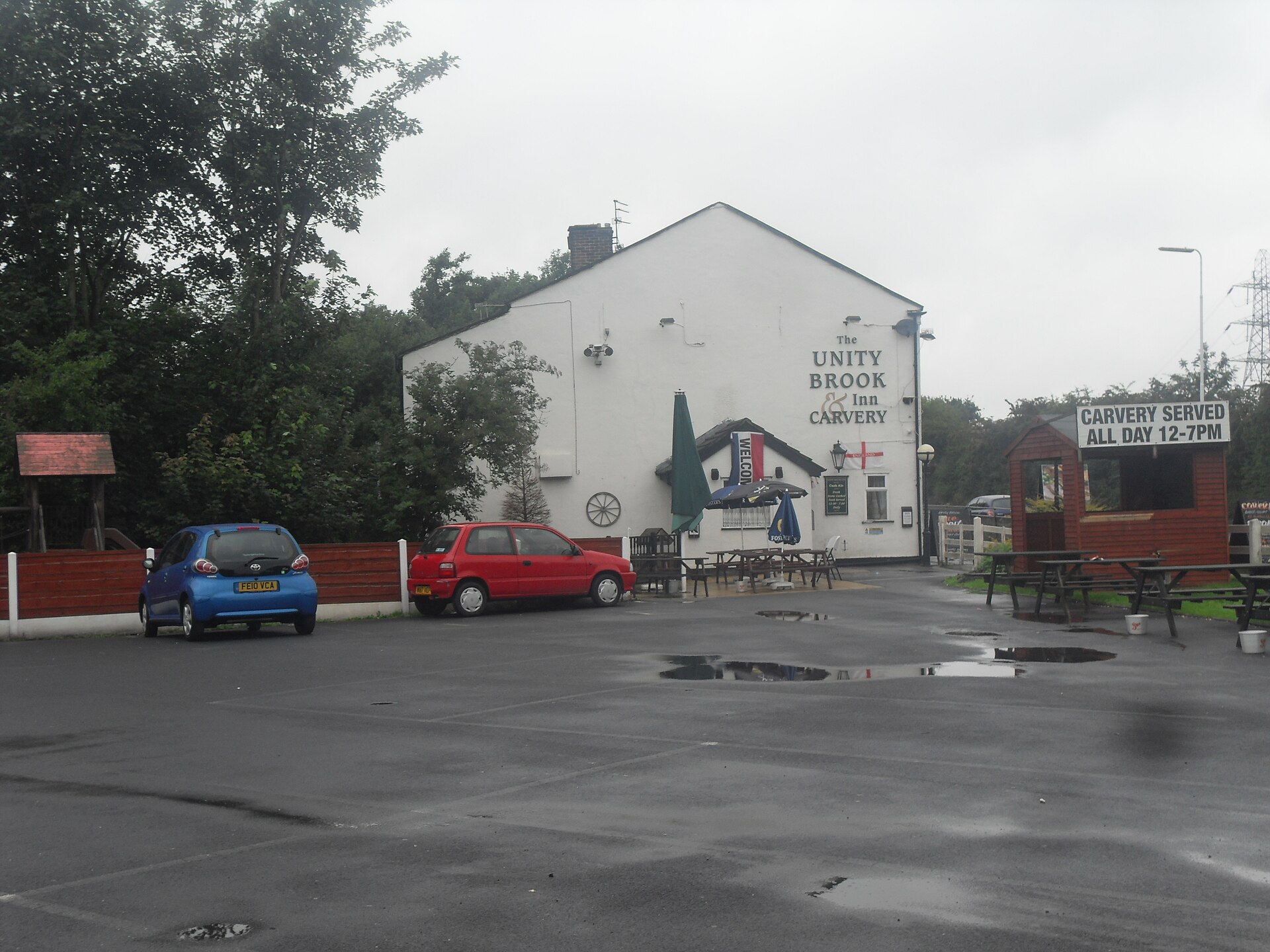
Nothing of the colliery remains. A memorial in the form of a replica coal truck stands near the site of the disaster at Kearsley, where memorial services for the forty-three have been held; the brook the colliery was named after still runs through the district.
None of the colliery; a modern memorial stands near the site.
Related mines
- Stonehill Colliery — Neighbouring Lancashire pits three miles apart that worked the same two seams — the Trencherbone and the Cannel — with naked lights, and lost men to that cannel fourteen months apart: eighteen suffocated by the Stonehill fire in January 1877 and forty-three killed by the Unity Brook explosion in March 1878.
Nearby mines
- Stoneclough Colliery — 0.3 miles (0.5 km) NE
- Ashton's Field Colliery — 1.0 miles (1.6 km) W
- Spindle Point Colliery — 1.0 miles (1.6 km) E
- Linnyshaw Colliery — 1.1 miles (1.7 km) SE
- Stonehill Colliery — 1.1 miles (1.7 km) NW
Straight-line distance, within 9 miles (15 km). Show on the map.
Disasters & major incidents
-
Unity Brook Colliery explosion
12 March 1878 · Explosion · 43 fatalities
Gas escaping from a roof fall exploded in the lower Cannel mine at Unity Brook Colliery, Kearsley, killing forty-three men and boys — the worst day in the town’s history. Nineteen were buried at the parish church. The jury returned accidental death, praised the management, and refused to recommend safety lamps in place of the naked candles the pit worked by.
What's uncertain
Points where sources disagree or the record could not be settled; both accounts are kept. All open questions in the archive.
- The BGS mine-plans catalogue holds a Mining Remediation Authority abandonment plan titled 'Unity Brook' (catalogue 1261, Doe, Five Quarter, Trencherbone, Cannel, dated 1881); the catalogue gives no location and the plan's details do not clearly tie it to this working, so it may belong to another of the same name. (uncertain) 4
Recorded claims
Individual factual claims, each attached to the source(s) that support it below. Where sources disagree, both are kept.
- Forty-three miners were killed by an explosion at Unity Brook Colliery, Kearsley, near Bolton, on 12 March 1878; nineteen of them were buried at the parish church. 1,2
- Joseph Dickinson, HM Chief Inspector of Mines, told the inquest he had no doubt the explosion was caused by gas escaping from a fall of the roof in Partington’s place. 1
- The jury found a verdict of accidental death, spoke highly of the management of the colliery, and would not recommend the use of lamps instead of candles; the inspector had told the coroner there were more fatalities in mines worked by lamps than with naked candles, as with candles miners could better see falls of roof and coal. 1
- The colliery worked the Trencherbone mine at about 300 yards and the Cannel at about 360; open lights were used in both and safety lamps only for examinations. Both shafts had winding engines and the downcast was the winding shaft for both seams; the cage, which had just reached the pit bank, was blown to fragments. 3
- The colliery was the property of Messrs James Stott and Company. 2
- The BGS mine-plans catalogue holds a Mining Remediation Authority abandonment plan titled 'Unity Brook' (catalogue 1261, Doe, Five Quarter, Trencherbone, Cannel, dated 1881); the catalogue gives no location and the plan's details do not clearly tie it to this working, so it may belong to another of the same name. (uncertain) 4
Photographs & further reading
The newspaper report of the inquest, 26 March 1878, with the chief inspector’s finding and the jury’s refusal to recommend safety lamps.
View sourceHow the forty-three are remembered now: the modern memorial services and the replica coal truck standing near the site.
View sourceSources
- (primary) The Kearsley colliery disaster — newspaper report of the inquest, 26 March 1878 — Durham Mining Museum
- (observational) Kearsley community remembers Unity Brook mining disaster — Mining Connection
- (secondary) Bolton Encyclopedia: 1870–1879 — Bolton Encyclopedia
- (primary) BGS / Mining Remediation Authority mine plans: UNITY BROOK — British Geological Survey / Mining Remediation Authority
Record created: 6 September 2026 · Last researched: 6 September 2026