 MineArchive
Speech House Hill Colliery
| Also known as | Royal Forester Colliery, Speech House Main Colliery |
|---|---|
| Location | Beechenhurst, Speech House, Forest of Dean — 51.8049, -2.5605 (approximate) |
| Commodity | Coal |
| Type | Coal |
| Worked | 1830s–1906 (disused) |
| Maximum depth | 420 feet |
| Operators | Richard James (1832–1847) Cornelius Brain (1847–?, owner) — Bought Royal Forester with his brother Francis by 1847 to drain the Rose-in-Hand gale Speech House Hill Colliery Co. (1869–1873) Great Western (Forest of Dean) Coal Consumers Co. Ltd (1873–1884) Great Western Collieries Co. (1884–1892) Speech House Hill Collieries Co. Ltd (1894–1896) Speech House Main Collieries Co. Ltd (1898–1903) Henry Crawshay & Co. Ltd (1903–1937, owner) — Worked the area through Lightmoor and kept the shaft as an emergency exit |
A Forest of Dean colliery on the Royal Forester gale, worked from the 1830s and sunk to 420 feet by a Crawshay company after 1873; after a string of failed owners it closed in 1906 and is now the Beechenhurst picnic site.
Location
Approximate location. The large pin is this mine; the small round markers are the nearest mines on record. Click one for its page. View on full map
History
Speech House Hill Colliery worked the Royal Forester gale in the middle of the Forest of Dean. Richard James of Whitecroft applied for it in April 1832, was refused, built and worked anyway at considerable cost, and had his right confirmed by the awards of 1841. By 1847 Cornelius and Francis Brain, who held the neighbouring Rose-in-Hand gale, had bought it to drive a drainage level through it. The Speech House Hill Colliery Co. had it by 1869, and in 1873 the Great Western (Forest of Dean) Coal Consumers Co. Ltd, a Crawshay company with Edwin Crawshay as chairman, took over Royal Forester and Cannop Bridge Level, about 400 acres, and deepened the shafts to the Churchway High Delf. A branch from the Severn and Wye Railway was laid in 1874 and 1875, and in 1880 the colliery raised 56,976 tons.
Then the colliery began changing hands, and rarely for long. The Great Western Collieries Co. of R. Toomer of Reading bought it in 1884, quarrelled with Trafalgar over water in 1888, and went into liquidation in April 1892 after Toomer's bankruptcy and death. A new Speech House company took it on by 1894, cut wages in December 1895, locked out 517 men and boys, and was itself in liquidation by August 1896. When no one else would buy it, a former director, W. Alfred Holbrow of Stroud, did, and sold it on that October to a Mr Whittaker of Keighley, whose Speech House Main Collieries Co. Ltd restarted it in 1898 and added the Union and Cannop deep gale in 1899, only to strike heavy water there.
In March 1903 Henry Crawshay & Co., owners of the adjoining Lightmoor Colliery, bought it out of liquidation. They opened up the barrier between the two pits, and with Lightmoor's coal now coming that way, the surface works at Speech House Hill were no longer needed; the colliery was disused by 1906 and the reusable buildings went to Lightmoor. The main shaft and headframe were kept as an emergency exit for Lightmoor until the Royal Forester gale was surrendered in April 1937.
Geology
The upper seams of the Supra-Pennant Group in the Upper Coal Measures. The winding shaft reached the Churchway High Delf, 3 feet 3 inches thick, at 393 feet. In the 1890s the company was working the Smith Coal, Lowrey, Starkey, Rockey, Churchway, No Coal and Brazilly seams.
Workings
The winding shaft was eventually 420 feet deep. A branch of the Severn and Wye Railway, built by the contractor J. E. Billups in 1874 and 1875, served the colliery, dropping to the main line on a gradient of 1 in 30 with a runaway siding to protect it. The workings were connected with Lightmoor Colliery after 1903.
Closure
Coal winding ended when Henry Crawshay & Co. worked the area through Lightmoor after 1903, and the colliery was disused by 1906. The shaft served as Lightmoor's emergency exit until the gale was surrendered in April 1937.
What remains
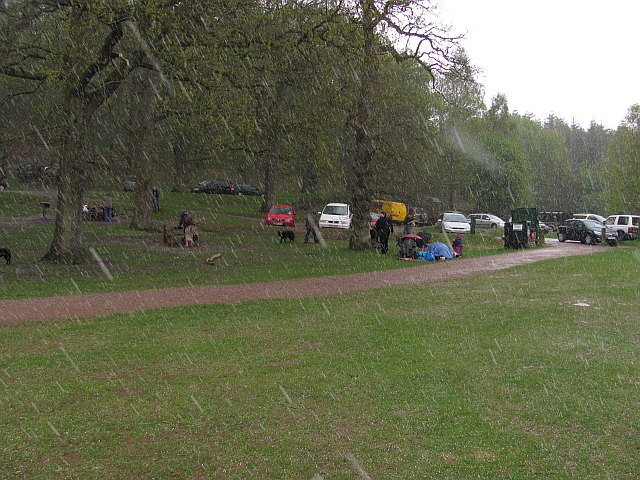
The site has been landscaped as the Forestry Commission's Beechenhurst picnic site.
Redevelopment
Landscaped as the Beechenhurst picnic site, with a car park, recreation ground and the Forestry Commission's visitor lodge.
Related mines
- Lightmoor Colliery — Henry Crawshay & Co. bought Speech House Hill in 1903, opened the barrier between the two and kept its shaft as Lightmoor's emergency exit until 1937.
- Trafalgar Colliery — Neighbours on the Brain family's Rose-in-Hand side, whom the Speech House owners blamed for an influx of water in 1888.
Nearby mines
- Cannop Colliery — 0.4 miles (0.7 km) SW, Gloucestershire
- Hopewell Colliery — 0.6 miles (1.0 km) SW, Gloucestershire
- Hamblin's Yorkley Free Mine — 0.8 miles (1.2 km) W
- Wimberry Colliery — 0.8 miles (1.2 km) W
- Speculation Colliery — 1.0 miles (1.6 km) N
Straight-line distance, within 9 miles (15 km). Show on the map.
Further reading
The society's heritage-site note on the colliery, with its grid reference, seams, dates and the state of the site.
View sourceA dated chronology of the gale drawn from Crown records, company files and newspaper reports.
View sourceSources
- (secondary) Speech House Hill Colliery — Forest of Dean Local History Society
- (secondary) Royal Forester (Forest Coal) — Forest of Dean Local History Society / Lightmoor
- (primary) BGS mine plans: Lightmoor and Speech House Main (Churchway High Delf, abandoned 1950) — British Geological Survey / Mining Remediation Authority
Record created: 12 November 2026 · Last researched: 12 November 2026