 MineArchive
Rosewall Hill Mine
| Also known as | Rosewall Hill and Ransom United, Wheal Ransom |
|---|---|
| Location | Rosewall Hill, west of St Ives, Cornwall — 50.2011, -5.5095 (exact) |
| Commodity | Tin |
| Type | Metal |
| Worked | By 1761–1876 |
| Maximum depth | 166 fathoms (304 m), New Engine shaft |
Overview
An old tin mine on Rosewall Hill above St Ives, worked continuously from 1761 to 1811 and, after amalgamation with Wheal Ransom in 1857, until falling tin prices closed it in 1876; two engine chimneys still stand on the hillside.
History
Rosewall Hill Mine worked tin on the slopes of Rosewall Hill, west of St Ives. Records go back to the seventeenth century, and it worked continuously from 1761 to 1811, reaching 132 fathoms below adit by one account and 321 fathoms by another, before mounting debts stopped work in 1817. From 1818 Rosewall Hill and Wheal Ransom were part of St Ives Consols, and in 1838 it was at work as the Rosewall Hill and Gweans Mining Company, which ran into trouble four years later.
In 1857 Rosewall Hill and Ransom United restarted mining, bringing second-hand engines from Wheal Trenwith: a 40-inch pumping engine by the Copper House Foundry for Great Ransom shaft and, in 1858, a 32-inch stamps engine. Seven years later the mine employed 120 men, 20 women and 30 boys. It worked the Main and Wheal Winze lodes from more than a dozen shafts, among them New Engine at 166 fathoms and Great Ransom at 115, and produced some 1,500 tons of tin in 1839-59 and 1876. Falling tin prices closed it in 1876; it was worked for the last time in 1908 as part of St Ives Consolidated Mines. Its richest orebodies were left as large empty stopes.
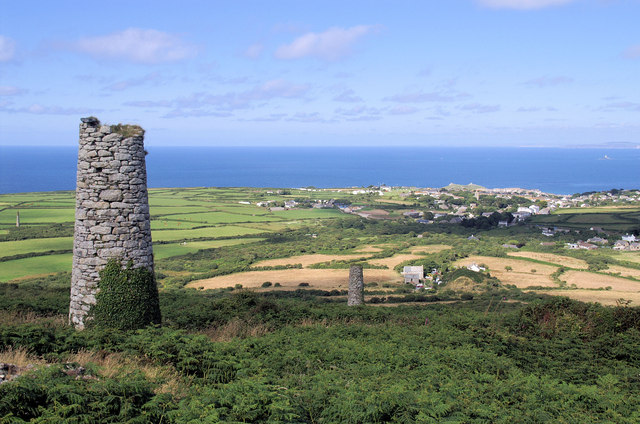
Two chimneys stand on the hillside from the earlier workings: the upper served a 20-inch Boulton and Watt whim sold in 1842, the lower a 36-inch Harvey pumping engine. The overgrown bob wall of the 40-inch engine on Great Ransom shaft remains at the foot of the hill, with the site of a whim and the remains of the stamps below.
Geology
Tin from the Main and Wheal Winze lodes.
Workings
Over a dozen shafts, including New Engine (166 fathoms), Great Ransom (115), Ransom Whim (110) and Praed's or Old Engine (100); a 40-inch pumping engine, 20-inch and 22-inch whims, a 36-inch pumping engine and a 32-inch stamps engine at different dates.
Closure
Closed in 1876 by low tin prices; worked briefly in 1908 within St Ives Consolidated Mines.
What remains
Two chimneys stand on the hill; the engine houses are overgrown with gorse and ivy.
Two engine chimneys, the bob wall of the 40-inch pumping engine on Great Ransom shaft, the remains of a stamps engine house, and shafts.
Redevelopment
Unknown.
Nearby mines
- Giew Mine — 1.3 miles (2.2 km) S
- Rosevale Mine — 1.6 miles (2.6 km) W
- Gurnard's Head Mine — 3.8 miles (6.2 km) W
- Ding Dong Mine — 4.9 miles (7.8 km) SW
- Carn Galver Mine — 5.1 miles (8.1 km) SW
Straight-line distance, within 9 miles (15 km). Show on the map.
What's uncertain
Points where sources disagree or the record could not be settled; both accounts are kept. All open questions in the archive.
- Worked continually from 1761 to 1811 to a depth of 132 fathoms below the adit. (disputed) 1
- By 1811 the mine had reached 321 fathoms below adit; work stopped in 1817 because of mounting debts. (disputed) 2
Recorded claims
Individual factual claims, each attached to the source(s) that support it below. Where sources disagree, both are kept.
- Worked continually from 1761 to 1811 to a depth of 132 fathoms below the adit. (disputed) 1
- By 1811 the mine had reached 321 fathoms below adit; work stopped in 1817 because of mounting debts. (disputed) 2
- Rosewall Hill and Ransom United restarted mining in 1857, and seven years later employed 120 men, 20 women and 30 boys. 1
- Closed in 1876 as tin prices continued to fall. 1,2
- The 40-inch pumping engine on Great Ransom shaft came from Wheal Trenwith in 1857. 2
- Rosewall and Ransom United produced about 1,500 tons of tin; its richest orebodies were left as large empty caverns. 2,3
- Plans of Rosewall Hill and Ransom United and Wheal Gweans in tin ore are dated to abandonment in 1862. 4
Sources
- (secondary) Rosewall Hill Mine — Northern Mine Research Society
- (secondary) Rosewall Hill Mine — Explore Cornwall
- (secondary) St Ives Mining District — Cornish Mine Images
- (primary) BGS mine plan: Rosewall Hill and Ransom United, Wheal Gweans (tin, abandoned 1862) — British Geological Survey
Record created: 17 October 2026 · Last researched: 17 October 2026