 MineArchive
Penrhyn Du Mines
| Also known as | Penrhyn Du Lead Mine, Penrhyndu Mine |
|---|---|
| Location | Penrhyn Du headland, south of Abersoch, Llanengan, Llŷn, Gwynedd — 52.8076, -4.4902 (exact) |
| Commodities | Lead, Copper, Zinc |
| Type | Metal |
| Worked | By 1662–1892 |
| Maximum depth | Unknown. |
Overview
A group of lead, copper and zinc mines on the Penrhyn Du headland south of Abersoch, worked from at least the 1660s to 1892, where a Boulton and Watt pumping engine was set to work in 1780 and a Cornish engine house still stands.
History
The Penrhyn Du mines lie on the black headland (Penrhyn Du) south of Abersoch and east of Llanengan, at the tip of the Llŷn peninsula. They are a group rather than a single working, taking in the Penrhyn, Assheton, Western and Tan-y-Bwlch mines. Roman working has been suggested but not proved, and the medieval workings were said to belong to Cymer Abbey; the first definite record is from 1662, with mining mentioned again in 1668 and 1734. In the mid-18th century the mines were worked by Roe and Company of Macclesfield, the prospectors who went on to find the Parys Mountain lodes on Anglesey.
Being close to the sea, the mines were always fighting water. An order went to Boulton and Watt early in 1779, and a 27-inch pumping engine was at work on 26 August 1780; another engine was put up in 1785 by John Cartwright and three partners. Thomas Pennant wrote in 1781 that the cost of draining had proved greater than the profit, and by 1809-11 all mining had stopped. Cornish adventurers took over in 1828: Williams of Gwennap ran the mines until 1839, and John Taylor is said to have spent £10,000 on improvements by then for only 20 tons of ore. A new find in 1869 began the last revival. Tan-y-Bwlch, worked first for copper and then for lead, was the richest of the group, returning 8,722 tons of lead ore, 450 tons of zinc ore and 4,652 tons of copper ore between 1873 and 1886. The mines closed in 1892, though a last 5 tons of ore are recorded in 1930.
The engine house, built for a Newcomen-type engine and altered in the 19th century for a Boulton and Watt beam engine, is listed Grade II, as is the brick-topped chimney of about 1878 at the neighbouring Llanengan (Porth Neigwl) mine, part of the same group of workings. The headland's mines stood on land of Lord Penrhyn, while the Assheton-Smith family's Vaynol estate held most of the rest of the peninsula and is also recorded as owning the mine in the 19th century.
Geology
Lodes worked first for copper and later for lead, with zinc, manganese and iron also recorded, in rocks running close under the sea at the headland.
Workings
Several mines on the headland, the Penrhyn, Assheton, Western and Tan-y-Bwlch, with shafts drained by steam pumping engines and day levels to the shore.
Closure
Closed with the other Llanengan mines in 1892; a last 5 tons of ore are recorded in 1930.
What remains
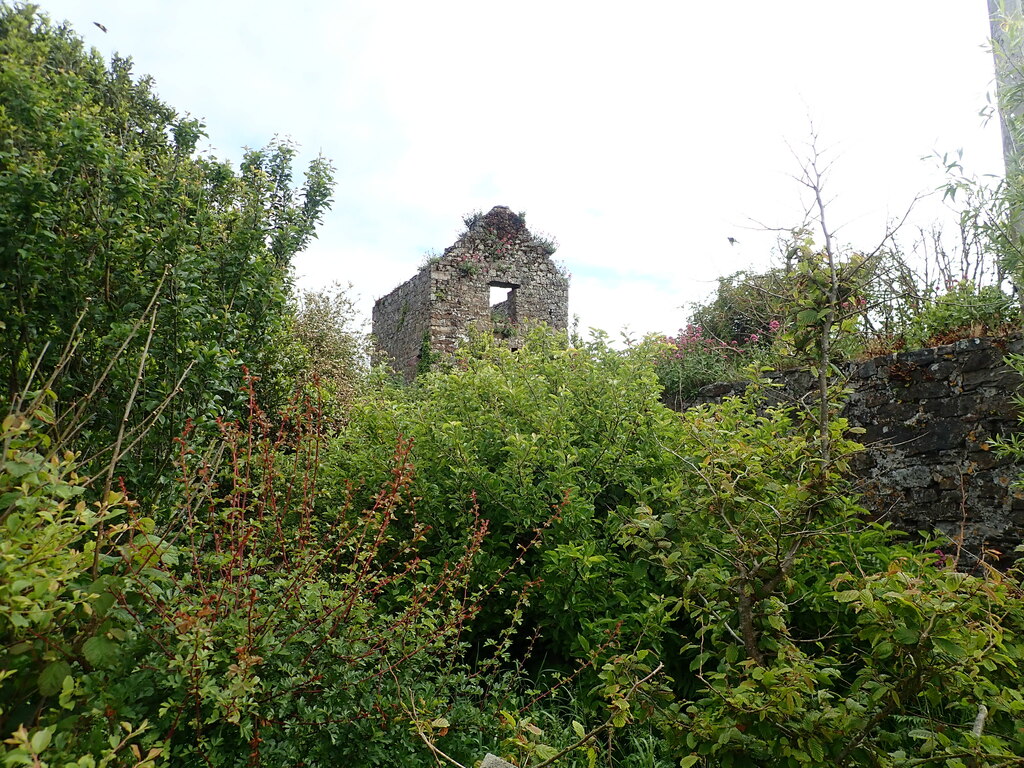
The roofless Cornish engine house stands ruinous among dense vegetation, and the Cornish Row of miners' cottages survives on the headland; later building has covered many of the workings.
The Grade II engine house, Cornish Row, extensive spoil tips, two day levels uncovered in 2018 and the Grade II chimney of the Llanengan (Porth Neigwl) mine nearby.
Redevelopment
Housing and holiday development on and around the headland.
Related mines
- Porth Neigwl Lead Mine — Neighbouring mines on the same Llanengan lead and copper veins, closing together about 1892.
Nearby mines
- Porth Neigwl Lead Mine — 1.8 miles (2.8 km) W
- Benallt Mine — 6.3 miles (10.2 km) W
Straight-line distance, within 9 miles (15 km). Show on the map.
What's uncertain
Points where sources disagree or the record could not be settled; both accounts are kept. All open questions in the archive.
- The land of the Penrhyn Du mine belonged to Lord Penrhyn, while most of the rest of the peninsula belonged to the Vaynol estate. (disputed) 2
- In the 19th century the Penrhyn Du mine was owned by the Assheton-Smith family of Vaynol. (disputed) 4
Recorded claims
Individual factual claims, each attached to the source(s) that support it below. Where sources disagree, both are kept.
- The Penrhyn Du mines near Llanengan include the Penrhyn, Assheton, Western and Tan-y-Bwlch mines. 1
- There is no definite evidence of mining at Penrhyn Du before 1662, though Roman working has been suggested. 1,2
- The engine house held a 27-inch Boulton and Watt pumping engine of 1779. 3
- A Boulton and Watt engine ordered early in 1779 was put to work on 26 August 1780. 1
- Messrs Williams of Gwennap, Cornwall, took over the mine in 1828 and ran it until 1839. 4,2
- Tan-y-Bwlch mine returned 8,722 tons of lead ore, 450 tons of zinc ore and 4,652 tons of copper ore between 1873 and 1886. 1
- After a successful find in 1869 the mines worked until 1892. 4,5,2
- The land of the Penrhyn Du mine belonged to Lord Penrhyn, while most of the rest of the peninsula belonged to the Vaynol estate. (disputed) 2
- In the 19th century the Penrhyn Du mine was owned by the Assheton-Smith family of Vaynol. (disputed) 4
- A plan of the Penrhyn Du lead ore workings is recorded with an abandonment date of 1851. 6
Sources
- (secondary) Penrhyn Du Mines — Wikipedia
- (secondary) Jaggers Heritage, Section 26 (Llŷn) — Jaggers Heritage
- (secondary) Penrhyn Du Lead Mine, Engine House (NPRN 33788) — Coflein (RCAHMW)
- (secondary) Engine house tower by Tower Cottage, Llanengan (Grade II) — British Listed Buildings (Cadw listing text)
- (secondary) Chimney of former Llanengan lead mine (Grade II) — British Listed Buildings (Cadw listing text)
- (primary) BGS mine plans: PENRHYN DU (lead ore, abandoned 1851) — British Geological Survey / Mining Remediation Authority
Record created: 20 October 2026 · Last researched: 20 October 2026