 MineArchive
Gimlet Quarry
| Also known as | Gimblet Rock Quarry, Carreg yr Imbill |
|---|---|
| Location | Pwllheli, Gwynedd — 52.8816, -4.3996 (exact) |
| Commodity | Granite |
| Type | Quarry |
| Worked | by 1886 |
| Operators | Liverpool and Pwllheli Granite Company — Quarried the rock for setts (Wikipedia) John Brundrith (owner) — Proprietor in 1889 (revision court report) |
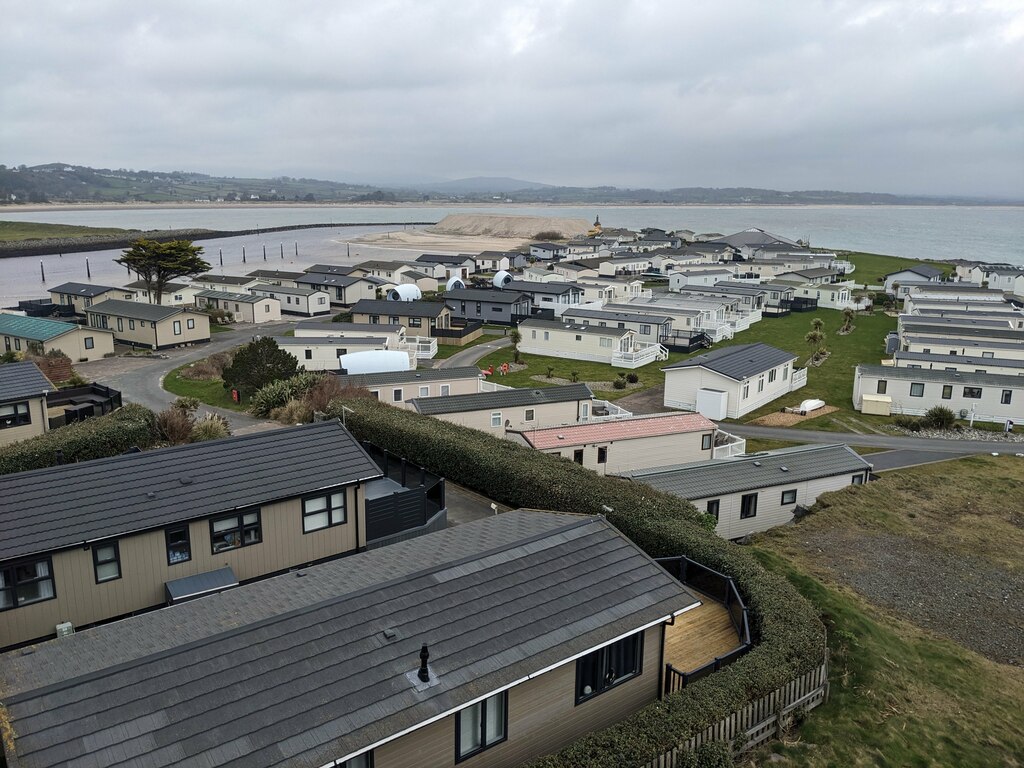
The quarry that cut away most of Carreg yr Imbill (Gimlet Rock) at Pwllheli for paving setts, worked by the Liverpool and Pwllheli Granite Company and now a holiday village.
Location
Recorded location. The large pin is this mine; the small round markers are the nearest mines on record. Click one for its page. View on full map
History
Carreg yr Imbill, Gimlet or Gimblet Rock, stands on the south side of Pwllheli at the entrance to the harbour. It was once a much larger outcrop of dolerite. Most of it was quarried away by the Liverpool and Pwllheli Granite Company for setts to pave the streets, many of them in English towns.
The local papers give glimpses of the quarry at work. In May 1886 a man blasting rock there had his leg broken by a stone from the firing. John Brundrith was its proprietor in 1889, when his vote in the borough was challenged, and at Christmas 1900 the manager gave each workman a present and spoke of the good feeling between employer and men. In 1904 a quarryman was charged by one of the stewards with breaking the quarry's special rules.
The accident returns from 1913 to 1929 record the familiar run of injuries: two sett makers struck by stone from a shot in 1915 after failing to take shelter, four labourers hurt when a wagon left the rails in 1922, a leg broken when a wall gave way in 1923, and a hand and eye injured by gunpowder going off early in 1929. By November 1915, in a slump in the setts trade, only a few men were employed. The worked-out quarry is now the site of a large holiday village.
Geology
Dolerite with pegmatite pods.
Workings
An open quarry in the rock outcrop at the harbour entrance, worked by blasting.
What remains
The worked-out quarry is a holiday village; the remnant of the rock still stands at the harbour entrance.
The remnant of Carreg yr Imbill.
Redevelopment
A holiday village run by the Haulfryn Group.
Nearby mines
- Gwylwyr Quarry — 6.1 miles (9.8 km) NW
- Penrhyn Du Mines — 6.4 miles (10.2 km) SW
- Nant Gwrtheyrn Quarries — 6.8 miles (10.9 km) NW
- Porth Neigwl Lead Mine — 7.3 miles (11.8 km) SW
- Trefor Granite Quarry — 7.3 miles (11.8 km) N
Straight-line distance, within 9 miles (15 km).
Further reading
The rock and its quarry: the Liverpool and Pwllheli Granite Company, setts, and the holiday village on the worked-out site.
View sourceSources
- (secondary) Carreg yr Imbill (Wikipedia) — Wikipedia
- (secondary) North Wales Express, 4 June 1886: Pwllheli, accident at the Gimblet quarry (Welsh Newspapers Online) — Welsh Newspapers Online, National Library of Wales
- (secondary) Carnarvon and Denbigh Herald, 27 September 1889: Revision courts (Welsh Newspapers Online) — Welsh Newspapers Online, National Library of Wales
- (secondary) NMRS deaths and injuries database: Gimlet Quarry, 1915 — Northern Mine Research Society
- (secondary) North Wales Chronicle, 12 November 1915: South Carnarvon setts industry (Welsh Newspapers Online) — Welsh Newspapers Online, National Library of Wales
- (observational) Trwyn Carreg (Gimblet Rock) caravan site (Geograph) — Geograph
- (secondary) Cambrian News, 7 October 1904: Pwllheli (Welsh Newspapers Online) — Welsh Newspapers Online, National Library of Wales
- (secondary) NMRS deaths and injuries database: Gimlet Quarry, 1922 — Northern Mine Research Society
- (secondary) NMRS deaths and injuries database: Gimlet Quarry, 1929 — Northern Mine Research Society
- (secondary) North Wales Express, 4 January 1901: Pwllheli, Gimblet Rock (Welsh Newspapers Online) — Welsh Newspapers Online, National Library of Wales
Record created: 20 November 2026 · Last researched: 20 November 2026