 MineArchive
Pennant Mine
| Location | Rhuallt, Denbighshire — 53.2677, -3.3719 (exact) |
|---|---|
| Commodities | Lead, Barite, Silver |
| Type | Metal |
| Worked | Early 18th century–1920 |
| Operators | Pennant Lead and Barytes Company (?–1888, lessee) — Lease taken over from a group of gentlemen to whom General Wynne had let the land; in liquidation by 1888. |
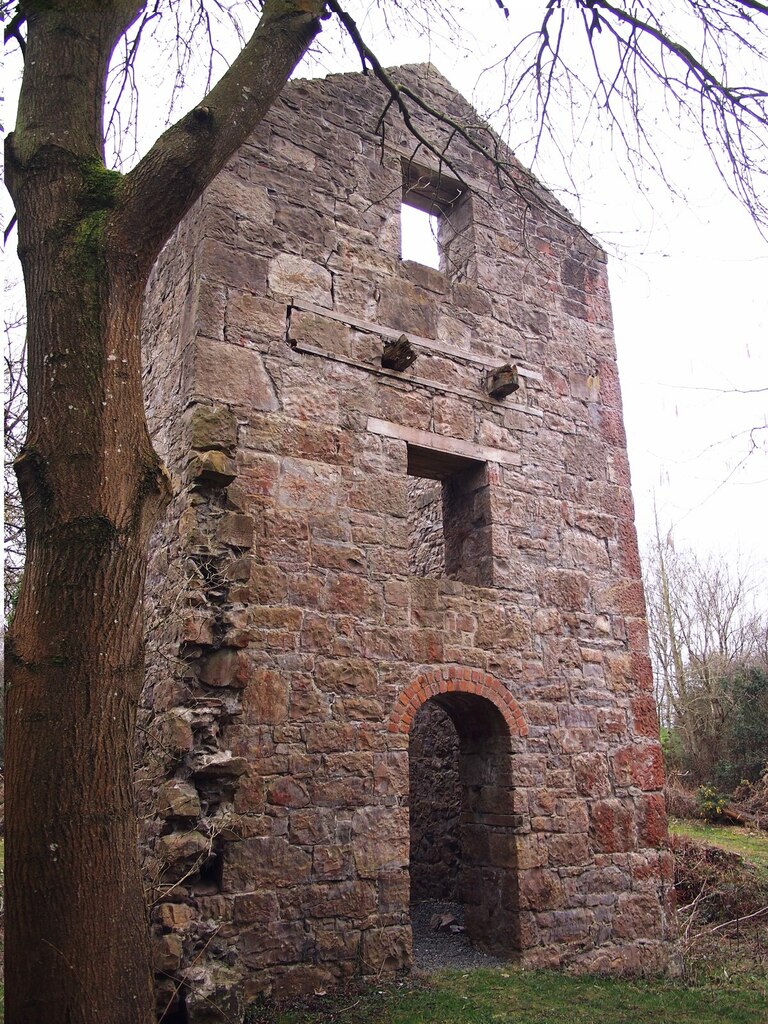
Pennant Mine was a lead, silver and barytes mine at Rhuallt near Tremeirchion, worked from the early 18th century until 1920. Its Cornish engine house still stands to full height.
Location
Recorded location. The large pin is this mine; the small round markers are the nearest mines on record. Click one for its page. View on full map
History
Pennant Mine worked an east-west vein in the Silurian shales on the hillside above the Rhuallt road, near Tremeirchion and about three miles from St Asaph. It was worked from at least the early 18th century, and 19th-century returns show it producing lead, silver and barytes with a considerable workforce.
In April 1860 a newspaper writer went down it with the captain, called only Mr M-, riding a kibble 20 yards down the shaft to a new discovery where the lode was solid lead two to two and a half feet wide; he called it a lead mine, "not a large one either", which was honest of him. By 1871 the old Whim Shaft had been deepened to become the main Engine Shaft, worked by a 30-inch Cornish pumping engine with a 30-foot boiler, and in January that year the engine, boiler, capstan, pumps, a 12-inch beam engine and the office furniture were advertised for auction on the instructions of the company. The mine carried on regardless. In 1873 tenders were invited for driving a level of 200 to 250 yards, in 1882 the workmen gave a timepiece to a bridegroom whose wedding breakfast was at Pennant View, and in 1883, under Captain Kemp, the 40-yard level was being driven west after lead with sulphate of barytes while the dressing floors were busy.
By 1888 the lessees, the Pennant Lead and Barytes Company, had gone into liquidation, and the inspector of mines prosecuted the landowner, General Wynne, for leaving two or three disused shafts unfenced. The mine is recorded as closing in 1891. It reopened in 1913 for barium minerals, with a concrete mill that separated barytes from zinc ore by roasting, and was abandoned in 1920.
Geology
An east-west vein in Silurian rocks and Wenlock shales, carrying lead with silver, and barytes.
Workings
A deep, square, stone-lined Engine Shaft south of the engine house, the New Engine Shaft with an iron A-frame of the pumping gear, and a line of collapsed shafts and trials to the west. An incline carried ore down to dressing floors by an old adit level, with a crusher house beyond.
Closure
Closed in 1891 after the lessees' liquidation; reopened in 1913 for barytes and abandoned in 1920.
What remains
The three-storey Cornish engine house stands to its full height and gable, with its cylinder base inside; the boiler house has gone and the chimney survives only to about a metre. The incline is overgrown.
The engine house, the chimney base, shafts, the concrete bases of the 20th-century barytes mill and jigs with mounting bolts, air-receiver platforms with a cast-iron receiver in place, a concrete cistern, the crusher house with its crushing wheel, and the stone cottage that was the mine office.
Redevelopment
The ore bins and picking floors are lost under the old lane.
Nearby mines
- Meliden Lead Mines — 3.1 miles (5.0 km) NW
- Talargoch Mine — 3.3 miles (5.3 km) NW, Flintshire
- Axton Mine — 3.5 miles (5.6 km) NE, Flintshire
- Lloc Mine — 3.7 miles (6.0 km) E, Flintshire
- Fish Mine — 3.8 miles (6.1 km) N
Straight-line distance, within 9 miles (15 km).
Further reading
The trust's field survey of the Pennant workings, engine house and the 20th-century barytes mill.
View sourceSources
- (secondary) Clwyd Metal Mines Survey: Pennant (HER 102766) — Clwyd-Powys Archaeological Trust, Clwyd Metal Mines Survey
- (secondary) Two hours under ground (North Wales Chronicle, 28 April 1860) — Welsh Newspapers Online (National Library of Wales)
- (secondary) Sale by Messrs Churton and Elphick: machinery at the Pennant Lead Mine near St Asaph (Wrexham Advertiser, 14 January 1871) — Welsh Newspapers Online (National Library of Wales)
- (secondary) Advertising: Pennant Mine, Rhuallt, tenders for driving a level (Baner ac Amserau Cymru, 16 April 1873) — Welsh Newspapers Online (National Library of Wales)
- (secondary) Metals and mining: local lead mines, Pennant (Flintshire Observer, 21 June 1883) — Welsh Newspapers Online (National Library of Wales)
- (secondary) St Asaph Petty Sessions: neglecting to fence off an abandoned mine (Rhyl Record and Advertiser, 9 June 1888) — Welsh Newspapers Online (National Library of Wales)
- (primary) Pennant Mine Engine House (NPRN 33692) — Coflein (RCAHMW)
- (primary) Mine plan: Pennant, lead ore (MRA OM15237) — British Geological Survey / Mining Remediation Authority
- (secondary) Tremeirchion: wedding; a timepiece from the workmen at Pennant Mine (Flintshire Observer, 14 April 1882) — Welsh Newspapers Online (National Library of Wales)
Record created: 21 November 2026 · Last researched: 21 November 2026