 MineArchive
North Steelend Colliery
| Location | Steelend, Saline parish, near Dunfermline, Fife — 56.1146, -3.5519 (approximate) |
|---|---|
| Commodity | Coal |
| Type | Coal |
| Worked | By 1880–1896 (colliery) |
| Maximum depth | Unknown. |
| Operators | Steel End Coal Co. (?–1896), James Payne (1957–1965) |
Overview
Two coal workings of the same name on the hillside north of the West Fife mining village of Steelend, in Saline parish. A North Steel End colliery of the Steel End Coal Company was at work in 1880 and its Gas and Upper Eight Feet seams were abandoned in 1896. Sixty years later James Payne, a Steelend miner invalided out of Comrie Colliery with pneumoconiosis, took a licence and opened a private mine of the same name on the south-east side of Knockhill near Din Moss, worked by five men from 1957 to 1965 and described by the Dunfermline Press as probably the smallest coalmine in Scotland. Whether the two used the same ground is not established.
History
Steelend grew up as a mining village between Saline and Kelty, served by a goods station on the West of Fife Mineral Railway that handled the Sunnybraes, Saline Valley, Killernie and North Steelend collieries; the Steelend blackband ironstone was being worked on William Smith Sligo's land by 1873. The 1880 official return lists North Steel End, Saline, under the Steel End Coal Co., and the national mine-plans catalogue holds a North Steelend abandonment plan for the Gas and Upper Eight Feet seams dated 1896; nothing more is known about this Victorian pit. In the early twentieth century the Wilsons and Clyde Coal Company worked the Lethans collieries north of Knockhill and at Steelend, abandoned in 1933 and 1938. James Payne, son of a Steelend quarry master, went to work at twelve in 1919 driving a pithead pony at the Steelend colliery, worked underground there until it closed before the Second World War, and after spells at Herbertshire and a private mine at Bonhard demonstrated the Duckbill power loader at Comrie Colliery, the first American mining machine used in Scotland, before pneumoconiosis forced him out at 52. He applied for a licence to mine coal privately and in 1957 opened North Steelend on the south-east side of Knockhill near Din Moss: a diesel compressor drove the boring machines and a haulage motor brought the coal to a small screening plant, five men including his son John and William Wallace of Saline worked it, and in the first year six tons a day came up from the Smithy seam, sold direct to households around Dollar and Airth with the dross going to schools in Alloa. The returns give four men underground and one on the surface in 1959 and 1964, raising household and industrial coals and sulphur, with A. Moffat as manager in 1959. The BBC filmed a scene of Dr Finlay's Casebook at the mine, a small boy supposedly trapped underground. It closed in 1965, and the catalogue holds a North Steelend abandonment plan dated 1964.
Geology
The Steelend pits worked the Limestone Coal Group and Lower Coal Measures on the northern rim of the West Fife coalfield, where the Gas, Upper Eight Feet, Smithy and Splint coals lie in sedimentary beds with the Steelend blackband ironstone, and the seams are cut off to the north of Lethans by a large fault. The 1964 plan tentatively names the Lochgelly Splint.
Geological setting: Faults and Fractures (historical documentary reference), Sedimentary Beds and Seams (well documented example)
Workings
The Victorian colliery is known only from its 1880 return and 1896 abandonment plan. Payne's mine of 1957-65 was a small licensed drift on the hillside with a diesel compressor, pneumatic boring machines, a haulage motor and a screening plant at the entrance, worked by five men.
Closure
The Victorian pit's Gas and Upper Eight Feet workings were abandoned in 1896. James Payne's private mine closed in 1965, with an abandonment plan dated 1964; no reason is recorded beyond the scale of the working.
What remains
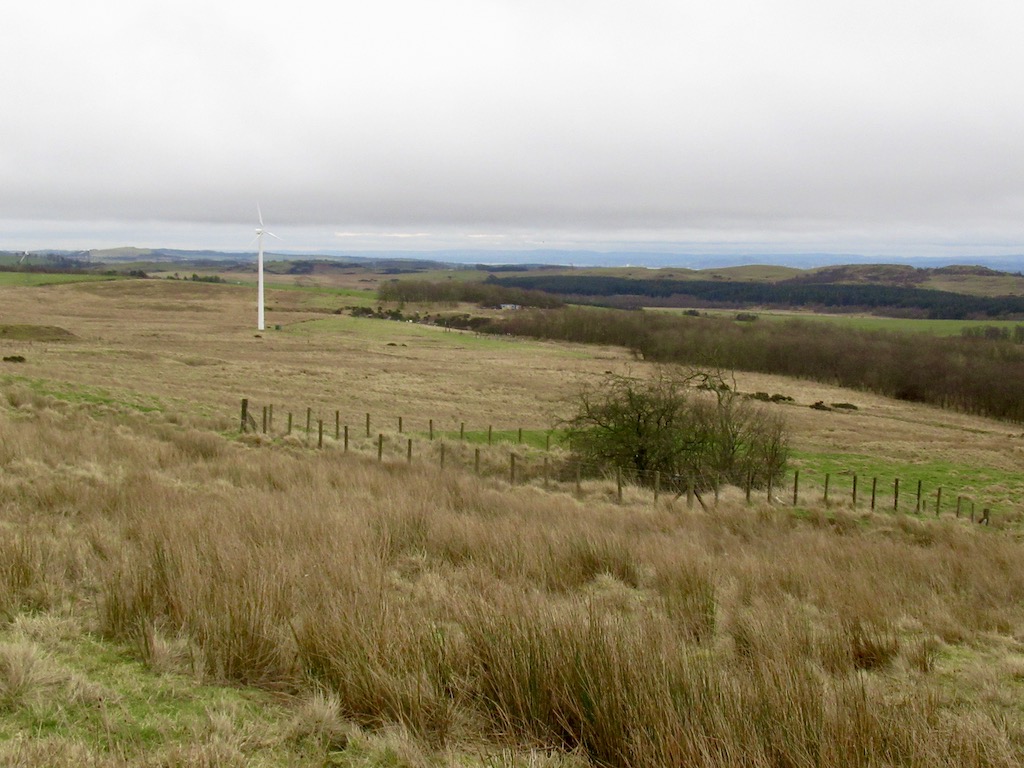
Fenced old mineshafts and a ruin stand on the hillside north-east of Steelend, photographed in February 2022, though none can be identified as North Steelend's own; the village keeps its Miners' Welfare Club and had a Steelend Victoria football club until 2013.
Fenced shafts and a ruined building on the hillside above the village, not identified as this working's.
Related mines
- Saline Valley Colliery — Fife Pits' abandonment plans treat 'Steelend North or Dean Valley' as part of the Sunnybraes or Saline Valley workings, and the Dean Valley name was given to the Saline Valley Colliery's 1929 redevelopment.
Nearby mines
- Saline Valley Colliery — 0.5 miles (0.7 km) E
- Oakley Colliery — 1.1 miles (1.8 km) S
- Comrie Colliery — 2.1 miles (3.4 km) SW
- Isle of Canty Colliery — 2.8 miles (4.5 km) SE
- Blairhall Colliery — 3.1 miles (5.0 km) SW
Straight-line distance, within 9 miles (15 km). Show on the map.
Recorded claims
Individual factual claims, each attached to the source(s) that support it below. Where sources disagree, both are kept.
- The 1880 official list gives North Steel End, Saline, under the Steel End Coal Co. 1
- A North Steelend abandonment plan for the Gas and Upper Eight Feet seams is dated 1896. 2
- James Payne opened North Steelend as a licensed private mine in 1957 on the south-east side of Knockhill near Din Moss; it worked household and industrial coals until 1965. 3,4
- Four men worked underground and one on the surface in 1959 and 1964, with A. Moffat as manager in 1959; in its first year six tons a day came from the Smithy seam. 3,4
- The Dunfermline Press described North Steelend as probably the smallest coalmine in Scotland. 4
- The BBC shot a scene of Dr Finlay's Casebook at the mine, about a small boy supposedly trapped underground. 3,4
- The mine-plans catalogue holds a North Steelend abandonment plan dated 1964. 5
- Steelend's goods station on the West of Fife Mineral Railway served the Sunnybraes, Saline Valley, Killernie and North Steelend collieries. 6
- The Wilsons and Clyde Coal Company's Lethans No. 1 and No. 2 collieries, north of Knockhill and at Steelend, were abandoned in 1933 and their surface mine in 1938. 7
Photographs & further reading
The returns for the 1957-65 private mine and the story of James Payne, its owner.
View sourceThe village, its railway station and the collieries it served.
View sourceSources
- (secondary) List of coal mines UK 1880 — Coalmining History Resource Centre
- (primary) North Steelend abandonment plan: Gas and Upper Eight Feet seams, 1896 (mine plans catalogue) — British Geological Survey / Mining Remediation Authority
- (secondary) Pit-N-4. North Steelend Mine — Fife Pits and Memorial Book (Michael Martin)
- (secondary) The Story of a Steelend Miner — Fife Pits and Memorial Book (Michael Martin)
- (primary) North Steelend abandonment plan, 1964 (mine plans catalogue) — British Geological Survey / Mining Remediation Authority
- (secondary) Steelend — Wikipedia
- (secondary) Pit-L-9. Lethans No. 1 & No. 2 Collieries — Fife Pits and Memorial Book (Michael Martin)
Record created: 6 September 2026 · Last researched: 9 September 2026