 MineArchive
North Laxey Mine
| Also known as | North Great Laxey Mine, East Snaefell Mine |
|---|---|
| Location | Head of the Cornaa valley, Maughold, Isle of Man — 54.2724, -4.4156 (approximate) |
| Commodities | Lead, Silver, Zinc |
| Type | Metal |
| Worked | 1856–1897 |
| Maximum depth | A main shaft recorded as 171 fathoms. |
| Operators | North Laxey and Glencherry Consols Silver Lead Mining Co. Ltd. |
Overview
North Laxey was a lead, zinc and silver mine at the head of the Cornaa valley in Maughold, worked from 1856 to 1897. It is also recorded as East Snaefell and North Great Laxey, and it began as a portion of the Great Laxey Mining Company's ground. Its remains are among the most significant on the Island: an excellently preserved processing area survives, and the mine's dressing floor is the reason the site matters now rather than anything it produced.
History
By the mid-1850s the Great Laxey Mine was the parent of several smaller ventures on the surrounding ground, and North Laxey was one of them. It worked from 1856 for lead, zinc and silver at the head of the Cornaa valley, under the shoulder of North Barrule, and is recorded in the Manx mining literature under three names — North Laxey, North Great Laxey and East Snaefell.
The mine's working life ended in 1897. It appears in the statutory return of 1902 only as a shell: the List of Mines under the Metalliferous Mines Act enters North Laxey at Maughold, Ramsey, with the North Laxey and Glencherry Consols Silver Lead Mining Company Limited of Bank Chambers, Douglas — in liquidation — as owner, J. Corlett as agent, and a single man employed at surface. That is the last position this record can document, and it is a caretaker's job rather than a mine.
The main shaft is recorded at 171 fathoms, and very significant remains survive on the ground, including an unusually complete processing area.
Geology
The Manx orefield carried lead with zinc and silver in steep veins cutting the Manx Slates, and the ground at the head of the Cornaa valley is part of the same mineralised belt that made Great Laxey one of the richest lead and zinc mines in the British Isles. Silver here is not a separate ore but a component of the galena, which is argentiferous across much of the Island — the reason the company that held this sett had 'Silver Lead' in its name. No source names the vein North Laxey was following or gives its width or dip.
Geological setting: Veins and Lodes (historical documentary reference)
Workings
A main shaft recorded at 171 fathoms, with a processing area at surface that survives in unusually good condition — significant enough that the site is noted for its remains rather than for its output. Nothing on record describes the levels, the method of working underground, or how the mine was drained.
Closure
The mine finished in 1897. By the time of the 1902 return its owning company was in liquidation and it employed one man at surface. No source gives a reason, but the pattern is the ordinary one for Manx metal mining at the end of the century: lead prices had collapsed against cheap imported ore and the smaller setts around Great Laxey went first.
What remains
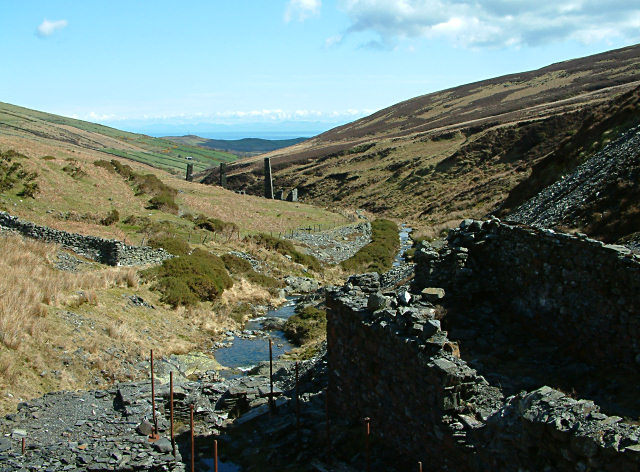
Very significant remains survive, including an excellently preserved processing area. The upper Cornaa valley is open hill ground below North Barrule, and the former mine workings there have been photographed from the valley.
An excellently preserved processing area — the dressing floor and its associated structures — together with the other workings at the head of the valley.
Nearby mines
- Snaefell Mine — 2.0 miles (3.2 km) W
- Great Laxey Mine — 2.3 miles (3.6 km) S
- Elerslie Mine — 7.1 miles (11.5 km) SW
- Beckwith Mine — 9.3 miles (15.0 km) SW
Straight-line distance, within 9 miles (15 km). Show on the map.
Recorded claims
Individual factual claims, each attached to the source(s) that support it below. Where sources disagree, both are kept.
- East Snaefell, also known as North Laxey and North Great Laxey, was a lead, zinc and silver mine worked from 1856 to 1897 at the head of the Cornaa valley, with very significant remains at SC 428 890, a main shaft to 171 fathoms and an excellently preserved processing area. 1
- The 1902 List of Mines records North Laxey at Maughold, Ramsey, owned by the North Laxey and Glencherry Consols Silver Lead Mining Co. Ltd. of Bank Chambers, Douglas, in liquidation, with J. Corlett as agent and one man employed at surface. 2
- Former mine workings survive in the upper Cornaa valley below North Barrule. 3
Photographs & further reading
A site-by-site list of Manx mines with dates, grid references and what survives at each — the entry for this mine gives its three names, its 1856-97 working life and the preserved processing area.
View sourceSources
- (secondary) Industries — Mines, Quarrying & Extraction — Manx Environmental Records / MERS
- (primary) 1902 List of Mines under the Metalliferous Mines Act: Isle of Man — Durham Mining Museum
- (observational) Upper Cornaa Valley, Isle of Man (photograph) — Geograph Britain and Ireland
Record created: 5 September 2026 · Last researched: 5 September 2026