 MineArchive
Nine Mile Point Colliery
| Also known as | Coronation Colliery |
|---|---|
| Location | Cwmfelinfach, Caerphilly — 51.6156, -3.1674 (exact) |
| Commodity | Coal |
| Type | Coal |
| Worked | 1902 (sinking)–25 July 1964 |
| Maximum depth | c. 394 yards (West and East Pits); Rock Vein Pit c. 200-203 yards |
| Operators | Burnyeat, Brown and Company (1902–1905), Ocean Coal Company |
Overview
A steam-coal colliery sunk 1902-05 at Cwmfelinfach in the Sirhowy valley, originally named Coronation Colliery. Seven men died in a rockfall during sinking in 1904, and in October 1935 it was the site of one of the first 'stay-down' strikes in the South Wales coalfield, when men refused to leave the pit in protest at non-federation labour. It closed in 1964; the site is now an industrial estate.
History
Sinking of the colliery's shafts began in July 1902 under contractors Burnyeat, Brown and Company; the pit was first named Coronation Colliery, and only later took the name Nine Mile Point, after the distance of its tramroad from the edge of Lord Tredegar's Newport boundary. Sinking was completed by 1905. Seven men were killed in a rockfall during the sinking work in August 1904 — see Disasters, below.
The colliery worked the Five Feet, Black Vein, Lower Black Vein and Big Vein seams from its West and East Pits, with a third shaft, the Rock Vein Pit, sunk in 1908 to work the Rock Vein seam separately. Employment grew steadily through the Edwardian and First World War years, from 1,137 men in 1908 to a peak of around 2,105 in 1913, and stood at 2,236 in 1923 (958 at the East pit, 656 at the West, 622 at the Rock Vein pit). By the time of nationalisation in 1947 the workforce had fallen to 1,261 men.
In October 1935 the colliery, then run by the Ocean Coal Company, became the scene of one of the first stay-down strikes in the South Wales coalfield. The South Wales Miners' Federation had struck on 28 September 1935 over the company's employment of non-federation men recruited from the unemployed, undercutting wages, but called the strike off after nine days without a resolution. On 12 October around 74 men at the West Pit spontaneously refused to come to the surface; sympathetic stay-down strikes followed at the Rock Vein and East pits, bringing the total to around 164 men underground. The contemporary socialist writer C. L. R. James, who visited South Wales that autumn, reported the action lasting some 177 hours and described it as a genuinely spontaneous rank-and-file tactic rather than one directed by the Federation leadership. Management conceded the men's core demand — that no non-federation men would be employed and no striker victimised — though the company simultaneously served notice that it intended to close the colliery; in the event Nine Mile Point continued working for almost another three decades. A further, shorter stay-down strike over the removal of an official is recorded in May 1945.
A serious labour disturbance is also recorded in the colliery's earlier history, though sources disagree on its date: one account places it in 1922, when the colliery manager was confronted over attempted wage cuts and sixteen miners were arrested; another places a similar confrontation, involving several hundred men, in 1929. The two may be the same event misdated by one source, or two distinct incidents — this is recorded here as an unresolved discrepancy rather than settled fact.
The colliery later saw genuine technical distinction: in January 1965 it became the first colliery in South Wales to install a remotely operated coalface. That milestone came only months before closure, however — Nine Mile Point closed on 25 July 1964 [sic: the ROLF installation and closure dates as reported by the sources sit awkwardly close together and are recorded here exactly as given, without attempting to resolve the apparent sequencing]. The site was later cleared and redeveloped as an industrial estate.
Geology
Coal of the South Wales field: the Five Feet, Black Vein, Lower Black Vein and Big Vein seams.
Workings
West Pit (upcast) and East Pit (downcast) were sunk to around 394 yards depth to reach the steam coal seams; the separate Rock Vein Pit, sunk in 1908, worked the Rock Vein seam at roughly 200-203 yards. The BGS/Coal Authority mine plans catalogue for the colliery instead names the seams worked as the Lower Black (Five Feet and Gellideg), Meadow (Yard/Seven Feet), Black (Nine Feet) and Big (Six Feet) — a different naming convention from the Five Feet/Black Vein/Big Vein/Rock Vein names given by mining-history secondary sources, most likely reflecting regional seam-naming variation rather than a genuine conflict over what was worked. The Rock Vein Pit closed in 1954, a decade before the rest of the colliery.
Closure
Unknown.
What remains
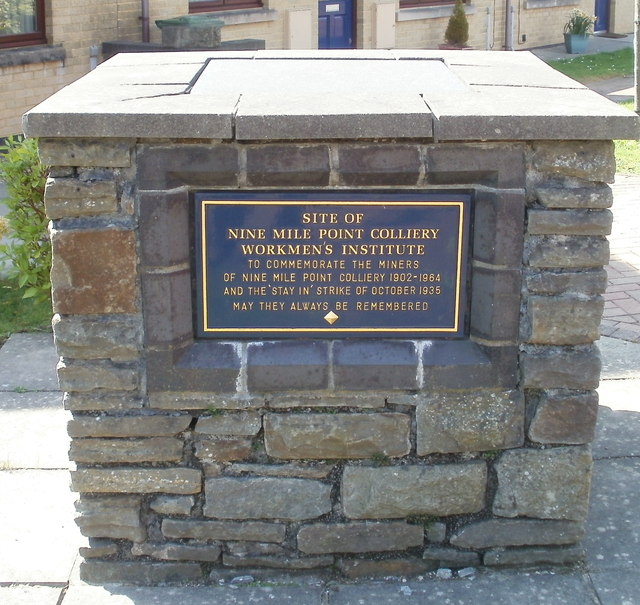
The colliery has been fully demolished and the site redeveloped as an industrial estate. A memorial plaque recording the site of the colliery's Workmen's Institute survives nearby in Cwmfelinfach/Ynysddu.
Related mines
- Lletty Shenkin Colliery — Both were held by Burnyeat, Brown and Company: the Liverpool and Whitehaven consortium bought Lletty Shenkin in the 1870s and sank Nine Mile Point in the Sirhowy valley from 1902.
Nearby mines
- Black Vein Colliery — 1.2 miles (2.0 km) E
- Bedwas Navigation Colliery — 1.5 miles (2.4 km) SW
- Machen Colliery — 1.8 miles (2.9 km) SE
- Wyllie Colliery — 1.9 miles (3.0 km) NW
- Gelligroes Colliery — 2.4 miles (3.8 km) NW
Straight-line distance, within 9 miles (15 km). Show on the map.
Disasters & major incidents
-
Nine Mile Point Colliery sinking rockfall
August 1904 · Collapse / Roof Fall · 7 fatalities
Twenty-six men were buried when a rockfall struck the workings during the sinking of Nine Mile Point's shafts in August 1904; seven were killed.
What's uncertain
Points where sources disagree or the record could not be settled; both accounts are kept. All open questions in the archive.
- Sources disagree on the date of an earlier serious labour disturbance at the colliery: one places it in 1922 (colliery manager confronted over wage cuts, sixteen miners arrested), another in 1929 (several hundred villagers and miners involved in disorder over blackleg labour). The two accounts may describe different events. (disputed) 3,2
Recorded claims
Individual factual claims, each attached to the source(s) that support it below. Where sources disagree, both are kept.
- Shaft sinking began July 1902 under contractors Burnyeat, Brown and Company; the colliery was originally named Coronation Colliery and completed sinking by 1905. 1,2
- Employment rose from 1,137 men in 1908 to a peak of around 2,105 in 1913, stood at 2,236 in 1923, and had fallen to 1,261 men by nationalisation in 1947. 1,2
- Around 164 men across the West, East and Rock Vein pits staged a stay-down strike beginning 12 October 1935, reported as lasting about 177 hours, after a company strike over non-federation labour was called off; it is widely described as one of the first stay-down strikes in the South Wales coalfield. 3,1,4
- Sources disagree on the date of an earlier serious labour disturbance at the colliery: one places it in 1922 (colliery manager confronted over wage cuts, sixteen miners arrested), another in 1929 (several hundred villagers and miners involved in disorder over blackleg labour). The two accounts may describe different events. (disputed) 3,2
- The colliery closed on 25 July 1964; the Rock Vein Pit had already closed separately in 1954. 1,2
- The BGS/Coal Authority mine plans catalogue holds records for Nine Mile Point covering the Lower Black, Meadow, Black and Big seams plus a Big Rock Shaft section, catalogued as 1974 Mining Remediation Authority abandonment plans. 5
Sources
- (secondary) Nine Mile Point, Cwmfelinfach — welshcoalmines.co.uk
- (secondary) Nine Mile Point Colliery — Northern Mine Research Society
- (secondary) Nine Mile Point Colliery — Wikipedia
- (primary) How the Miners Could Win an Increase — What I Learned in Wales — C. L. R. James, November 1935 (contemporary published account)
- (primary) Nine Mile Point mine plan records — British Geological Survey / Coal Authority mine plans catalogue
Record created: 26 August 2026 · Last researched: 26 August 2026