 MineArchive
Nine Mile Point Colliery sinking rockfall
Twenty-six men were buried when a rockfall struck the workings during the sinking of Nine Mile Point's shafts in August 1904; seven were killed.
| Date | 13 August 1904 |
|---|---|
| Mine | Nine Mile Point Colliery |
| Region | Caerphilly |
| Type | Collapse / Roof Fall |
| Fatalities | 7 (Seven men killed: William Everson (24), Jack Gabb (21), Sam Gladwin, William James (28), Joseph Norman (36), Thomas Richards (47) and William Rideout (30).) |
| Context | During active mining (Occurred during shaft-sinking, before the colliery had reached production (first coal was not raised until 1905).) |
Location
Plotted at Nine Mile Point Colliery. Recorded location. The large pin is the mine; the small round markers are the nearest mines on record. Click one for its page. View on full map
Cause
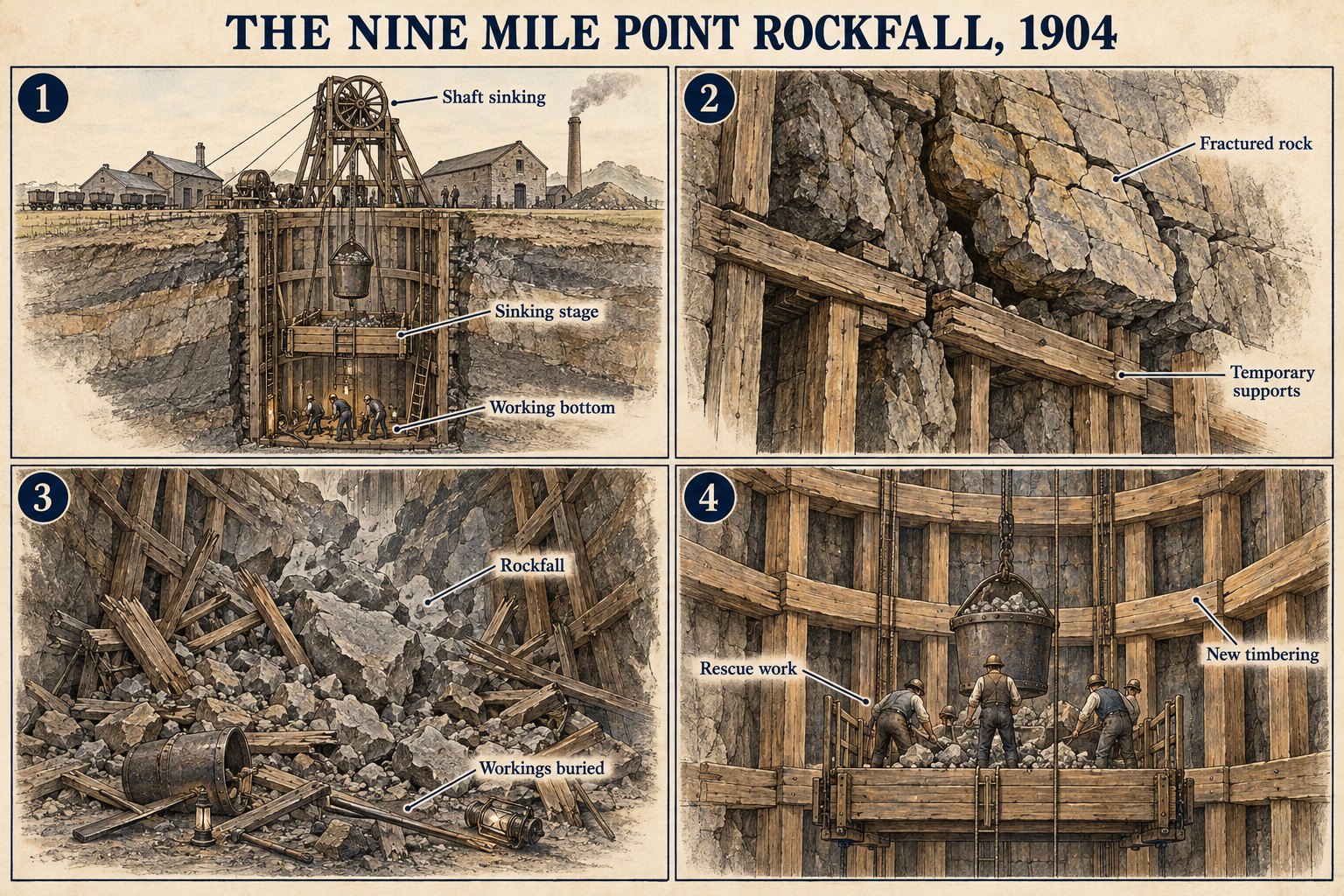
A fall of the shaft side during sinking: the weakest side, bad ground on a fault that had been bricked up and thought safe, gave way without warning and brought down the last length of walling. The foreman sinker also blamed water loosening the earth and gas from a four-foot coal seam.
What happened
Twenty-six men were buried by the fall; seven of them died. The colliery would not reach full production for another year. The pits were then known only as the New Sinkings, Ynysddu, being sunk by direct labour for Burnyeat, Brown and Co. Ltd of Cardiff under the manager Mitchell Falcon, with Thomas Braithwaite as engineer and John Belch as foreman sinker; sinking had begun in June 1902, the west pit was down 172 yards and bricked except for the last few yards, and the Black Vein was expected about the end of the year. At about ten minutes to six on the evening of Saturday 13 August, as the shift in the west pit was preparing a bed for the next length of walling, one side of the shaft gave way and the whole of the last length of brickwork, some thirteen feet of it, came down on the men. Contemporary reports put seventeen men in the pit; the colliery's own later account gives twenty-six. One man, Matthew Smith from Durham, was on the bowk as it rose and climbed its chain clear of the fall; he raised the alarm at the top. Falcon went down with about a dozen volunteers from the east pit and worked for more than an hour freeing men pinned under the broken curb. At about ten to eight clay began to fall and the brickwork moved; the rescuers were a wooden stay away from freeing Jack Gabb when they had to leap into the bowk, and the second fall, of several hundred tons, buried the seven men still below as the bowk rose through it. Nothing more was heard from them.
Rescue & recovery
The first fall left most of the men wedged under the ruined side rather than crushed, and the rescue party, led by Falcon with Griffith Griffiths, Arthur Pope, John Belch and others, had freed all but a few when the second fall drove them out. The injured lay in the sinkers' corrugated-iron huts below the winding house; Martin Jones of Llanelli had two ribs broken, the rest were bruised. The walling kept giving way, and from the Sunday night the sinkers filled the shaft with ashes brought from the North Risca pit, to stand on while they rebuilt the wall before they could dig again. The first body was recovered at ten on the morning of Monday 29 August and the last by two that afternoon.
Investigation & inquiry
The South Monmouthshire coroner opened the inquest at the Co-operative Hall, Cross Keys, on 30 August 1904. Falcon said the ground on one side was known to be a little risky and had been propped and bricked at shorter intervals than usual; shots fired at noon had not, he thought, weakened it. The sinkers David Jones and Evan Jones and the engineer Braithwaite found no fault with anyone. The coroner saw no trace of negligence, and the jury returned a verdict of accidental death with no blame attached.
Recorded claims
Individual factual claims, each attached to the source(s) that support it below. Where sources disagree, both are kept.
- Twenty-six men were buried by the fall; seven were killed, named as William Everson (24), Jack Gabb (21), Sam Gladwin, William James (28), Joseph Norman (36), Thomas Richards (47) and William Rideout (30). 1
- The fall came at about 5.50 p.m. on Saturday 13 August 1904 in the west pit of Burnyeat, Brown and Co.'s new sinking at Ynysddu, begun in June 1902 and then 172 yards deep. 2,3
- Contemporary newspaper reports put seventeen men in the west pit when it fell, seven of whom died. 2,3
- Matthew Smith of Durham, on the rising bowk, climbed its chain clear of the fall and gave the alarm at the surface. 2
- A second fall at about 7.50 p.m. drove the rescuers into the bowk as they were about to free Jack Gabb, and buried the seven men still below. 4,3
- The shaft was filled with ashes from the North Risca pit so the walling could be rebuilt; the bodies were recovered on Monday 29 August, the first at 10 a.m. and the last by 2 p.m. 4,5,3
- The inquest at Cross Keys on 30 August returned accidental death, the coroner finding no trace of negligence. 3
Related terminology
Mining terms this disaster is structurally linked to, with the nature of the relationship.
- Coal Seam (contextual relationship)
Named in this record’s cause: “…also blamed water loosening the earth and gas from a four-foot coal seam.” - Fault (contextual relationship)
Named in this record’s cause: “…of the shaft side during sinking: the weakest side, bad ground on a fault that had been bricked up and thought safe, gave way without warning…” - Kibble (contextual relationship)
Named 3 times in this record, first in the narrative: “…gives twenty-six. One man, Matthew Smith from Durham, was on the bowk as it rose and climbed its chain clear of the fall; he raised the…” - Shaft Sinking (contextual relationship)
Named in this record’s summary: “…men were buried when a rockfall struck the workings during the sinking of Nine Mile Point's shafts in August 1904; seven were killed.” - Winding Engine (contextual relationship)
Named in this record’s rescue and recovery: “…out. The injured lay in the sinkers' corrugated-iron huts below the winding house; Martin Jones of Llanelli had two ribs broken, the rest were…”
Sources
- (secondary) Nine Mile Point, Cwmfelinfach — welshcoalmines.co.uk
- (secondary) Weekly Mail, 20 August 1904: Disaster at Ynysddu: pit shaft gives way: seven men buried in debris — Weekly Mail (Welsh Newspapers Online, National Library of Wales)
- (secondary) Evening Express, 31 August 1904: Ynysddu disaster: coroner's inquiry at Cross Keys: verdict — Evening Express (Welsh Newspapers Online, National Library of Wales)
- (secondary) Evening Express, 15 August 1904: Ynysddu tragedy: burying bodies in order to recover them — Evening Express (Welsh Newspapers Online, National Library of Wales)
- (secondary) Evening Express, 16 August 1904: Ynysddu disaster: how the bodies will be got out — Evening Express (Welsh Newspapers Online, National Library of Wales)
- (secondary) Nine Mile Point Colliery — Wikipedia
Record created: 26 August 2026 · Last researched: 30 October 2026