 MineArchive
Kelly Mine
| Also known as | Kelly Iron Mine, Shiny Ore Mine |
|---|---|
| Location | Lustleigh, eastern Dartmoor, Devon — 50.6211, -3.7076 (exact) |
| Commodity | Micaceous Haematite |
| Type | Metal |
| Worked | 1797 (first recorded lease)–1951 |
| Operators | Kelly Iron Company (1877–1892), Scottish Silvoid Company (1900–1917), Ferrubron Manufacturing Company (1917–1944) |
Overview
A tiny Dartmoor mine that never employed more than a handful of men, worked micaceous haematite for paint rather than iron, and stopped in 1951 when a face broke into workings nobody had recorded — leaving its machinery standing where it was, which is why it is now the most complete small mine site in Devon.
History
The first record is a lease of 1797, when the landowner George Wills let to John Pinsent for twenty-one years 'a certain mine of black lead or some other substance' — the substance being micaceous haematite. Waste analysis suggests iron was being taken here far earlier than that. Documented working runs from 1877, when the Kelly Iron Company under Captain W. H. Hosking employed two or three men for around 25 tons a year, through the Scottish Silvoid Company of Glasgow from 1900, which expanded the operation to a peak of 202 tons in 1907, and then the Ferrubron Manufacturing Company, which also held Great Rock a few miles away. Even at its busiest this was a very small concern: nine men in 1913, four of them underground, and an average of six over the fifty years to 1938. A final phase from 1947 reopened the processing plant and nearby Slade workings.
Geology
Kelly worked micaceous haematite in hydrothermal lodes within the Dartmoor granite — the same 'shiny ore' as Great Rock on the other side of the Bovey basin, an iron oxide occurring as minute, brilliant, flaky crystals. Its worth had nothing to do with its iron content: the flakes lie flat and overlap in a paint film, which is what made it a protective pigment for the iron and steel structures of the industrial age. Before blotting paper it had a quieter trade as 'Devonshire sand', shaken over wet ink.
Geological setting: Veins and Lodes (well documented example)
Workings
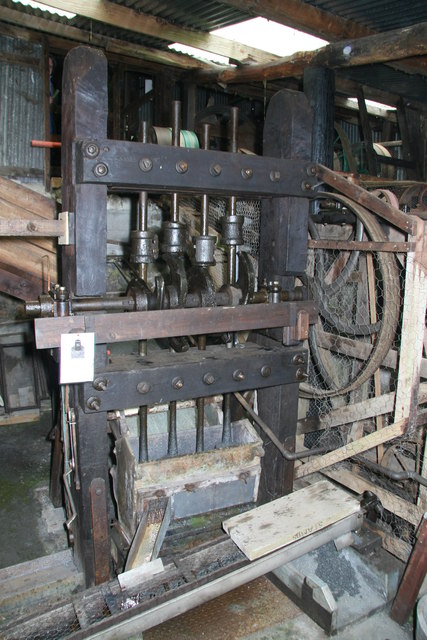
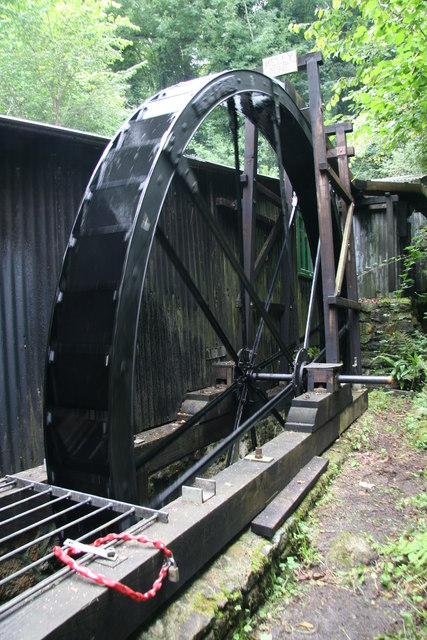
Adit and shaft workings on the lode, with the ore dressed at surface rather than smelted. The processing sequence is the interesting part and it survives: a waterwheel driving stamps at first, replaced by a turbine in 1915 and a Turgo impulse wheel in 1920, with a Blackstone oil engine added in 1934 to keep the plant running through dry seasons. Californian stamps, a screw classifier, a compressor, a haulage winch, a drying furnace, ore packing equipment and a blacksmith's shop all remain on site.
Closure
In 1951 blasting on what was believed to be new ground broke into unrecorded 'old men's workings', and a major underground collapse followed shortly afterwards — at night, so nobody was hurt. The company could not recover from it and mining ended. Because it went out owing money, the machinery was left standing where it stood.
What remains
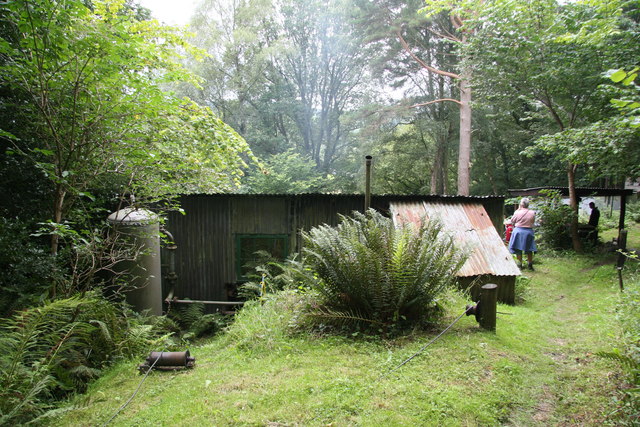
Restored and maintained. The Kelly Mine Preservation Society leased the abandoned site in 1984 and has been putting it back into working order ever since. Surface buildings and machinery are open to visitors on Wednesdays and Sundays by appointment; there are no underground tours.
Outstanding — the reason the site matters. Because the plant was abandoned in place rather than sold for scrap, Kelly holds a collection of mining machinery still standing where it originally worked, which is close to unique in Britain.
Redevelopment
None. The site is run as a working museum by the volunteers who restored it.
Related mines
- Great Rock Mine — The two mines worked the same material (micaceous haematite/ochre); Kelly survives as a preserved site while Great Rock does not.
Nearby mines
- Frank Mills Mine — 1.0 miles (1.7 km) NE
- Yarner Copper Mine — 1.6 miles (2.6 km) SW
- Great Rock Mine — 1.9 miles (3.0 km) E
- Bagtor Mine — 3.4 miles (5.5 km) S
- Haytor Granite Quarry — 3.5 miles (5.6 km) S
Straight-line distance, within 9 miles (15 km). Show on the map.
Recorded claims
Individual factual claims, each attached to the source(s) that support it below. Where sources disagree, both are kept.
- The first record of workings is a lease of 1797, when George Wills let to John Pinsent for 21 years 'a certain mine of black lead or some other substance'. 1,2
- Documented working ran under the Kelly Iron Company from 1877, the Scottish Silvoid Company of Glasgow from 1900, and the Ferrubron Manufacturing Company from about 1917, with a final phase from 1947. 1
- Output rose from around 25 tons a year in the 1880s to a peak of 202 tons in 1907; 324 tons were produced between 1879 and 1891. 1,2
- The mine never employed many: nine men in 1913, four of them underground, and an average of six over the fifty years to 1938. 1,2
- Ore dressing used a waterwheel driving stamps, replaced by a turbine in 1915 and a Turgo impulse wheel in 1920, with a Blackstone oil engine added in 1934 for dry seasons. 1
- The micaceous haematite occurs in hydrothermal lodes within the Dartmoor granite and was worked for corrosion-resistant paint rather than for iron. 2,3
- In 1951 blasting on supposedly new ground broke into unrecorded old workings and a major underground collapse followed at night, ending mining. 1,2
- The Kelly Mine Preservation Society leased the site in 1984 and has restored it; the machinery survives standing where it originally worked, and the surface site is open to visitors on Wednesdays and Sundays by appointment. 2,3
Photographs & further reading
Archive photographs of the mine at work.
View sourceA readable account of the mine and the shiny ore trade.
View sourceThe volunteers who restored the mine, with visiting arrangements and the site's own history.
View sourceSources
- (primary) History of Kelly Mine — Kelly Mine Preservation Society
- (secondary) Kelly Mine, Devon — Wikipedia
- (secondary) Kelly Mine — Show Mines of Great Britain
- (secondary) Kelly Mine — Subterranea Britannica
Record created: 24 August 2026 · Last researched: 24 August 2026