 MineArchive
Micaceous Haematite
| Also known as | Micaceous Iron Oxide (Standard modern paint-industry name, now more common than the mineralogical term), MIO (The paint industry's usual abbreviation), Shiny Ore (The Devon miners' own name for it) |
|---|---|
| Category | Commodities |
| Commodity page | Micaceous Haematite → |
A variety of haematite occurring as tiny, glittering, greyish-purple flakes rather than solid rock — 'shiny ore' to the miners who worked it — mined not to be smelted for iron but to be ground into one of the most effective anti-corrosion paint pigments ever found.
Historical usage
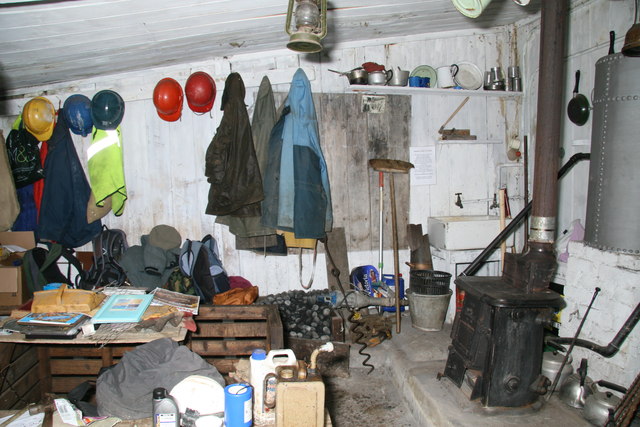
Devon's Hennock district, on the eastern flank of Dartmoor, was mined for micaceous haematite from at least the 1790s — a 1797 lease at Kelly refers cautiously to 'a certain mine of black lead or some other substance' — though documented, continuous working really begins in 1877. Demand grew sharply with the industrial expansion of steel structures from the late 19th century, and the Ferrubron Manufacturing Company, which took over the district's mines from about 1902-1920, kept Kelly and the larger Great Rock mine working well into the 20th century on the strength of it. Production at Great Rock peaked at around 2,500 tons a year in the 1940s, when Admiralty demand for protective paint was at its height. Kelly, the smaller of the two, finally closed in 1951 when a working face broke into old, unrecorded workings; Great Rock outlasted every other mine on Dartmoor before it too closed.
How it worked
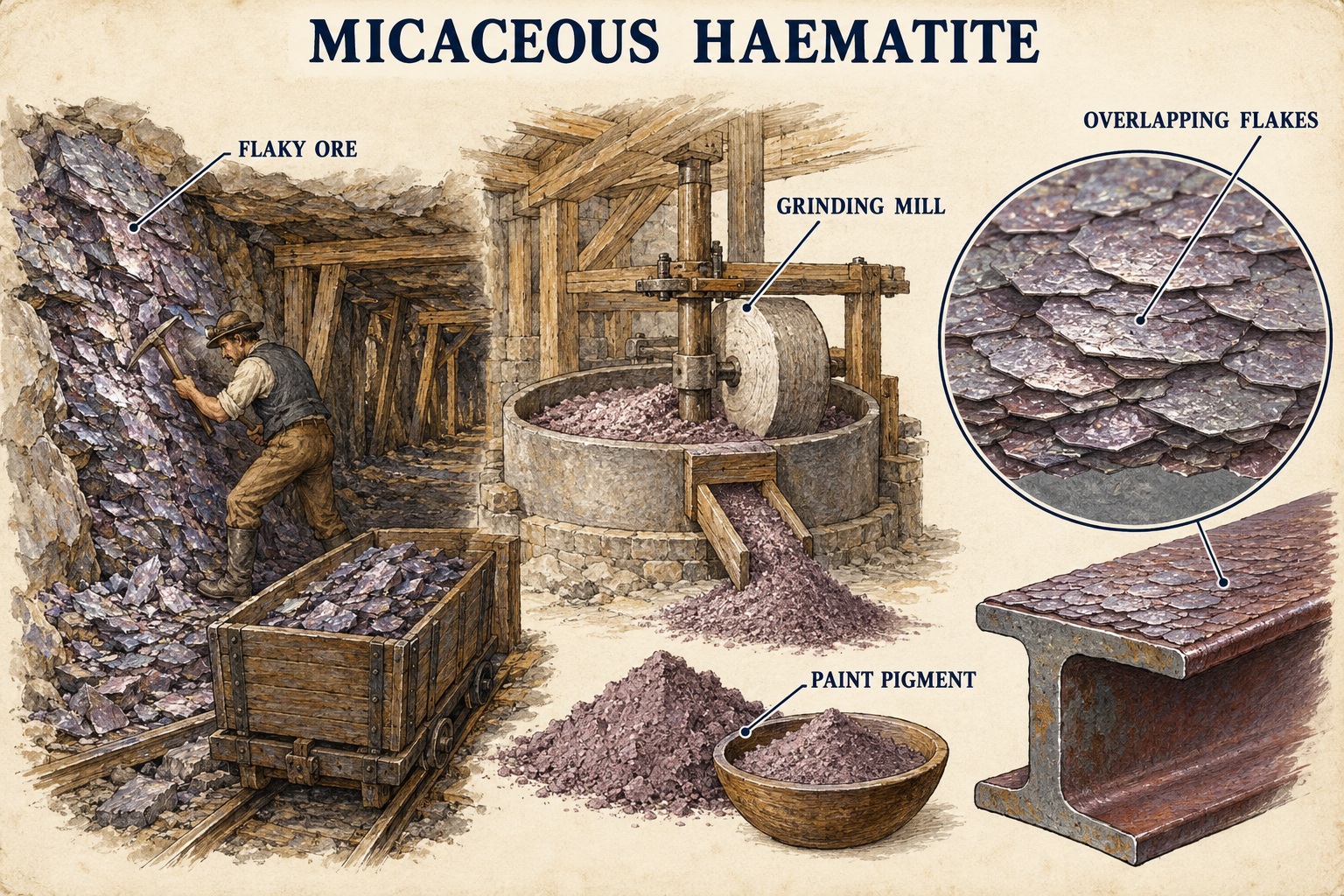
The ore forms as soft, flaky crystals of iron oxide rather than a hard, massive rock, and that physical form is the entire point: unlike ordinary red haematite mined for iron, the flakes need no smelting, only crushing and grinding fine enough to suspend in paint. Ground micaceous haematite is stirred into a paint base, and once brushed or sprayed onto steel the flat flakes settle down parallel to the surface and overlap like roof tiles or fish scales, building a dense, layered film. That overlapping structure forces any moisture trying to reach the steel beneath to take a long, indirect path around each flake rather than a short one straight through the film, which is what makes the paint so much more resistant to water and rust than paints made with ordinary round-grained pigments.
Why it was used
Devon's paint, sold under the Ferrubron name among others, found its way onto exactly the structures that most needed protecting from salt water and weather: Royal Navy warships, the Royal Albert Bridge at Saltash, and reportedly the Sydney Harbour Bridge. The distinctive grey colour of the unpigmented paint became so associated with naval use that 'Battleship Grey' takes its name directly from it. The same flake-barrier principle that made it valuable in the 1900s still makes micaceous iron oxide a standard specification for protecting bridges, pylons, offshore platforms and storage tanks today, though the ore itself is now sourced from Austria, Turkey, Spain and Australia rather than Devon.
Value over time
Devon's micaceous haematite had no real market until the steel age gave it one: demand rose sharply from the 1880s onward as ever more steel structures — ships, bridges, gasholders, storage tanks — needed protecting from corrosion, and the ore's unusual flake shape happened to be exactly what the job required, something no ordinary iron oxide pigment could match at the time. That gave Devon's small mines a genuine, if narrow, monopoly-like advantage for several decades, sustaining production at Great Rock and Kelly long after every other kind of Dartmoor mining had ended. The advantage did not last: cheaper micaceous iron oxide from Austria and elsewhere in Europe eventually undercut Devon ore, and the last of the Hennock district's mines closed in the 1950s. The pigment itself never lost its market — it is still specified today for exactly the same corrosion-protection reason — but the ore is now sourced from Austria, Turkey, Spain and Australia rather than from Devon.
Hazards & challenges
The mineral itself is chemically inert and not associated with the toxic or poisoning hazards of commodities like lead or mercury, but working it was not without risk: fine mineral dust from crushing and grinding the ore carried the same silicosis danger as hard-rock dust generally, and at Kelly Mine a miner named John Johns died in 1913 of an illness reported at the time as pneumonia but later thought to have been silicosis contracted from the ore dust.
Risks & limitations
Because the mineral's only value lies in its physical shape rather than its chemistry, quality depended entirely on how intact and flaky the mined ore was: softer ore that broke down into fine, unbroken flakes made noticeably better paint than harder, more shattered material, and mines competed on the quality of their flake as much as on tonnage.
Regional variation
Distinct from ordinary haematite worked as an iron ore — the same iron oxide chemistry, but a completely different physical form and a completely different market. Also known outside Devon as micaceous iron oxide or MIO, the name now standard in the paint industry that has entirely replaced the old mineralogical term in commercial use.
Related terminology
Mines associated with this term
Included only where MineArchive's own research gives a reasonable evidential basis — not every mine where this might plausibly apply.
- Great Rock Mine — Devon (well documented example)
Great Rock's own summary and history explicitly describe it selling micaceous haematite for paint on Royal Navy battleships, the Royal Albert Bridge and the Sydney Harbour Bridge, under the Ferrubron Manufacturing Company. - Kelly Mine — Devon (well documented example)
Kelly Mine's own record names micaceous haematite directly as the ore worked from at least 1797, through the Kelly Iron Company, the Scottish Silvoid Company and the Ferrubron Manufacturing Company.
See every mine that worked micaceous haematite →
Sources
- (primary) MIO Paints — Kelly Mine Preservation Society
- (secondary) Kelly Mine, Devon — Wikipedia
- (secondary) Micaceous Iron Oxide (MIO) Primers For Steel — Rawlins Paints
Record created: 24 August 2026 · Last researched: 24 August 2026