 MineArchive
International Colliery
| Also known as | Pwllcarn Colliery, Pwll Carn Colliery |
|---|---|
| Location | West of Blaengarw, head of the Garw valley, Bridgend — 51.6270, -3.5946 (exact) |
| Commodity | Coal |
| Type | Coal |
| Worked | 1874 (Pwllcarn level)–1968 |
| Maximum depth | Unknown. |
| Operators | International Coal Company (1889–1928), Ocean Coal Company (1937–1944), Ocean and United National Collieries Ltd (1945–1947), National Coal Board (1947–1968) |
Overview
A steam and house-coal colliery at the head of the Garw valley, west of Blaengarw, which grew from the Pwllcarn level of 1874 into a deep pit sunk from 1883; it employed about a thousand men in the 1890s and 1920s and closed in 1968.
History
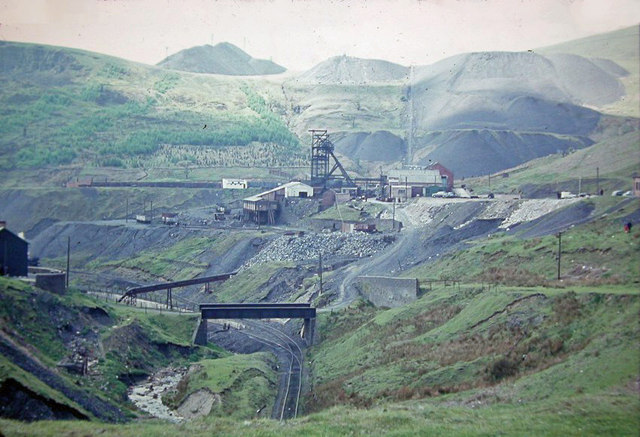
International Colliery stood at the head of Cwm Garw, west of Blaengarw town, with the Ocean company's Garw pit to the east. It began as a level: in 1874 John Thomas and a Mr Davies leased the ground and applied for railway sidings, and the working was known as Pwllcarn, run by a partnership of seven as Thomas, Sons and Davies and then as the Pwllcarn Colliery Company. The partnership was dissolved on 15 June 1877 and John Davies, joined by John Bovey, carried on the level. On 11 May 1883 the Transatlantic Steam Coal Company was formed to acquire Pwllcarn and began sinking pits; the level closed in 1885. The International Steam Coal Company took over in 1886 and was re-formed as the International Coal Company in April 1889.
The colliery employed 1,015 men in 1896, raising house and steam coal, and 875 in 1908. A third shaft was sunk in 1910, and the old level was reopened in 1909 as International No. 2 Level, working the No. 2 Rhondda seam until 1923. In 1918 the Nos. 1 and 2 pits employed 831 and the level 132; in 1923 the pits employed 962 in the Nine Feet, Upper and Lower Five Feet and Red seams. By 1899 the surface had a railway, an engine shed, buildings and an air shaft.
Glenavon Collieries took the colliery in 1928, and in 1937 it passed to the Ocean Coal Company through a subsidiary, the International Colliery Company, then to Ocean and United National Collieries from 1945. It employed 664 in 1938 and 552 in 1945, and the National Coal Board worked it from 1947 until it closed in the late 1960s.
Geology
South Wales Coalfield: the Nine Feet, Five Feet, Red, Lower New and Upper New seams, and the No. 2 Rhondda by a level.
Workings
Three shafts (the third sunk in 1910) and the Pwllcarn level, reopened as International No. 2 Level from 1909 to 1923.
Closure
Closed by the National Coal Board in the late 1960s.
What remains
Unknown.
Redevelopment
Unknown.
Related mines
- Garw Colliery — Neighbouring pits at Blaengarw: International to the west of the town, the Ocean company's Garw pit to the east.
- Glengarw Colliery — Neighbouring Blaengarw collieries at the head of the Garw valley.
Nearby mines
- Glengarw Colliery — 0.4 miles (0.6 km) SE
- Garw Colliery — 0.5 miles (0.8 km) E
- Ffaldau Colliery — 1.1 miles (1.8 km) S
- Braichycymmer Colliery — 1.5 miles (2.4 km) S
- St John's Colliery — 1.7 miles (2.7 km) SW
Straight-line distance, within 9 miles (15 km). Show on the map.
What's uncertain
Points where sources disagree or the record could not be settled; both accounts are kept. All open questions in the archive.
- Pwll Carn Colliery started in 1873. (disputed) 2
- International was sunk in 1890-1893. (disputed) 3
- The colliery closed in 1968. (disputed) 1,5
- International closed in 1967. (disputed) 3
Recorded claims
Individual factual claims, each attached to the source(s) that support it below. Where sources disagree, both are kept.
- Began in 1874 as the Pwllcarn level, leased by John Thomas and a Mr Davies. 1
- Pwll Carn Colliery started in 1873. (disputed) 2
- The Transatlantic Steam Coal Company, formed on 11 May 1883 to acquire Pwllcarn, began sinking the pits. 1
- International was sunk in 1890-1893. (disputed) 3
- By 1899 International Colliery stood west of Blaengarw with a railway, engine shed, buildings and an air shaft; Blaengarw Pit lay to the east. 4
- It employed 1,015 men in 1896 and 962 at Nos. 1 and 2 pits in 1923. 1
- The colliery closed in 1968. (disputed) 1,5
- International closed in 1967. (disputed) 3
- A National Museum of Wales slide of May 1968 shows the view from International Colliery. 6
Sources
- (secondary) International Colliery Blaengarw — Welsh Coal Mines
- (secondary) The Beginning of a Mining Community — Garw Valley Heritage Society
- (secondary) Garw Valley map — Digging up the Past
- (secondary) International Colliery, Blaengarw (NPRN 418082) — Coflein (RCAHMW)
- (secondary) Blaengarw railway station — Wikipedia
- (secondary) International Colliery, slide (2017.6/1286) — Amgueddfa Cymru - Museum Wales
Record created: 17 October 2026 · Last researched: 17 October 2026