 MineArchive
Garw Colliery
| Also known as | Ocean Colliery, Blaengarw, Blaengarw Colliery |
|---|---|
| Location | Blaengarw, Garw valley, Bridgend — 51.6260, -3.5833 (approximate) |
| Commodity | Coal |
| Type | Coal |
| Worked | Sinking from 1883; first coal wound 1886–December 1985 |
| Maximum depth | Unknown; the Gellideg seam, the deepest worked, lay below the Nine Feet at 271 yards |
| Operators | Ocean Coal Company (1883–1946), Blaengarw Ocean Coal Company (1886–1913), National Coal Board (1947–1985) |
Overview
The Ocean Coal Company's pit at the head of the Garw valley, sunk in 1883 and winding its first coal in 1886 through a subsidiary, the Blaengarw Ocean Coal Company. It worked a long series of steam-coal seams from the Two Feet Nine at 182 yards down to the Gellideg, employed 756 men by 1913 and 749 in 1923, and in 1887 lost two men to a fall of stone while ripping. Merged underground with the neighbouring Ffaldau colliery in 1975, it was the last mine in the valley to close, in December 1985.
History
David Davies of Llandinam and his partners -- Thomas Webb, Morgan Joseph, John Osborne Riches, Abraham Howell and E. Roberts -- had begun sinking in the Rhondda Fawr in 1866, and the company they formed grew into the Ocean Coal Company. At Blaengarw the sinking began in 1883: the Two Feet Nine seam was found at 182 yards, the Four Feet at 200, the Six Feet at 238, the Red Vein at 243, the Nine Feet at 271 and others below that. A Schiele fan 13 feet 6 inches across ventilated the pit, the first coal was wound in 1886, and a subsidiary called the Blaengarw Ocean Coal Company was formed to run it; the colliery, originally called the Garw, took the Ocean name from its parent. The Western Mail of 18 May 1887 reported a fall of stone on three men who were ripping early on the Tuesday morning: William Roberts of Alexandria Road, Pontycymmer, and John Griffiths, lately come to the valley from the Rhondda, were killed on the spot, and Richard Davies, also of Alexandria Road and a prominent Methodist in the valley, was left in a critical condition. In 1884 the manager was Rowland Rowlands and in 1896 David Matthews, when 462 men worked underground and 78 on the surface. The Ocean company went on expanding -- Deep Navigation in 1893, Lady Windsor sunk in 1895, Avon bought in 1912 -- and by 1913 employed over 9,000 men, 756 of them at Garw under the manager William Jenkins. A list of 1923 gives 749 at work in the Nine, Six and Two Feet seams, the New and the Red. The company was among the strongest backers of the non-political South Wales Miners Industrial Union against the Federation, and Garw lay idle for 105 days in 1930 and 119 in 1931 for want of orders. In 1937 the Ocean company bought the neighbouring International colliery and linked it to Garw, and merged with the United National company. In 1954-55 Garw was one of 42 collieries whose accident rate concerned the Coal Board and the union; 682 men were employed in 1945 and 297 were at the coalfaces in 1955.
Geology
Coking steam coals of types 203 and 204, low in volatiles, ash and sulphur. The seams ran from the Two Feet Nine at 182 yards through the Four Feet, Six Feet, Red Vein at 243 yards and Nine Feet at 271, to the Bute -- known here as Brunts and worked at 70 inches -- the Yard, called the Seven Feet, and the Gellideg at 48 inches.
Geological setting: Sedimentary Beds and Seams (well documented example)
Workings
Shafts sunk from 1883 and winding from 1886, ventilated by a Schiele fan 13 feet 6 inches in diameter. In March 1975 a roadway 500 yards long joined Garw to the neighbouring Ffaldau colliery at a cost of 86,000 pounds, and from then the two worked as one unit with all winding, manriding and supplies through Garw's shafts.
Closure
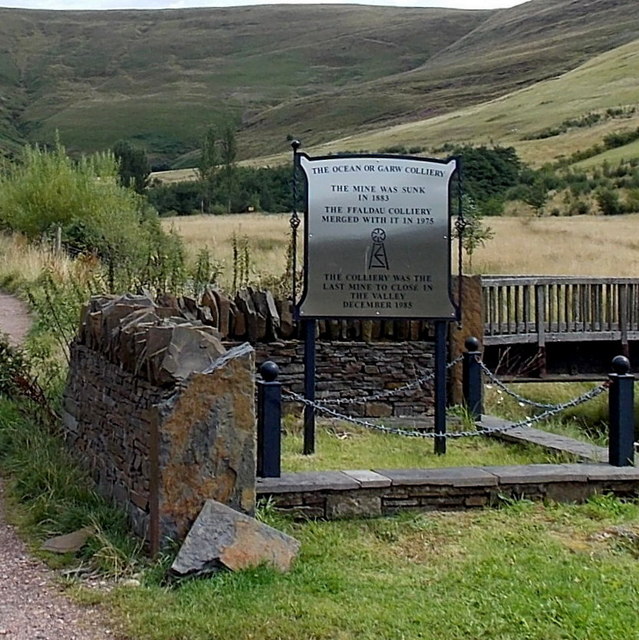
Garw and Ffaldau were merged underground in 1975 and worked as a single unit employing about 1,000 men. The combined colliery closed in December 1985, the last mine working in the Garw valley, as the memorial plaque at Blaengarw records.
What remains
The colliery site at Blaengarw is cleared and landscaped, with a cycle track along the old railway and a memorial plaque beside the Nant Hir recording the colliery's sinking, the Ffaldau merger and the closure.
Nothing of the colliery buildings survives; a memorial plaque and colliery inscriptions mark the site at the head of the valley.
Redevelopment
Landscaped open ground and a cycle track at Blaengarw.
Related mines
- Ffaldau Colliery — Neighbouring Garw valley pits joined underground in March 1975 by a 500-yard roadway and worked as one unit, with Ffaldau's coal raised through Garw's shafts until the combined colliery closed in December 1985.
Nearby mines
- Ffaldau Colliery — 1.6 km S
- Lluest Colliery — 3.2 km S
- St John's Colliery — 3.3 km SW
- Glenavon Colliery — 3.8 km NW, Neath Port Talbot
- Caerau Colliery — 4.2 km W
Straight-line distance, within 15 km. Show on the map.
People
- John Griffiths (d. 1887) · victim, from 1887 — Lately come to the Garw valley from the Rhondda; killed on the spot by the same fall of stone in May 1887.
- David Matthews · manager, from 1896 — Manager of the Garw colliery in 1896, when 462 men worked underground and 78 on the surface.
- William Roberts (d. 1887) · victim, from 1887 — Of Alexandria Road, Pontycymmer; killed on the spot by a fall of stone while ripping at the Ocean Colliery, Blaengarw, in May 1887.
- Rowland Rowlands · manager, from 1884 — Manager of the Garw colliery in 1884.
Recorded claims
Individual factual claims, each attached to the source(s) that support it below. Where sources disagree, both are kept.
- Sinking began in 1883 and the first coal was wound in 1886, the Two Feet Nine seam having been found at 182 yards and the Nine Feet at 271; a subsidiary called the Blaengarw Ocean Coal Company was formed to run the pit. 1,2
- The colliery was originally called the Garw and took the Ocean name from the Ocean Coal Company, which owned it until nationalisation in 1947. 1
- The Western Mail of 18 May 1887 reported that a large stone fell on three men ripping at the colliery, killing William Roberts of Alexandria Road, Pontycymmer, and John Griffiths on the spot and leaving Richard Davies in a critical condition. 2
- The 1896 Inspector of Mines list records 550 men at the pit, 462 underground and 78 on the surface; by 1913 the Ocean company employed over 9,000 men, 756 of them at Garw, and a list of 1923 gives 749. 1,2
- In March 1975 Garw and the neighbouring Ffaldau colliery were linked by a roadway 500 yards long and worked as a single unit, with Ffaldau's coal brought up Garw's shafts; the merger cost 86,000 pounds. 1,2
- The combined Garw and Ffaldau colliery closed in December 1985, the last mine working in the Garw valley. 1
Photographs & further reading
The Ocean company's history, the seams and their depths, the 1887 accident from the Western Mail, and the Ffaldau merger of 1975, read through the Internet Archive.
View sourceSources
- (secondary) Ocean Colliery Blaengarw (Welsh Coal Mines, via the Internet Archive) — Welsh Coal Mines
- (secondary) Garw Colliery — Northern Mine Research Society (Internet Archive)
Record created: 20 September 2026 · Last researched: 20 September 2026