 MineArchive
Horden Colliery
| Location | Horden, near Peterlee, County Durham — 54.7683, -1.3145 (exact) |
|---|---|
| Commodity | Coal |
| Type | Coal |
| Worked | From November 1900 (sinking)–28 February 1987 |
| Maximum depth | North shaft 438m; South shaft 401m |
| Operators | Horden Collieries Ltd (1900–1947), National Coal Board (1947–1987) |
Overview
A large Durham coastal colliery sunk to work coal beneath the North Sea, which set a European record for coal raised in a single day in 1930 — a record that stood for over thirty years — and whose workforce gave rise to one of England's largest pit villages.
History
Horden Collieries Ltd began sinking shafts at Horden, on the Durham coast, in November 1900, specifically to work coal seams extending out beneath the North Sea; the North and South shafts, each 6.1 metres in diameter, were completed in 1904 at depths of 438 and 401 metres respectively. The colliery grew quickly into one of the largest in the Durham coalfield, and on 9 May 1930 it set a new European record for coal raised in a single day — 6,758 tonnes — a record that stood for more than thirty years. Employment peaked at 4,342 in 1935, and the surrounding pit village grew with it, reaching a population of around 15,000 by 1951.
Horden Collieries Ltd operated the colliery until the 1947 nationalisation of the coal industry brought it under the National Coal Board. Output and employment both declined steadily in the following decades as the colliery's richer, more accessible lower seams were worked out: annual output fell from over a million tonnes to around 600,000 tonnes, and the workforce from around 4,000 to under 2,000 by the early 1980s. Large volumes of water and other geological problems meant Horden had stopped making a profit by the later 1970s, and the colliery finally closed on 28 February 1987.
Geology
Horden was sunk specifically to reach coal seams extending out beneath the North Sea, reached through the North and South shafts at depths of 438 and 401 metres respectively; the colliery's richer, more accessible lower seams were progressively exhausted from the postwar period onward, and increasing water ingress in its later decades was a major factor in its eventual closure.
Workings
Coal was raised through twin 6.1-metre-diameter shafts, completed in 1904, and power for the colliery came from its own generating station — rated at 2,600 kilowatts, with a 1,000kW turbo-alternator and four 400kW rotary converters supplying direct current underground.
Closure
Horden closed on 28 February 1987, brought down by a long decline in output and workforce as its richer lower seams were exhausted, compounded by large volumes of water that had made the colliery unprofitable from the later 1970s onward.
What remains
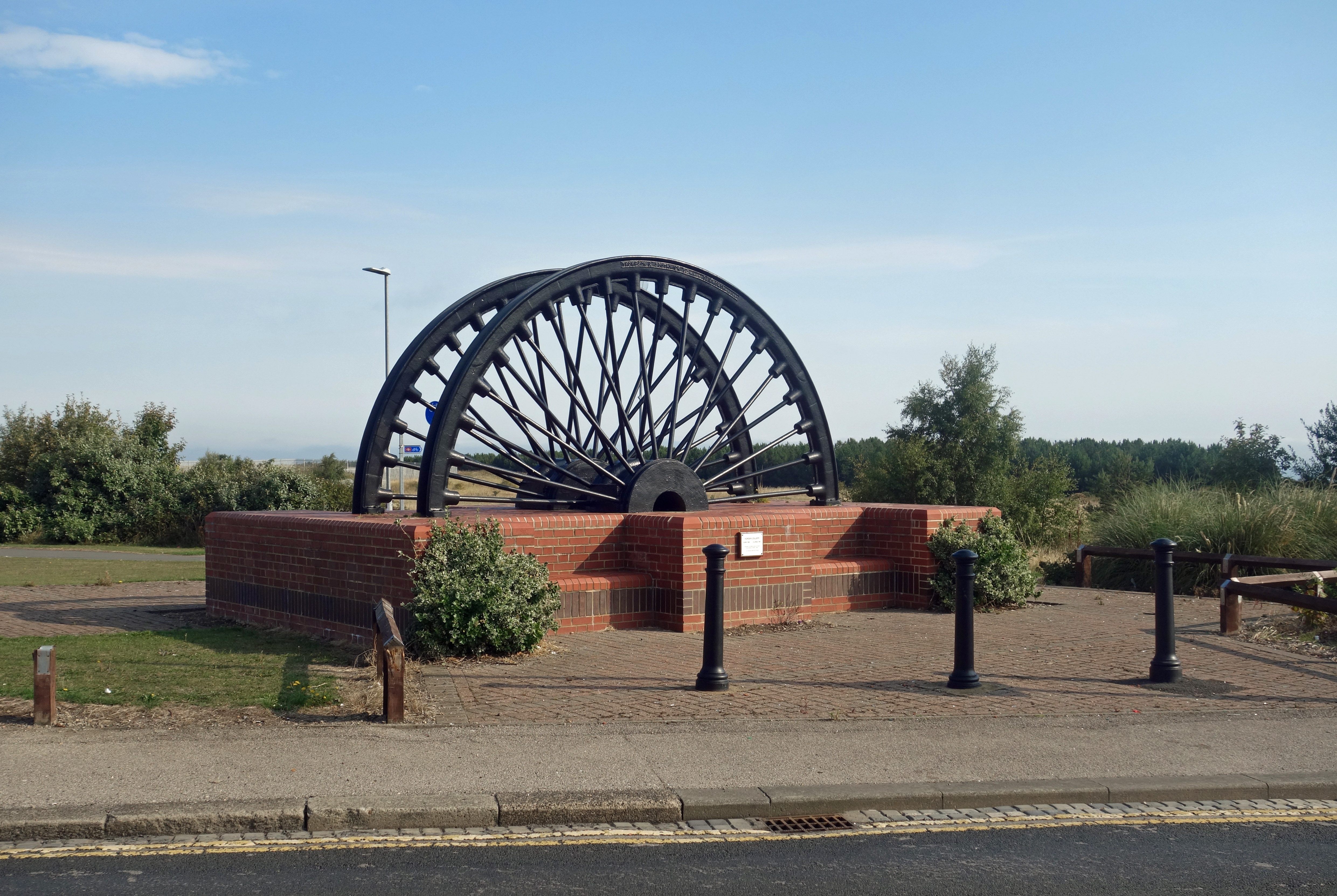
The colliery and its power station have both been demolished; the site has been extensively landscaped and redeveloped. A memorial made from the colliery's own pit head winding wheels now stands on the former site.
A handful of original buildings survive in altered form — the former medical centre (now a gymnasium), baths (rebuilt as offices), canteen (now a garage) and ventilation office (now used by the local council) — alongside a memorial built from the colliery's own pit head wheels.
Related mines
- Blackhall Colliery — Both were sunk and worked by Horden Collieries Ltd, and both tipped their waste onto the same stretch of Durham coast until the Turning the Tide clean-up.
- Castle Eden Colliery — Horden Collieries Ltd took over Castle Eden in 1900 and kept it as a pumping station draining Horden.
Nearby mines
- Easington Colliery — 1.4 miles (2.3 km) NW
- Blackhall Colliery — 1.9 miles (3.0 km) SE
- Castle Eden Colliery — 2.3 miles (3.7 km) S
- Shotton Colliery — 3.2 miles (5.2 km) W
- Hutton Henry Colliery — 3.5 miles (5.7 km) SW
Straight-line distance, within 9 miles (15 km). Show on the map.
Culture
- Horden Colliery Welfare F.C. (Sports)
The club took the colliery welfare's name in 1928 and played at Welfare Park, laid out in 1929 with Miners' Welfare Fund money raised from the pay of Horden's miners; the colliery closed in 1987 and the club continued until 2016.
Recorded claims
Individual factual claims, each attached to the source(s) that support it below. Where sources disagree, both are kept.
- Horden Collieries Ltd began sinking in November 1900; the North and South shafts, each 6.1m in diameter, were completed in 1904 at depths of 438m and 401m respectively. 1
- On 9 May 1930 Horden set a new European record for coal raised in a single day, 6,758 tonnes, which stood for more than thirty years. 1
- Employment at the colliery peaked at 4,342 workers in 1935. 1
- Output fell from over a million tonnes a year to around 600,000 tonnes, and the workforce from around 4,000 to under 2,000 by the early 1980s, as richer lower seams were exhausted and water ingress made the colliery unprofitable from the later 1970s; it closed on 28 February 1987. 1
- The colliery had its own generating station, rated at 2,600 kilowatts with a 1,000kW turbo-alternator and four 400kW rotary converters supplying underground DC power. 2
- A handful of original buildings survive in altered use (medical centre, baths, canteen and ventilation office), and a memorial built from the colliery's own pit head winding wheels now stands on the former site. 1
- Located at about 54.768 N, 1.315 W. 1
Sources
- (secondary) Horden Colliery — Wikipedia
- (secondary) Horden Colliery (1900 - 1987) — co-curate.ncl.ac.uk (Newcastle University)
Record created: 27 August 2026 · Last researched: 27 August 2026