 MineArchive
Hetton Colliery
| Also known as | Hetton Lyons Colliery, Lyons Colliery |
|---|---|
| Location | Hetton-le-Hole, Sunderland, Tyne and Wear — 54.8156, -1.4397 (approximate) |
| Commodity | Coal |
| Type | Coal |
| Worked | 1820 (sinking)–11 July 1950 |
| Maximum depth | 148 fathoms (Hutton seam) |
| Operators | Hetton Coal Company (1822–1911), Lambton & Hetton Collieries Ltd (1911–1923), Lambton, Hetton & Joicey Collieries Ltd (1923–1947), National Coal Board (1947–1950) |
Overview
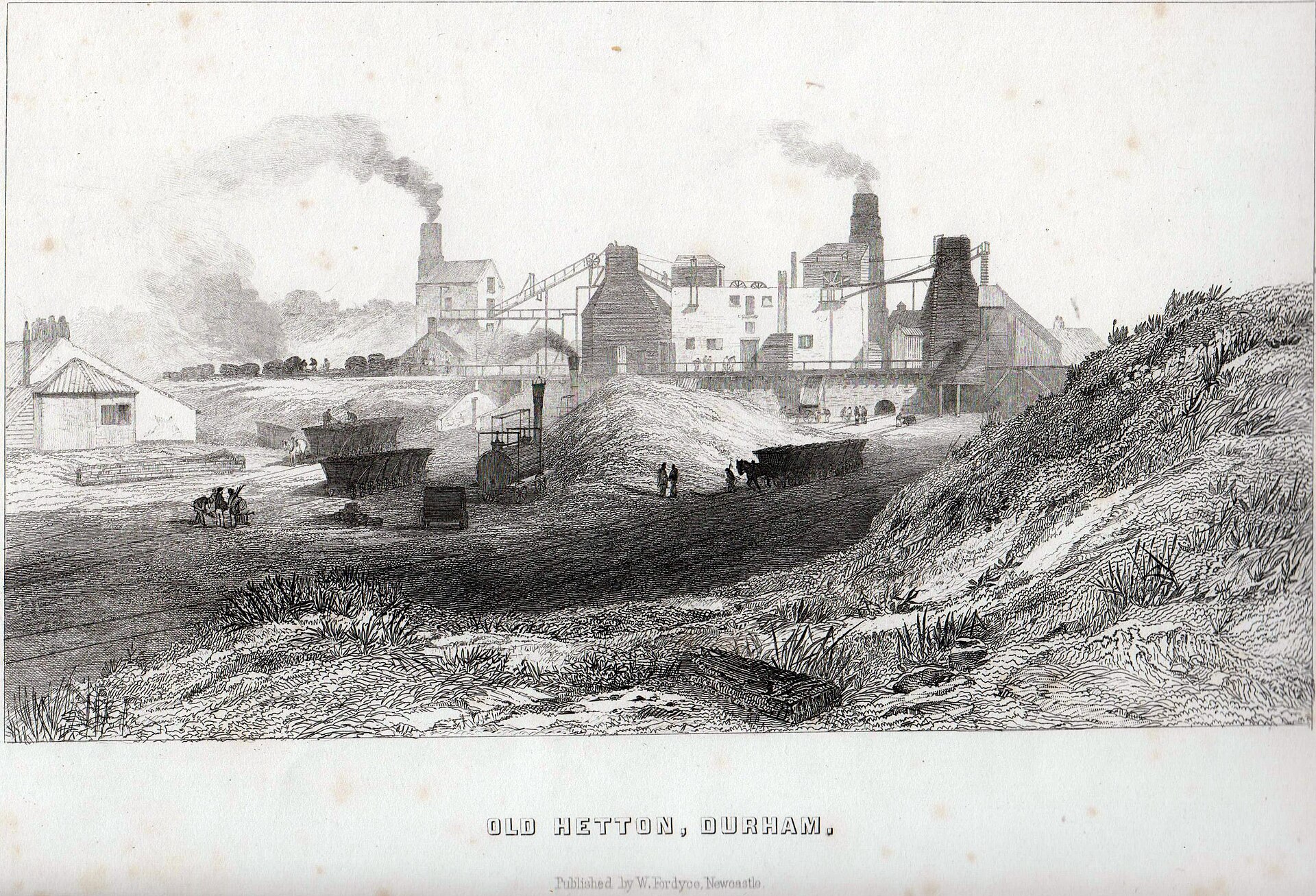
The Hetton Coal Company's colliery at Hetton-le-Hole, sunk from December 1820 through the Magnesian Limestone to coal that geologists had doubted lay beneath it. It shipped its first coal in November 1822 along George Stephenson's Hetton colliery railway and closed on 11 July 1950.
History
The Hetton Coal Company was formed in 1819 to try for coal beneath the Magnesian Limestone of east Durham, where geologists had said there was none, or none worth working. Sinking of the Blossom or Engine Pit began in December 1820, and the Main Coal was reached on 3 September 1822 at 109 fathoms, excellent in quality and thickness; the Minor Pit was taken on to the Hutton seam at 148 fathoms. Hetton was the first mine to draw coal from beneath the limestone plateau, and its success opened up the whole concealed coalfield of north-east Durham. The first coal reached the company's staiths on the Wear at Sunderland in November 1822 over an eight-mile railway engineered by George Stephenson, the first line designed from the start to work without animal power.
The pits were ventilated by furnaces and boiler fires, and beside them stood 200 beehive coke ovens, brickworks and engineering, blacksmiths' and joiners' shops. The Hutton coal sold as Hetton Wallsend house coal. In 1894 the colliery employed over a thousand and raised about 1,000 tons a day. On 20 December 1860 gas that had gathered in a boiler flue exploded and killed 22. The Hutton seam was abandoned in 1915. The colliery passed to Lambton & Hetton Collieries in 1911, Lambton, Hetton & Joicey in 1923 and the National Coal Board in 1947, and closed on 11 July 1950.
Geology
Durham Coal Measures concealed beneath the Magnesian Limestone: the Main Coal at 109 fathoms, the Low Main at 131 fathoms and the Hutton at 148 fathoms, with the Five Quarter and Maudlin worked by 1950.
Workings
Two shafts sunk from December 1820, the Blossom or Engine Pit and the Minor Pit; furnace and boiler-fire ventilation; 200 beehive coke ovens; an eight-mile private railway to staiths on the Wear at Sunderland.
Closure
The Hutton seam was abandoned in March 1915; the colliery closed on 11 July 1950 under the National Coal Board.
What remains
A group of decorative stone colliery buildings survives on the north side of Colliery Lane, and a former engine house stands on Hetton Lyons Industrial Estate.
Stone colliery buildings on Colliery Lane; a brick former engine house; the colliery workers' cottages on Lyons Avenue, with a plaque recording that Robert Stephenson lived there.
Redevelopment
Part of the site is Hetton Lyons Industrial Estate; two colliery buildings, Trainor's Depot and Lyons Garage, were recorded in 2004 before demolition.
Related mines
- Elemore Colliery — Both Hetton Coal Company collieries, joined by the company's private railway (Whellan, 1894).
- Eppleton Colliery — Both Hetton Coal Company collieries, joined by the company's private railway.
Nearby mines
- Elemore Colliery — 0.8 miles (1.4 km) S, County Durham
- Eppleton Colliery — 1.0 miles (1.5 km) N
- Hawthorn Combined Mine — 2.0 miles (3.2 km) E, County Durham
- Rainton Meadows Colliery — 2.3 miles (3.7 km) W, County Durham
- Houghton Colliery — 2.5 miles (4.0 km) NW
Straight-line distance, within 9 miles (15 km). Show on the map.
Disasters & major incidents
-
Hetton Colliery explosion, 1860
20 December 1860 · Explosion · 22 fatalities
On the evening of 20 December 1860 gas that had gathered in a nearly level boiler flue exploded in the Minor Pit of the Hetton Coal Company's colliery at Hetton-le-Hole, killing 22 men and boys. Some 200 had just come up, and only the stonemen and shifters were below.
Recorded claims
Individual factual claims, each attached to the source(s) that support it below. Where sources disagree, both are kept.
- Sinking began in December 1820 and the Main Coal was reached on 3 September 1822 at 109 fathoms. 1,2
- Hetton was the first mine to work coal from beneath the Magnesian Limestone of north-east Durham. 1,3
- The first coal was shipped at Sunderland in November 1822 over the eight-mile Hetton railway engineered by George Stephenson. 4,5
- In 1894 the colliery employed over a thousand and produced about 1,000 tons a day. 1
- An explosion on 20 December 1860 killed 22. 1,3
- The colliery closed in July 1950. 1,3
- A number of colliery buildings survive on Colliery Lane and Hetton Lyons Industrial Estate. 3
Photographs & further reading
Sinking, seams, owners, employment 1854-1950 and those killed.
View sourceThe Historic Environment Record entry: the colliery's importance and its surviving buildings.
View sourceStephenson's 1822 line from the colliery to the Wear.
View sourceSources
- (primary) Hetton Colliery — Durham Mining Museum
- (primary) Hetton Colliery: shaft section, Blossom Pit — Durham Mining Museum
- (secondary) Hetton Colliery (Lyons Colliery) — Tyne and Wear Historic Environment Record (Sitelines)
- (secondary) Hetton colliery railway — Wikipedia
- (secondary) History of Hetton-le-Hole — Hetton Town Council
Record created: 3 October 2026 · Last researched: 3 October 2026