 MineArchive

Hetton Silver Band
| Category | Music |
|---|---|
| Dates | Founded 1 April 1887; first recorded contest 1896; Crystal Palace Grand Shield 1912; National Second Section champions 1947; National Fourth Section champions 1961; National Mineworkers Third Section champions 1994; merged 2009; hall rebuilt at Beamish 2010 to 2011. |
The brass band of the Durham pit village of Hetton-le-Hole, founded on 1 April 1887 and linked with the miners of Hetton Colliery, which won the Grand Shield at the Crystal Palace in 1912, merged into the Durham Miners' Association Brass Band in 2009, and whose band hall now stands rebuilt at Beamish Museum.
The mining history in this record
Hetton Silver Band was founded on 1 April 1887 among the miners of Hetton Colliery. It bought a small plot in South Market Street from the Hetton Coal Company for £25 and put up a tin hut there to practise in. Over its life it played under several names, among them Hetton Colliery, Hetton District Saxhorn, Hetton Silver Prize Band and Hetton Town.
Its first recorded contest was at Hebburn in July 1896. In September 1912 it took first prize in the Grand Shield at the national festival at the Crystal Palace in London, and around that time the tin hut gave way to a brick band hall. Some 305 contest results are recorded for the band. Under George Scorer it won the Second Section final of the National Championship in 1947 and the Fourth Section final in 1961, and it was National Mineworkers Third Section champion in 1994.
People
George Scorer, its conductor at the National finals of 1947 and 1961; William Straughan, who conducted it at the Crystal Palace in 1912.
Legacy today
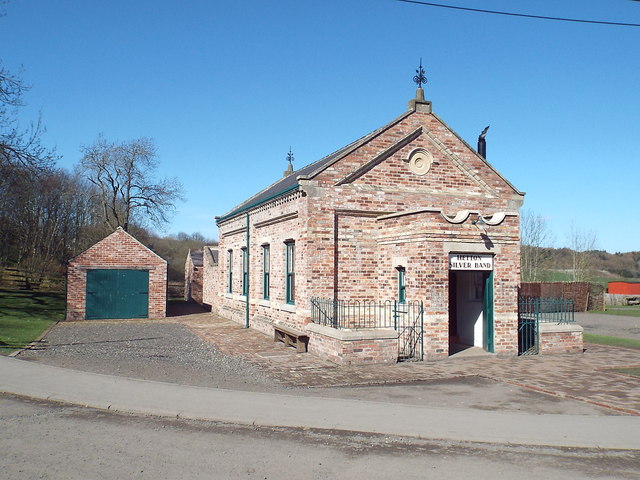
In 2009 Hetton Silver Band merged with another local band to form the Durham Miners' Association Brass Band, and its hall in South Market Street fell out of use. The Durham Miners' Association gave the building to Beamish Museum, and with money raised locally it was taken down in 2010 and 2011 and rebuilt in the museum's 1900s pit village.
Recorded claims
Individual factual claims, each tagged with how solidly it's grounded and attached to the source(s) that support it. Where sources disagree, both are kept.
- Hetton Silver Band was founded on 1 April 1887 and was associated with the miners of Hetton Colliery. (documented fact) 1,2
- The band bought a plot in South Market Street from the Hetton Coal Company for £25 and built a tin hut there to practise in. (documented fact) 1
- In September 1912 the band won first prize in the Grand Shield at the Crystal Palace. (documented fact) 1,2
- A brick band hall replaced the tin hut in about 1912. (documented fact) 1,3
- The band won the National Championship Second Section final in 1947 and the Fourth Section final in 1961 under George Scorer. (documented fact) 2
- In 2009 the band merged with another local band to form the Durham Miners' Association Brass Band. (documented fact) 1,3,2
- The Durham Miners' Association gave the band hall to Beamish Museum, where it was dismantled and rebuilt in 2010 and 2011. (documented fact) 1,3
Mines
- Hetton Colliery — Tyne and Wear
The band was founded in 1887 among the miners of Hetton Colliery and built its first hut on land bought from the Hetton Coal Company.
Real-world mining concepts used here
Sources
- (secondary) Hetton Silver Band (1887 - 2009) (Co-Curate, Newcastle University) — Co-Curate, Newcastle University
- (secondary) Hetton Silver Band 1887-2009 (Brass Band Results) — Brass Band Results
- (secondary) Hetton Silver Band Hall (Co-Curate, Newcastle University) — Co-Curate, Newcastle University
Record created: 25 October 2026 · Last researched: 5 November 2026