 MineArchive
Elemore Colliery
| Location | Easington Lane, Pittington parish, near Hetton-le-Hole, County Durham — 54.8039, -1.4461 (approximate) |
|---|---|
| Commodity | Coal |
| Type | Coal |
| Worked | 1825 (sinking); coal from 1833–February 1974 |
| Maximum depth | The Hutton seam at 126 fathoms (756 feet); the George shaft was deepened after the Second World War. |
| Operators | Hetton Coal Company (1825–1896), Lambton & Hetton Collieries Ltd (1896–1924), Lambton, Hetton & Joicey Collieries Ltd (1924–1947), National Coal Board (1947–1974) |
Overview
A Hetton Coal Company colliery at Easington Lane, sunk from 1825 through flooding ground to the Hutton seam, struck by an 1886 coal-dust explosion that killed 28, and worked for nearly 150 years until 1974.
History
Elemore Colliery, in Pittington parish at Easington Lane, was begun by the Hetton Coal Company on 23 May 1825. The sinking was complicated by flooding, and although the Hutton seam was reached at 126 fathoms on 5 February 1827, the first coals were not drawn until 1833. In the early years its workmen lived in houses built of sod at Low Downs. The George and Isabella pits worked the Main Coal at 94 fathoms, the Low Main at 113 fathoms and the Hutton; the Caroline shaft, abandoned during sinking, was reopened in 1853, the Isabella became a ventilation shaft only in 1860, and the New or Lindsay shaft was sunk from 1870, drawing its first coal in March 1874. A description reproduced by the Durham Mining Museum gives 616 men underground and 172 above, an output of about 800 tons a day, ventilation by furnaces alone and extensive use of arc electric light. On the morning of 2 December 1886 an explosion in the George Low Main seam killed 28 men and boys (see Disasters, below); the Durham Mining Museum attributes it to coal dust ignited by shot firing, but the inquest jury found insufficient evidence to say what caused the ignition. Three more men died from foul air in December 1895. With the Main Coal exhausted and the Hutton nearly worked out, the colliery stood idle between 1893 and 1897 and its men were transferred to Eppleton. It passed to Lambton and Hetton Collieries in 1896, to Lambton, Hetton and Joicey Collieries in 1924 and to the National Coal Board in 1947, peaking at 1,603 workers in 1947. The Jane Pit reopened in 1925, pithead baths followed in 1930, and from January 1960 Elemore was part of the Hawthorn Combined Mine. It closed in February 1974.
Geology
The Main Coal (5 feet 8 inches, at 94 fathoms), Low Main (3-4 feet, at 113 fathoms) and Hutton (at 126 fathoms) seams; from the 1920s the Five Quarter, and after 1950 the Harvey, Three Quarter and Busty seams.
Workings
The George shaft, divided by a brattice into the George and Lady pits, and the Isabella shaft with its 1826 vertical winding engine; the Caroline shaft, reopened in 1853; the New or Lindsay shaft from 1870; and the Jane and Caroline engine houses of 1880, whose single-cylinder vertical engines both pumped and wound. Ventilated by furnace in the 19th century.
Closure
Closed in February 1974, after working from 1960 as part of the Hawthorn Combined Mine.
What remains
No surface traces survive of the mine buildings or of its railway, part of the pioneering Hetton Railway. The Isabella winding engine of 1826, a scheduled monument and one of only two surviving Durham vertical winding engines, was destroyed in 1981.
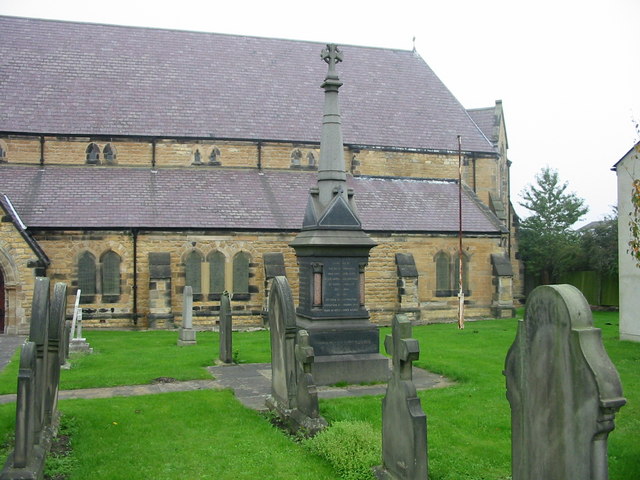
The Frizzell-designed pithead baths are all that remains on the site. A memorial to the 28 killed in 1886 — a grey granite pedestal with pink granite corner columns and a tall octagonal spirelet, designed by Emley of Newcastle — stands in the churchyard at Easington Lane.
Related mines
- Eppleton Colliery — Both Hetton Coal Company pits; Elemore's workers were transferred to Eppleton while Elemore stood idle in 1893-1897.
Nearby mines
- Eppleton Colliery — 2.9 km N, Tyne and Wear
- Haswell Colliery — 3.8 km SE
- Murton Colliery — 4.8 km E
- Houghton Colliery — 5.0 km N, Tyne and Wear
- Cocken Colliery — 6.3 km W
Straight-line distance, within 15 km. Show on the map.
What's uncertain
Points where sources disagree or the record could not be settled; both accounts are kept. All open questions in the archive.
- DMM records coal dust ignited by shot firing; the inquest jury found the explosion began between the Dale Way end and the greaser but that there was not sufficient evidence to show what caused the ignition. (disputed) 2,3
Recorded claims
Individual factual claims, each attached to the source(s) that support it below. Where sources disagree, both are kept.
- Elemore was commenced on 23 May 1825 by the Hetton Coal Company; flooding complicated the sinking and the first coals were drawn in 1833, the workmen living in sod-built houses at Low Downs. 1
- A 19th-century description gives 616 men underground and 172 above ground, 800 tons a day, ventilation by furnaces alone and arc electric lighting. 2
- An explosion on the morning of 2 December 1886 in the George Low Main seam killed 28. 2,3,4
- DMM records coal dust ignited by shot firing; the inquest jury found the explosion began between the Dale Way end and the greaser but that there was not sufficient evidence to show what caused the ignition. (disputed) 2,3
- The Isabella winding engine of 1826, a scheduled monument and one of only two surviving Durham vertical winding engines, was destroyed in 1981; the Frizzell pithead baths are all that remain. 1
- The colliery was idle 1893-1897 with men sent to Eppleton, became part of the Hawthorn Combined Mine in 1960 and closed in February 1974. 2,1
- The Elemore disaster memorial at Easington Lane has a grey granite pedestal, pink granite corner columns and an octagonal spirelet, by Emley of Newcastle. 5
- The national catalogue holds Elemore abandonment plans for seams abandoned between 1948 and January 1974. 6
Photographs & further reading
The colliery's sinking, shafts and later history in the county Historic Environment Record.
View sourceA 125th-anniversary account of the 1886 explosion and the Durham disasters before it.
View sourceSources
- (primary) Elemore Colliery (HER 3230) — Tyne and Wear Historic Environment Record (Sitelines)
- (secondary) Elemore Colliery (Durham Mining Museum) — Durham Mining Museum
- (secondary) Elemore Colliery Explosion – Hetton – 1886 — Northern Mine Research Society
- (secondary) Hetton-le-Hole Herald, vol. 3 issue 3 (November 2011): The Elemore Pit Disaster — Hetton Local History Group
- (primary) Elemore Colliery Disaster Memorial (HER 5185) — Tyne and Wear Historic Environment Record (Sitelines)
- (primary) BGS / Mining Remediation Authority mine plans catalogue: Elemore (Busty, 1974) — British Geological Survey
Record created: 17 September 2026 · Last researched: 17 September 2026