 MineArchive
Hafotty Manganese Mine
| Location | Dyffryn Ardudwy, near Barmouth, Gwynedd — 52.7400, -4.0503 (exact) |
|---|---|
| Commodity | Manganese |
| Type | Metal |
| Worked | December 1885–1894 (underground) |
| Maximum depth | A steeply dipping ore bed, only around 0.25 metres thick, worked at roughly 70 degrees |
| Operators | Dyffryn Mining Company (1885–1894) |
Overview
The largest of a string of manganese mines worked along a narrow, steeply dipping seam running north from Barmouth, opened in December 1885 to feed the sudden new steelmaking demand for manganese created by the Bessemer process, and worked out within a decade.
History
Manganese was first noted in Merioneth in the late 1790s, when the industrialist William Madocks sent ore samples to a friend, and small surface workings north of Barmouth extracted oxidised ore between 1835 and 1840 for the Glasgow bleaching-powder trade, before being abandoned. Real commercial exploitation only followed from 1883, driven by the Bessemer and open-hearth steelmaking processes developed from around 1870, which required manganese — added as ferromanganese or spiegeleisen — to strip phosphorus, sulphur and silica from the finished steel, at a rate of roughly 14 pounds of manganese for every ton produced. Twelve mines opened along the manganese outcrop north of Barmouth in 1886 alone, and Merioneth's output peaked at 12,391 tons from 14 mines the following year. Hafotty, opened in December 1885 by the Dyffryn Mining Company, quickly became the largest of them by recorded output, employing 22 underground and 12 surface workers at its 1890 peak. The mine passed through a succession of operators — the Dyffryn Mining Company until 1894, Samuel Pope in 1895-96, then W A Hills to 1900 — producing 12,204 tons of ore between 1886 and 1894 before underground working ceased entirely that year. Limited surface trials continued intermittently afterward (two men in 1907, thirteen in 1916), and some further output may have been recovered as late as 1924 as part of the neighbouring Egryn mine's operations.
Geology
The manganese ore at Hafotty forms a narrow bed, only around a quarter of a metre thick, within a sequence of Cambrian rocks, dipping steeply at roughly 70 degrees — a difficult, labour-intensive deposit to work compared with the thick, flat-lying seams typical of coal or salt mining.
Geological setting: Strike and Dip (well documented example)
Workings
Ore was worked both from surface opencast cuttings and underground, where stopes were driven on several levels using near-horizontal timber stemples to extract ore quickly from the narrow, steep bed. A 2-foot gauge tramway with inclines carried ore to a loading point, from where it travelled by a non-balanced incline and horse-drawn sledge to Barmouth station for onward shipment; a planned aerial ropeway to Barmouth was never built.
Closure
Underground working ceased in 1894 as the ore proved increasingly difficult and costly to extract from its steep, narrow bed, and cheaper, richer imported manganese ore undercut the Welsh mines; by 1900 the Ordnance Survey marked the site simply as 'Disused', though sporadic surface trials continued for decades afterward.
What remains
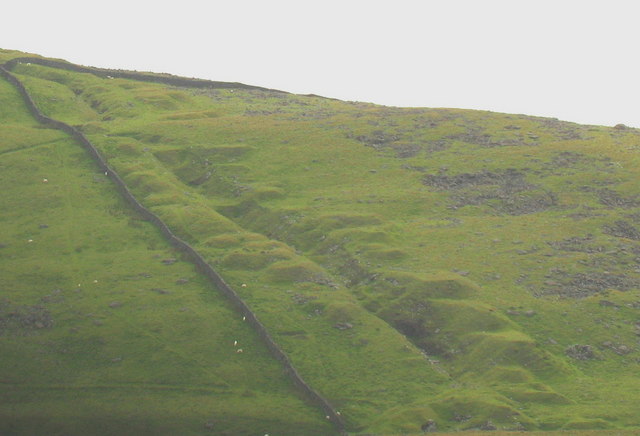
Substantial remains survive today, including quarry depressions, waste tips, tramway formations, a roofless smithy, building foundations and underground openings.
A short length of light flat-bottom rail survives by the northernmost underground opening, alongside the roofless smithy and building foundations.
Nearby mines
- Vigra Mine — 3.0 miles (4.9 km) E
- Clogau Gold Mine — 3.9 miles (6.3 km) NE
- Cefn Coch Gold Mine — 7.3 miles (11.7 km) NE
- Glasdir Mine — 8.1 miles (13.0 km) NE
- Dolgoch Quarry — 8.6 miles (13.9 km) S
Straight-line distance, within 9 miles (15 km). Show on the map.
Recorded claims
Individual factual claims, each attached to the source(s) that support it below. Where sources disagree, both are kept.
- Twelve mines opened along the manganese outcrop north of Barmouth in 1886 alone, and Merioneth's output peaked at 12,391 tons from 14 mines in 1887. 1
- Hafotty employed 22 underground and 12 surface workers at its 1890 peak, and produced 12,204 tons of ore between 1886 and 1894 before underground working ceased. 2
- The manganese bed at Hafotty was only around a quarter of a metre thick, dipping steeply at roughly 70 degrees. 2
- The Bessemer and open-hearth steelmaking processes, developed from around 1870, required roughly 14 pounds of manganese, as ferromanganese or spiegeleisen, for every ton of steel produced. 3,4
Sources
- (secondary) Merioneth Manganese: History — Hendrecoed North Wales Mining History
- (secondary) Merioneth Manganese: Hafotty — Hendrecoed North Wales Mining History
- (secondary) Uses of manganese — Hendrecoed North Wales Mining History
- (secondary) Manganese: history and industry development — Metalpedia
Record created: 22 August 2026 · Last researched: 22 August 2026