 MineArchive
Cefn Coch Gold Mine
| Location | Ganllwyd, Dolmelynllyn Estate, Gwynedd — 52.7924, -3.8998 (exact) |
|---|---|
| Commodity | Gold |
| Type | Metal |
| Worked | 1843–1914 |
Overview
Cefn Coch, on the Dolmelynllyn Estate near Ganllwyd, was the fourth-richest of the historic Dolgellau gold belt mines — smaller than its famous neighbours Clogau and Gwynfynydd, but worked across three separate periods between 1843 and 1914.
History
Mining first took place at the neighbouring Berthlwyd site from around 1843, with gold discovered there around 1845; gold was found in the Cefn Coch section itself in 1862, and the two mines — following the same lode — were often worked jointly. Between 1862 and 1865, before working ceased, 1,900 tons of ore yielded 648 ounces of gold. An unsuccessful attempt to rework the site followed from about 1873 to 1877, and Cefn Coch reopened again in 1889 on the back of a wider Welsh gold rush that year, continuing intermittently until 1914. Across its whole 1862–1912 working life, Cefn Coch produced a recorded 1,392 ounces of gold.
Geology
Gold at Cefn Coch was worked from a series of quartz veins running north-east to south-west, in places up to 6m wide, following the same lode as the neighbouring Berthlwyd workings. Like the other significant mines of the Dolgellau gold belt, Cefn Coch lies on or close to the outcrop of the Clogau Shales, and the belt's mines as a whole sit above major deep crustal fracture zones — in particular the north-east to south-west-trending Bala-Mawddach fracture zone that also underlies the larger Clogau mine nearby.
Workings
The surviving complex includes two crushing mills, a settling tank and water tank, a barracks, privy, assay office and powder magazine, along with a leat, dam and tramway; the earliest structure is a small 18th-century crushing mill beside the Afon Las.
Closure
Cefn Coch was worked in three distinct, separated phases rather than continuously: 1862-65, an unsuccessful attempt from 1873-77, and a final phase from 1889 to 1914, the last sparked by that year's wider Welsh gold rush. No further working has taken place since.
What remains
The mining complex is now ruined, protected as a Scheduled Monument on National Trust land at Dolmelynllyn; its buildings are scattered without an obvious overall layout, and there was no associated housing beyond the on-site barracks.
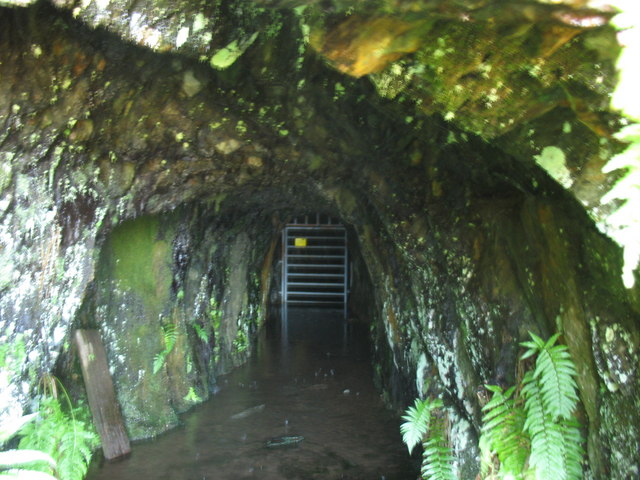
The mine workings building beside the tramway terminus and incline is a two-compartment stone structure some 4m high, 4m wide and 11m long, standing at about 255m above sea level next to an adit, with a stone-walled enclosure to its north-west built to collect water draining from that adit. Together with the crushing mills, settling tank, barracks, assay office and powder magazine elsewhere on site, it forms part of the Berth-Llwyd & Cefn Coch Gold Mining Complex, a Cadw Scheduled Monument (ME119) since 9 November 1981.
Nearby mines
- Glasdir Mine — 1.3 miles (2.0 km) E
- Turf Copper Mine — 1.9 miles (3.1 km) NE
- Dolfrwynog Mine — 2.2 miles (3.5 km) NE
- Tyddyn Gwladys Mine — 2.3 miles (3.7 km) N
- Gwynfynydd Gold Mine — 3.2 miles (5.2 km) N
Straight-line distance, within 9 miles (15 km). Show on the map.
Recorded claims
Individual factual claims, each attached to the source(s) that support it below. Where sources disagree, both are kept.
- Between 1862 and 1865, Cefn Coch's ore yielded 648 ounces of gold from 1,900 tons of rock; across its full working life to 1912, the mine produced a recorded 1,392 ounces of gold, making it the fourth-richest of the Dolgellau gold belt mines. 1
- Cefn Coch was worked in three distinct periods — 1862–65, an unsuccessful attempt from 1873–77, and a final phase from 1889, sparked by that year's Welsh gold rush, continuing to 1914. 1
- The surviving complex includes two crushing mills, a settling tank, barracks, assay office and powder magazine, along with a leat, dam and tramway, with the earliest structure a small 18th-century crushing mill beside the Afon Las. 2
- Gold at Cefn Coch was worked from a series of north-east to south-west-trending quartz veins, in places up to 6m wide, following the same lode as the neighbouring Berthlwyd workings. 1
- Like the other significant mines of the Dolgellau gold belt, Cefn Coch lies on or close to the outcrop of the Clogau Shales, part of a belt whose mines sit above major deep crustal fracture zones, including the north-east to south-west-trending Bala-Mawddach fracture zone. 3
- A two-compartment stone building beside the tramway terminus and incline, some 4m high, 4m wide and 11m long and standing at about 255m above sea level, stands next to an adit with a stone-walled water-collection enclosure to its north-west. 4
- The site is designated the Berth-Llwyd & Cefn Coch Gold Mining Complex, a Cadw Scheduled Monument (ME119), since 9 November 1981. 4,5
Sources
- (secondary) Cefn Coch Mine (incl. Berthlwyd Mine; New California Mine) — Mindat
- (primary) Gold mine, Cefn Coch Mine, Dolmelynllyn Estate — National Trust Heritage Records
- (secondary) Chapter 23: The Dolgellau gold belt — grahamhall.org
- (primary) Mine workings, Cefn Coch gold mine, Dolmelynllyn Estate — National Trust Heritage Records
- (secondary) Berth-Llwyd & Cefn Coch Gold Mining Complex — Wikidata (Cadw scheduled monument ME119)
Record created: 20 August 2026 · Last researched: 27 August 2026