 MineArchive
Ffrwd Colliery
| Location | Ffrwd, between Brymbo and Cefn-y-bedd, Wrexham — 53.0895, -3.0407 (approximate) |
|---|---|
| Commodities | Coal, Fireclay, Ironstone |
| Type | Coal |
| Worked | c. 1790s (estate pits)–1904 |
| Maximum depth | Unknown. |
| Operators | Kyrke family (1792–?), Ffrwd Iron Company (1850–1855), James Sparrow and Son (1855–1904) |
Overview
Ffrwd Colliery worked the coal and ironstone of the Ffrwd estate between Brymbo and Cefn-y-bedd, in the corner where the parishes of Wrexham, Gresford and Hope meet. Pits were sunk on the estate from the 1790s under leases granted to the Kyrke family, at Coed y Brain beside the short-lived Ffrwd canal and at Cae Gwydd; the colliery proper was opened around 1850 by the Ffrwd Iron Company to feed its own blast furnaces, and passed in 1855 to James Sparrow, who built it into one of the largest ironworks and collieries in North Wales. It was a dangerous pit: explosions killed seven in 1854, two in 1855, two in 1879 and three in 1887. By 1896 the Nos. 1 and 3 pits employed 246 people raising house and steam coal. The works closed in 1904, two years after Sparrow's death.
History
The Ffrwd estate straddled the township and parish boundaries north-west of Brynmally, and by the 1760s was held by a family called Griffiths, gentry sliding gently into farming. Their land was of great interest to the local coalmasters, and John Griffiths granted a variety of leases to the Kyrke family in the 1790s. Pits were sunk on several parts of the estate, the main ones at Coed y Brain — the pit shown in Edward Pugh's painting of the Ffrwd canal, with Caergwrle castle behind — and at Cae Gwydd, with earlier workings in the wooded ground behind Ffrwd farm known as 'the Yord', where the canal basin was dug. The canal was abandoned almost at once and a railway branch later took most of its line. The colliery proper was opened around 1850 by the Ffrwd Iron Company, which spelt itself 'Frood', to supply its own ironworks nearby. It consisted of a number of shafts and was worked with naked lights: on 19 October 1854 an explosion at the No. 9 Pit killed seven men and boys, and on 21 August 1855 an explosion of gunpowder killed two more (see Disasters, below). James Sparrow and Co. took over the colliery and ironworks later in 1855, and Sparrow expanded the Ffrwd Works — colliery, ironworks and brickworks together — into one of the most prominent businesses in North Wales, processing local ironstone into pig iron and firing bricks from fire-clay out of the same seams. The owners were Messrs Sparrow and Poole by 1859 and James Sparrow and Son by 1880. The No. 1 pit was still raising coal by whimsey in 1857. Gas explosions killed two young men in March 1879 and three more in November 1887, among many other fatal accidents at the colliery (see Disasters, below). In 1896 the Inspector of Mines listed 220 people working underground and 26 on the surface at Ffrwd Nos. 1 and 3, raising house and steam coal under the manager Lewis Williams.
Geology
Ffrwd worked the coal, ironstone and fire-clay of the Denbighshire Coalfield together, which is what made the combined colliery, ironworks and brickworks possible on one site: the ironstone went to the blast furnaces, the fire-clay from the same seams to the brick kilns, and the coal to both. The rich seams of the Nant-y-Ffrith valley supported a string of collieries and brick and iron works around Llay, Cefn-y-bedd and Ffrwd.
Geological setting: Sedimentary Beds and Seams (well documented example)
Workings
A number of shafts scattered across the estate rather than a single pit, numbered at least as high as No. 9 by 1854; the No. 1 pit was still winding by whimsey in 1857. Coal from the Coed y Brain workings originally went out by the Ffrwd canal, whose basin was dug behind Ffrwd farm and which was abandoned so early that a railway branch was later laid along most of its line. By 1896 the working pits were Nos. 1 and 3, employing 220 below ground and 26 on the surface.
Closure
James Sparrow of Gwersyllt Hill died in 1902, and in 1904 the Ffrwd works closed owing to difficult business conditions. A Clwyd Family History Society list of Denbighshire collieries gives the same closing year for Ffrwd, at Moss near Wrexham.
What remains
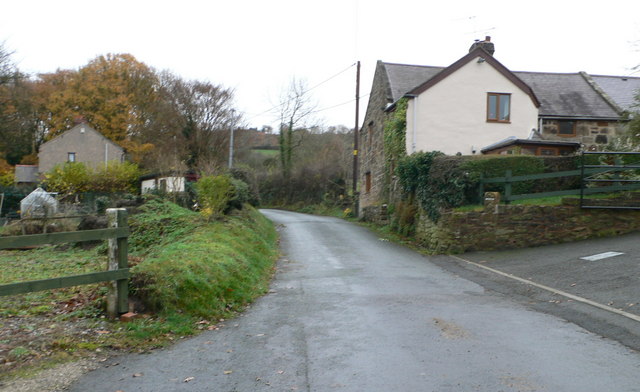
The Ffrwd is now an area of small wooded hills, deep-banked lanes and old farmhouses with very little to show that heavy industry was ever there. Fragments of water survive along the line of the canal near Ffrwd farm. The former Ffrwd Inn, also known as the Three Jolly Colliers and the Race Horses, still stands as a range of buildings at the bend in the road, and the Ffrwd Methodist chapel of 1843 survives up the left-hand fork.
Very little: fragments of the canal survive near Ffrwd farm, and the former Ffrwd Inn and the Methodist chapel of 1843 still stand.
Nearby mines
- Llay Hall Colliery — 0.7 miles (1.1 km) E
- Westminster Colliery — 1.1 miles (1.7 km) S
- Gwersyllt Colliery — 1.2 miles (1.9 km) SE
- Smelt Colliery — 1.6 miles (2.5 km) SW
- Broughton Colliery — 1.9 miles (3.1 km) S
Straight-line distance, within 9 miles (15 km). Show on the map.
Disasters & major incidents
-
Ffrwd Colliery Explosion, 1854
19 October 1854 · Explosion · 7 fatalities
On 19 October 1854 an explosion of gas at the No. 9 Pit of Ffrwd Colliery, near Brymbo in Denbighshire, killed seven men and boys. It was fired by a naked candle flame igniting gas that escaped when an air-door was opened. -
Ffrwd Colliery Gunpowder Explosion, 1855
21 August 1855 · Explosion · 2 fatalities
On 21 August 1855 an explosion of gunpowder killed two people at Ffrwd Colliery, near Wrexham, one of them a boy. -
Ffrwd Colliery Gas Explosion, 1879
March 1879 · Explosion · 2 fatalities
In March 1879 an explosion of gas killed two workers, one of them a teenager, at Ffrwd Colliery, near Wrexham in Denbighshire. -
Ffrwd Colliery Gas Explosion, 1887
18 November 1887 · Explosion · 3 fatalities
On 18 November 1887 an explosion of gas at Ffrwd Colliery, near Wrexham, killed three men, among them a collier and his son.
Recorded claims
Individual factual claims, each attached to the source(s) that support it below. Where sources disagree, both are kept.
- John Griffiths of Ffrwd granted a variety of coal leases to the Kyrke family in the 1790s, and pits were sunk on several parts of the estate, the main ones at Coed y Brain and Cae Gwydd. 1
- The colliery was opened around 1850 by the Ffrwd Iron Co. to supply its nearby ironworks, and consisted of a number of shafts. 2
- An explosion at the No. 9 Pit on 19 October 1854 killed seven men and boys, caused by a naked candle flame igniting gas when an air-door was opened. 2
- James Sparrow and Co. took over the colliery and ironworks in 1855; the owners were Messrs Sparrow and Poole by 1859 and James Sparrow and Son by 1880. 2
- The Inspector of Mines list for 1896 records 220 people working underground and 26 on the surface at Ffrwd Nos. 1 and 3, producing house and steam coal under the manager Lewis Williams. 2
- James Sparrow of Gwersyllt Hill died in 1902 and the Ffrwd works closed in 1904 owing to difficult business conditions; a Denbighshire colliery list gives the same closing year. 3,2
- The Ffrwd Works — colliery, ironworks and brickworks together — dominated Cefn-y-bedd, drawing in enough incoming workers that an area of the village was known on Ordnance Survey maps as 'Little Liverpool'. 4
- The BGS mine-plans catalogue holds a Mining Remediation Authority abandonment plan titled 'Ffrwd' (catalogue 5065, Lower Coed Rhial., dated 1906). 5
Photographs & further reading
Owners, the 1896 Inspector of Mines return and the named victims of the 1854, 1855, 1879 and 1887 explosions, on a page covering the Wrexham-area collieries together.
View sourceA close local history of the Ffrwd estate: the Griffiths family, the Kyrke leases of the 1790s, the Coed y Brain and Cae Gwydd pits, the canal and the Ffrwd Inn.
View sourceSources
- (secondary) The Ffrwd — The history of the township of Brymbo (read via a 2022 Wayback Machine capture)
- (primary) Ffrwd Colliery, near Brymbo — Welsh Coal Mines, from the Inspector of Mines lists
- (secondary) Denbighshire Collieries — Clwyd Family History Society
- (secondary) Cefn-y-bedd — Curious Clwyd
- (primary) BGS / Mining Remediation Authority mine plans: FFRWD — British Geological Survey / Mining Remediation Authority
- (observational) Ffrwd, the hamlet between Gwersyllt and Ffrith (photographed 2007) — Geograph Britain and Ireland, Eirian Evans
Record created: 9 September 2026 · Last researched: 9 September 2026