 MineArchive
Elliot Colliery
| Location | New Tredegar, Caerphilly — 51.7167, -3.2356 (exact) |
|---|---|
| Commodity | Coal |
| Type | Coal |
| Worked | 1883-85 (sinking)–1962 (closure) |
| Maximum depth | 530 yards (Lower Four Feet seam, East shaft) |
| Operators | Powell Duffryn Steam Coal Company (1882–1967) |
Overview
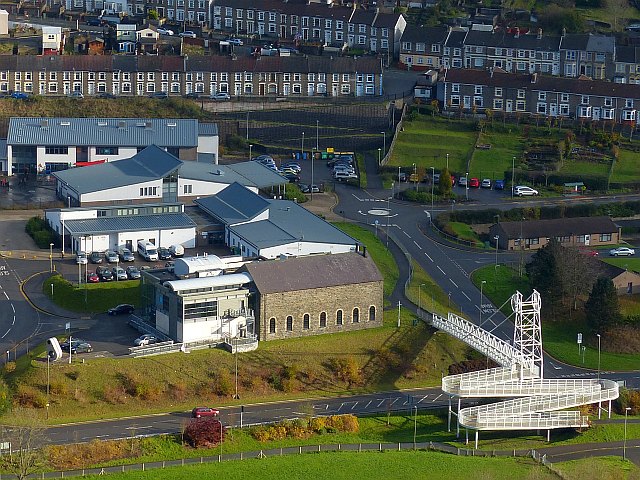
The premier colliery of New Tredegar, in the Rhymney Valley, sunk by the Powell Duffryn Steam Coal Company from 1883 and named after the company's chairman, Sir George Elliot. At its peak it employed around 2,800 people, and its 1891 Thornewill and Warham steam winding engine unusually continued winding coal and men until the colliery closed in 1967 — long after most collieries had switched to electric power. The surviving East Pit winding house, Grade II* listed, now houses the Winding House museum.
History
Elliot Colliery was sunk about a mile south of New Tredegar to work mineral rights negotiated from Lord Tredegar in 1882, and was named for Sir George Elliot, chairman of the Powell Duffryn Steam Coal Company. The west (upcast) shaft was begun on 17 January 1883 and completed to the Rhas Las seam, 450 yards down, by 1885; the east (downcast) shaft followed, begun 16 November 1888 and completed in April 1890 to the Lower Four Feet seam, 530 yards down, with the two shafts connected underground. By 1913 the colliery employed 2,757 men, and output later peaked at somewhere between roughly 450,000 and 742,000 tons a year through the mid-twentieth century, with employment reaching around 2,800 at its height. A steam winding engine built by Thornewill and Warham of Burton-on-Trent (works no. 603, twin horizontal cylinders 42 inches in diameter with a 6-foot stroke, Cornish valve gear) was installed at the East Pit in August 1891, and upgraded in 1904 with high-pressure cylinders operated through Corliss valve gear. Unusually, this engine continued to wind both coal and men up and down the East Pit shaft right up to the colliery's closure in 1967, long after most British collieries had converted to electric winding. The West Pit closed on 1 October 1962, and the whole colliery closed on 29 April 1967. Most of the surface buildings and machinery were then demolished, sold or scrapped, but the East Pit winding house and its Thornewill and Warham engine survived. Restored by Caerphilly County Borough Council in 1998, the winding house — Grade II* listed — reopened as the Winding House museum in 2008 after further redevelopment, with the engine still run periodically at reduced speed on an electric motor for visitors.
Geology
Coal of the South Wales field: the Rhas Las seam at 450 yards in the west shaft and the Lower Four Feet at 530 yards in the east.
Workings
Two shafts, the west (upcast, to the Rhas Las seam at 450 yards) and the east (downcast, to the Lower Four Feet seam at 530 yards), connected underground.
Closure
The West Pit closed 1 October 1962; the whole colliery followed on 29 April 1967, with most surface plant subsequently demolished or scrapped.
What remains
The East Pit winding house and its 1891 Thornewill and Warham steam winding engine survive, restored in 1998 as the Grade II*-listed centrepiece of the Winding House museum, which explores the history and heritage of Caerphilly County Borough; the engine is still demonstrated at reduced speed for visitors.
Nearby mines
- New Tredegar Colliery — 0.3 miles (0.4 km) NW
- Markham Colliery, Sirhowy Valley — 1.3 miles (2.1 km) E
- Groesfaen Colliery — 1.5 miles (2.4 km) SW
- McLaren Colliery — 1.5 miles (2.4 km) NW
- Pochin Colliery — 1.5 miles (2.4 km) NE, Blaenau Gwent
Straight-line distance, within 9 miles (15 km). Show on the map.
Disasters & major incidents
-
Elliot Colliery explosion, 1885
1 October 1885 · Explosion · 2 fatalities
Gas released by a roof fall exploded among a repair gang near the bottom of the new Elliot pit, New Tredegar, on 1 October 1885, burning a dozen men and boys; two or three later died. -
Elliot Colliery Cage Fall
4 March 1892 · Winding / Shaft Accident · 3 fatalities
Three men fell to their deaths at Elliot Colliery, New Tredegar, on 4 March 1892 when a bolt connecting the top of their cage snapped as they were being lowered down an 86-yard trial shaft, dropping the cage and its occupants to the bottom. -
Elliot Colliery roof fall, 1915
30 December 1915 · Collapse / Roof Fall · 4 fatalities
A small fall at the East Elliot Colliery pinned a fireman on 30 December 1915, and a much bigger one buried the men who went to free him, killing four.
Recorded claims
Individual factual claims, each attached to the source(s) that support it below. Where sources disagree, both are kept.
- The west shaft was begun 17 January 1883, completed to the Rhas Las seam (450 yards) by 1885; the east shaft was begun 16 November 1888 and completed to the Lower Four Feet seam (530 yards) in April 1890, the two connected underground. 1
- Sunk and operated by the Powell Duffryn Steam Coal Company, working mineral rights negotiated from Lord Tredegar in 1882; the colliery employed 2,757 men by 1913, rising to around 2,800 at its peak. 1
- A Thornewill and Warham steam winding engine (works no. 603) was installed at the East Pit in August 1891 and upgraded with high-pressure cylinders and Corliss valve gear in 1904; it continued winding coal and men until the colliery's closure in 1967, unusually late for a steam winder. 2
- The West Pit closed 1 October 1962 and the whole colliery closed 29 April 1967; the East Pit winding house and engine survived demolition and were restored by Caerphilly County Borough Council in 1998, reopening as the Winding House museum in 2008. 1,2
- The BGS/Mining Remediation Authority mine plans catalogue holds underground mine plans for 'ELLIOT NEW TREDEGAR', Monmouthshire/Gwent, with recorded abandonment dates from 1951 to 1968. 3
Sources
- (secondary) Elliot Colliery — Northern Mine Research Society
- (secondary) Elliot Colliery Steam Winding Engine — Wikipedia
- (primary) Mine plan: ELLIOT NEW TREDEGAR, Monmouthshire/Gwent (feature 21837287) — Mining Remediation Authority / BGS mine plans catalogue
Record created: 26 August 2026 · Last researched: 26 August 2026