 MineArchive
Deerplay Colliery
| Location | Deerplay Moor, off the A671 between Bacup and Burnley, Lancashire — 53.7345, -2.1966 (approximate) |
|---|---|
| Commodity | Coal |
| Type | Coal |
| Worked | 1894–1968 |
| Maximum depth | Drift mine: return drift 368 m at 1 in 3½, intake drift 455 m at 1 in 6. |
| Operators | Deerplay Colliery Co. Ltd (1894–1941), National Coal Board (1948–1968) |
Overview
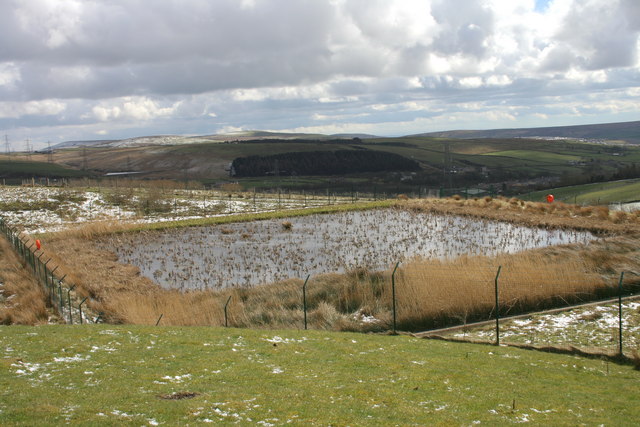
A small drift mine high on Deerplay Moor between Bacup and Burnley, driven in 1894-95 and reopened by the Coal Board in the 1950s; closed in 1968, it left ochreous water pouring from its drift into the very source of the River Irwell, now cleaned by a Coal Authority treatment scheme on the old pit site.
History
The Deerplay Colliery Company drove two drifts on Deerplay Moor in 1894-95 to work the Lower Mountain and Little Mines: a return drift 368 metres long at 1 in 3½ and an intake 455 metres long at 1 in 6. The workings drained through a water-level into Black Clough, and from 1915 the company also worked Black Clough Colliery, which straddled the Deerplay Fault, until February 1940. Before nationalisation Deerplay employed only 29 to 46 men underground and about eight on the surface, and it was temporarily closed in April 1941. The National Coal Board began refurbishing it in 1948 and reopened it in 1951-52 as a much larger venture, with about 143 men underground and 15 on the surface between 1952 and 1967, working ten advancing longwall faces east of the drifts; a short tunnel from one face linked it to the abandoned Hill Top workings. The last face line is dated 27 November 1967, and the mine was abandoned on 22 March 1968. Mine water overflowing from the workings then polluted the Irwell from its source until the Coal Authority built a pumping and treatment scheme on the colliery site, designed after test pumping in 2000, with settlement lagoons and reed beds that remove iron from the water.
Geology
The Lower Mountain (Union) and Little Mines of the Lower Coal Measures, cut by the Deerplay Fault.
Workings
Two drifts (return and intake); pillar workings west of the drifts before 1941, then ten advancing longwall faces to the east under the NCB, the last approaching the abandoned Hill Top workings.
Closure
Last face line dated 27 November 1967; NCB lists give closure as March 1968 and the mine was abandoned on 22 March, perhaps after four months of salvage.
What remains
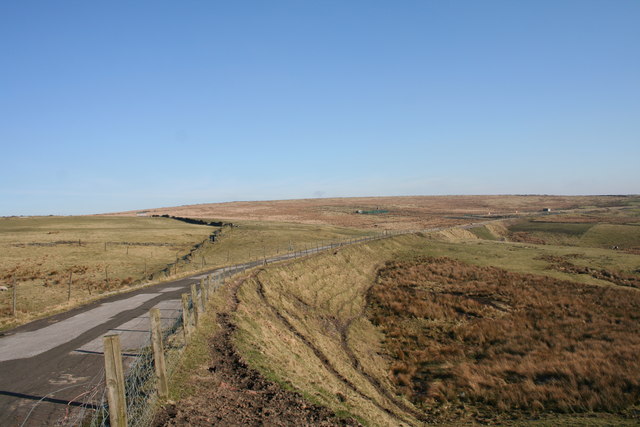
The colliery site is a Coal Authority mine-water treatment scheme of lagoons and reed beds; the approach road survives on its embankment, with one concrete lamp standard left at the gate off the A671.
The embanked approach road and a single concrete lamp standard at its entrance.
Redevelopment
Coal Authority mine-water pumping and treatment scheme (settlement lagoons and reed beds) on the colliery site; solar panels have since been installed there.
Related mines
- Hill Top Colliery — A short tunnel from one of Deerplay's NCB faces linked it to Hill Top's workings after Hill Top closed; Deerplay's last face worked ground Hill Top had left.
Nearby mines
- Hill Top Colliery — 2.1 km E
- Towneley Colliery — 5.4 km N
- Bank Hall Colliery — 7.5 km N
- Gannow Colliery — 8.0 km NW
- Hapton Valley Colliery — 9.1 km NW
Straight-line distance, within 15 km. Show on the map.
Recorded claims
Individual factual claims, each attached to the source(s) that support it below. Where sources disagree, both are kept.
- The drifts were driven by the Deerplay Colliery Co. in 1894/5 and worked the Lower Mountain and Little Mines; the return drift was 368 m long at 1 in 3½ and the intake 455 m at 1 in 6. 1
- The NCB began refurbishing Deerplay in 1948 and reopened it in 1951/2, with an average of 143 men underground and 15 on the surface between 1952 and 1967. 1
- The last face line is dated 27/11/1967; NCB lists give closure as March 1968, and the mine was abandoned on 22 March. 1
- Black Clough Colliery was opened by the Deerplay Colliery Co. Ltd in 1915 and temporarily closed in February 1940. 2
- Minewater from the Lower and Upper Mountain seams outfalling into Black Clough could be controlled by pumping from a borehole into the Lower Mountain workings of Deerplay Colliery; the scheme was to remediate the derelict colliery site. 3
- The Coal Authority's Deerplay scheme removes iron from water pumped out of the former colliery near Bacup to improve the discharge into the River Irwell. 4
Photographs & further reading
Technical paper on the mine-water problem and the design of the treatment scheme.
View sourceSources
- (secondary) Deerplay Colliery - Northern Mine Research Society — Northern Mine Research Society
- (secondary) Black Clough Colliery - Northern Mine Research Society — Northern Mine Research Society
- (primary) Treatment of the gravity minewater discharge at Deerplay Mine, Burnley, UK (IMWA 2000) — International Mine Water Association
- (primary) More sustainable way to refurbish reed beds is trialled — Coal Authority
Record created: 21 September 2026 · Last researched: 21 September 2026