 MineArchive
Daw Mill Colliery
| Location | near Arley, Warwickshire — 52.5064, -1.6178 (exact) |
|---|---|
| Commodity | Coal |
| Type | Coal |
| Worked | 1956 (sinking)–2013 |
| Maximum depth | 1,770 feet (shaft) |
| Operators | National Coal Board (1956–?), UK Coal Operations Ltd (1994–2013) |
Overview
Once Britain's biggest coal producer, Daw Mill was the only new colliery sunk in Warwickshire after nationalisation, and ended its life in 2013 in the worst underground fire Britain had seen in thirty years.
History
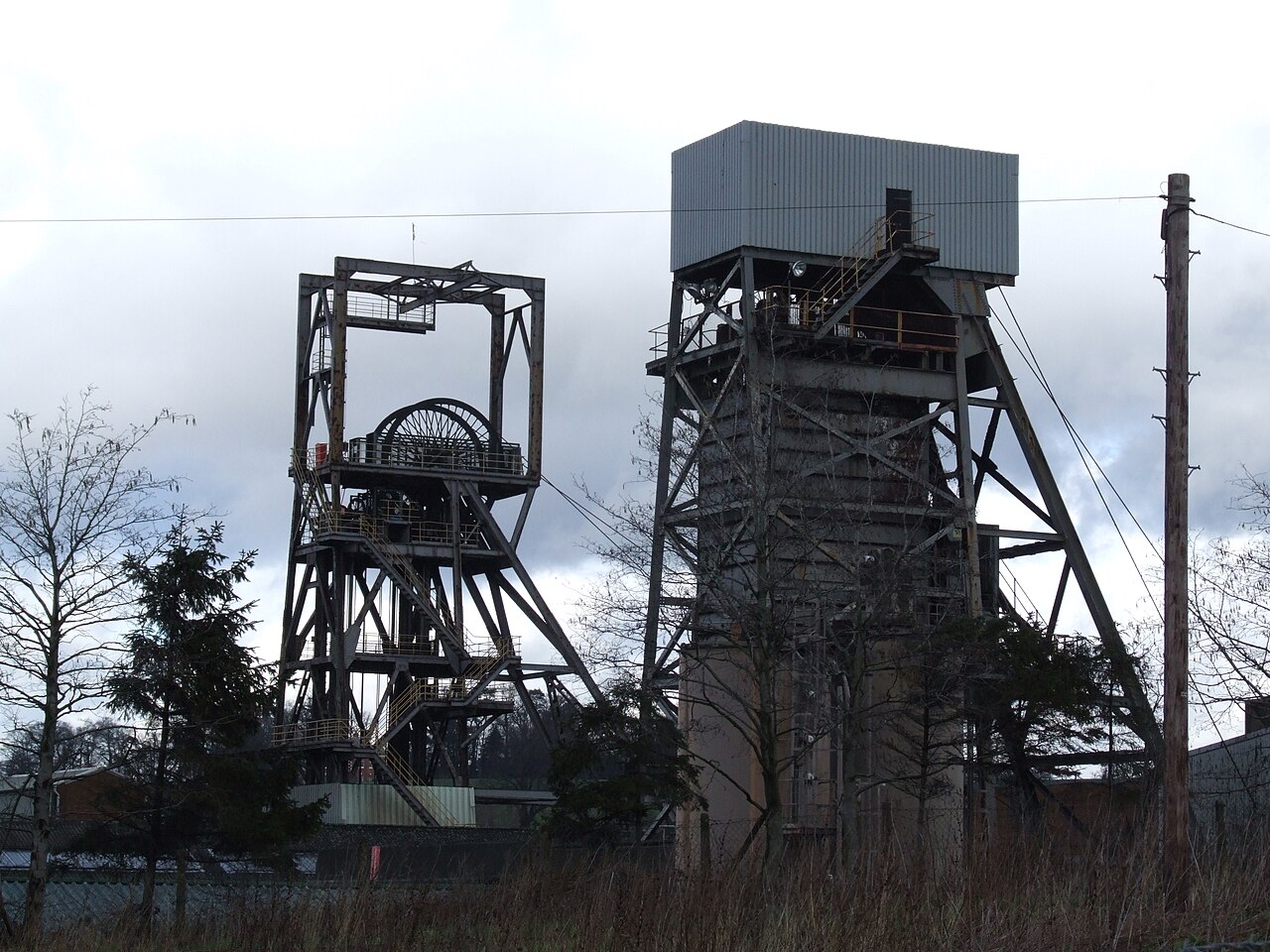
Site work at Daw Mill, near Arley in Warwickshire, began in 1956, on a shaft first meant only to ventilate the workings of Dexter Colliery, and by late 1958 it had been decided to develop it as a new colliery rather than simply an extension of existing workings — the only wholly new colliery sunk in Warwickshire after nationalisation. The shaft was completed in 1959 to a depth of 1,770 feet. A second shaft was sunk between 1969 and 1971, and when output had caught up with what the shafts could wind the Coal Board drove a drift from the surface, finished in 1983, so that coal came out by conveyor. The mine worked a five-metre section of the Warwickshire Thick coal.
Daw Mill went on to become Britain's biggest coal producer, setting a new annual output record of 3.25 million tonnes in 2008, surpassing the record previously held by Selby Colliery in North Yorkshire, and directly employed around 570 people at UK Coal.
On 22 February 2013 a serious underground fire broke out, caused by spontaneous combustion within a worked coal seam; it was described as the worst underground blaze in Britain for thirty years. Around 100 workers were evacuated from the mine, with 14 men staying behind for roughly four hours in an attempt to contain the blaze before being forced to withdraw; all 92 workers below ground at the time were safely brought to the surface. The fire could not be extinguished, and was not finally out until 15 May; on 7 March 2013 UK Coal announced the colliery's permanent closure, with the loss of some 650 jobs; the damage and its financial consequences tipped UK Coal Operations Ltd into administration that July. The closure was significant enough to be debated twice in the House of Commons, in March and April 2013.
The site passed to Harworth Estates, UK Coal's former property arm, whose plans for a business park and rail hub were refused by North Warwickshire Borough Council in November 2015. The Court of Appeal ended the appeals in 2018, and in May 2022 Warwickshire County Council served an enforcement notice requiring the land to be cleared, recontoured and replanted as Green Belt.
Geology
A five-metre section of the Warwickshire Thick coal, in the north of the Warwickshire coalfield; the seam is liable to spontaneous combustion.
Workings
Coal was raised via a single shaft completed in 1959 to a depth of 1,770 feet, developed into one of Britain's largest and most productive individual coal mines by the 2000s. A second shaft followed in 1969-71 and a surface drift with a conveyor in 1983, which took over coal clearance from the shafts; the mine began as an extension of Kingsbury and Dexter collieries, and Dexter's shaft was kept for man-riding.
Closure
UK Coal announced Daw Mill's permanent closure on 7 March 2013 following the underground fire, with the loss of around 650 jobs; the resulting financial damage helped tip UK Coal Operations Ltd into administration that July.
What remains
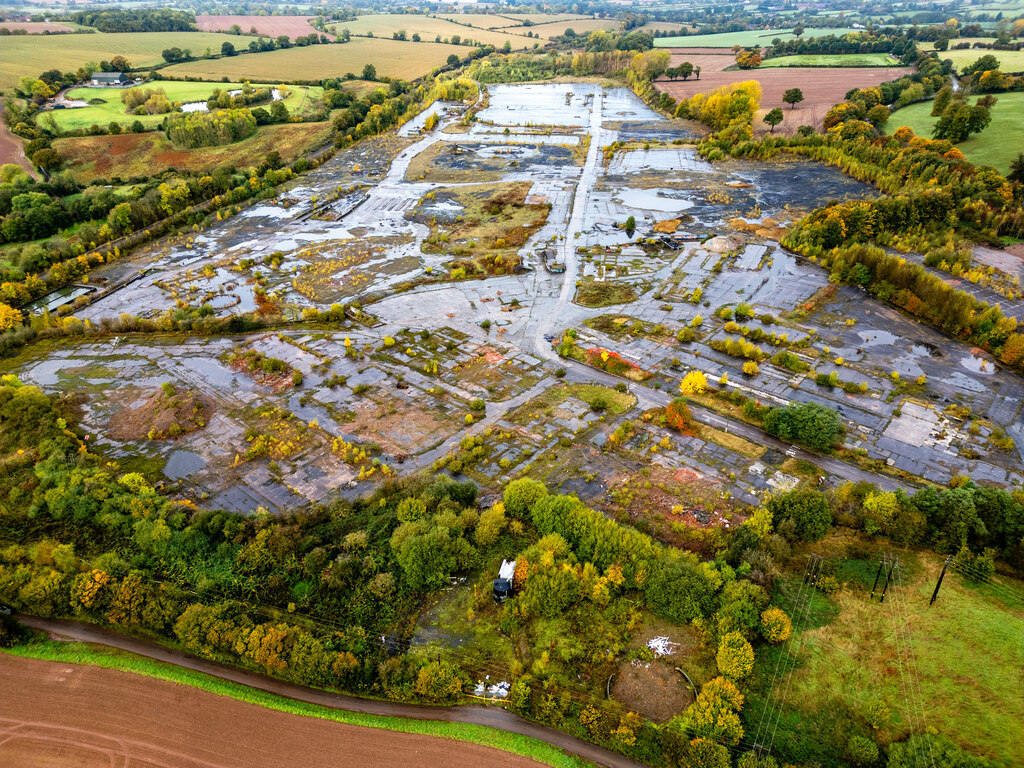
The colliery has been almost entirely demolished, leaving only foundations, a ruined building and former railway sidings. From the air the site is a wide spread of broken concrete and standing water, ringed by trees.
Foundations, a ruined former colliery building and disused railway sidings are all that remain of the site.
Redevelopment
None. Harworth Estates' business park and rail hub was refused in 2015 and the appeals ended in 2018; the 2022 enforcement notice requires the site to be restored to the Green Belt.
Related mines
- Dexter Colliery — Daw Mill took Dexter's coal from 1960; Dexter carried Daw Mill's men.
- Kingsbury Colliery — Daw Mill was developed as an extension of the Kingsbury and Dexter workings and took over their coal.
Nearby mines
- Arley Colliery — 0.1 miles (0.1 km) NE
- Ansley Hall Colliery — 3.7 miles (5.9 km) NE
- Baddesley Colliery — 4.6 miles (7.4 km) N
- Dexter Colliery — 4.8 miles (7.7 km) N
- Coventry Colliery — 5.1 miles (8.2 km) SE
Straight-line distance, within 9 miles (15 km). Show on the map.
Disasters & major incidents
-
Daw Mill Colliery fire, 2013
22 February 2013 · Fire · 0 fatalities
An underground fire caused by spontaneous combustion broke out at Daw Mill Colliery, Britain's biggest coal producer, described as the worst underground blaze in the UK for thirty years; all 92 workers underground were safely evacuated, but the fire could not be extinguished and led directly to the mine's permanent closure and UK Coal's collapse into administration.
Recorded claims
Individual factual claims, each attached to the source(s) that support it below. Where sources disagree, both are kept.
- Site work at Daw Mill began in 1956, with the shaft completed in 1959 to a depth of 1,770 feet; it was the only wholly new colliery sunk in Warwickshire after nationalisation. 1,2
- Daw Mill set a new British annual output record of 3.25 million tonnes in 2008, surpassing the previous record held by Selby Colliery, and became Britain's biggest coal producer. 1
- An underground fire caused by spontaneous combustion broke out on 22 February 2013, described as the worst underground blaze in Britain for thirty years; around 100 workers were evacuated, with 14 remaining for roughly four hours trying to contain it before withdrawing, and all 92 men below ground at the time reached the surface safely. 1,2
- UK Coal announced Daw Mill's permanent closure on 7 March 2013 after the fire could not be extinguished, with the loss of around 650 jobs; the company was forced into administration in July 2013. 1,3
- Located at about 52.506 N, 1.618 W. 1
- A second shaft was sunk between 1969 and 1971, and an inclined drift from the surface, completed in 1983, raised the mine's capacity. 1,2
- Daw Mill mined a five-metre thick section of the Warwickshire Thick coal and employed 680 people in 2008. 1
- The first shaft was begun in 1956 to ease ventilation in the Dexter Colliery workings; late in 1958 it was decided to make Daw Mill a new colliery handling Dexter's coal. 2,4
- The fire was finally extinguished on 15 May 2013, nearly three months after it broke out. 1
- North Warwickshire Borough Council refused Harworth Estates' business park in November 2015, and in 2018 the Court of Appeal ruled that there could be no further appeals. 1,5
- Warwickshire County Council served an enforcement notice in May 2022 requiring the site to be restored by removing the remaining structures and rubble and recontouring and replanting the ground. 6
- In 2023 all that remained were foundations, a ruined house and abandoned railway sidings. 4
Photographs & further reading
28DaysLater exploration report of the site's demolished remains.
View sourceA 2023 visit to the cleared site, with a history of the shafts, the drift and the fire.
View sourceSources
- (secondary) Daw Mill — Wikipedia
- (secondary) Daw Mill Colliery — Our Warwickshire
- (primary) Daw Mill Colliery Closure (Hansard, 11 March 2013) — UK Parliament (Hansard)
- (observational) Report - Daw Mill Colliery (remains of), Coventry, Mar 23 — 28DaysLater
- (secondary) Final decision on future of Daw Mill colliery — Coventry Telegraph
- (secondary) Daw Mill Colliery owners issued with urgent enforcement notice to restore site — Coventry Telegraph
- (observational) Daw Mill Colliery, aerial view (Geograph 7988390) — Geograph
Record created: 21 August 2026 · Last researched: 1 October 2026