 MineArchive
Cwm Eigiau Quarry
| Location | Cwm Eigiau, head of the Afon Eigiau valley, Gwynedd — 53.1526, -3.9441 (exact) |
|---|---|
| Commodity | Slate |
| Type | Slate |
| Worked | Before 1840–1885 |
| Maximum depth | Unknown. |
| Operators | Caedryn & Cwm Eigiau Slate Co. Ltd (1874–1885) |
Overview
A small open slate quarry at the head of the Afon Eigiau valley in Snowdonia, worked before 1840 and served by its own tramway down to the river Conwy -- a valley whose name later became notorious for an entirely separate catastrophe, the 1925 collapse of the Eigiau reservoir dam.
History
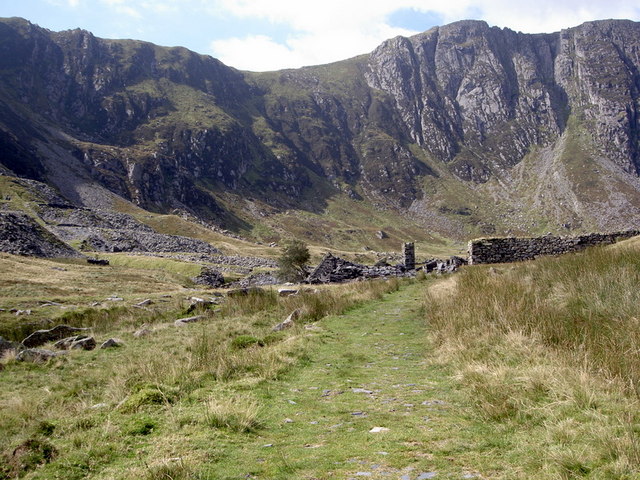
Cwm Eigiau slate quarry was a small open working at the head of the Afon Eigiau valley, a tributary of the Conwy, worked before 1840. Slate was originally carried out by packhorse before a tramway extension was built in the 1860s down to the river Conwy, connecting to the neighbouring Cedryn quarry's own tramway. By 1874 the two operations had combined as the Caedryn & Cwm Eigiau Slate Co. Ltd, but the company was dissolved just eleven years later, in 1885, once the slate proved to be of poor quality; the quarry itself had closed by the end of the 1900s. Decades later, the same valley's name became attached to one of Wales's worst civil engineering disasters: the Aluminium Corporation Limited built a dam at Eigiau from 1907 to power its aluminium processing plant at Dolgarrog, and a short extension to the old Eigiau Tramway was built to assist the dam's construction and later reconstruction work. On 2 November 1925, after five days of exceptionally heavy rain, the Eigiau dam failed, and the resulting flood killed 16 people in the village of Dolgarrog below; the disaster led directly to the Reservoirs (Safety Provisions) Act 1930, which introduced statutory safety requirements for large dam construction and inspection nationally.
Geology
Slate at the head of the Afon Eigiau valley, a tributary of the Conwy, worked as a small open quarry.
Workings
A small open quarry worked across five terraces with an incline down to a mill, alongside up to four separate mill buildings, a substantial leat embankment, and small supply reservoirs feeding the works.
Closure
The Caedryn & Cwm Eigiau Slate Co. Ltd was dissolved in 1885 after its slate proved poor quality; the quarry itself had closed by the end of the 1900s.
What remains
Ruined mill buildings, a workshop and a powder house survive on the terraced quarry site, along with the leat embankment and small reservoirs.
Five worked terraces, ruins of up to four mills, a workshop, a powder house, and a substantial leat embankment with small supply reservoirs.
Related mines
- Cedryn Quarry — Joined by the same tramway from the 1860s and worked by one company from 1874.
Nearby mines
- Cedryn Quarry — 1.1 miles (1.8 km) E, Conwy
- Pandora Mine — 4.6 miles (7.4 km) SE, Conwy
- Cae Coch Sulphur Mine — 4.9 miles (7.8 km) E, Conwy
- Penrhyn Quarry — 5.2 miles (8.3 km) W
- Pantdreiniog Quarry — 5.3 miles (8.5 km) NW
Straight-line distance, within 9 miles (15 km). Show on the map.
Recorded claims
Individual factual claims, each attached to the source(s) that support it below. Where sources disagree, both are kept.
- By 1874 the Cedryn and Cwm Eigiau slate operations had combined as the Caedryn & Cwm Eigiau Slate Co. Ltd, but the company was dissolved just eleven years later, in 1885, once the slate was found to be of poor quality. 1
- The quarry was worked across five terraces with an incline to a mill, with up to four separate mill ruins, a substantial leat embankment, small supply reservoirs, and buildings including a workshop and powder house surviving on site. 2
- On 2 November 1925, after five days of exceptionally heavy rain, the Eigiau dam -- built from 1907 by the Aluminium Corporation Limited to power its Dolgarrog processing plant, and served in part by an extension of the old quarry tramway -- failed, and the resulting flood killed 16 people in Dolgarrog; the disaster led to the Reservoirs (Safety Provisions) Act 1930. 1
Photographs & further reading
The official RCAHMW record for the quarry's surviving remains.
View sourceSources
- (secondary) Eigiau Tramway — Wikipedia
- (primary) Cwm Eigiau Slate Quarry — Coflein (RCAHMW)
- (observational) Quarry workings in Cwm Eigiau — Geograph Britain and Ireland (Patrick)

Record created: 30 August 2026 · Last researched: 30 August 2026