 MineArchive
Crich Limestone Quarries
| Also known as | Cliff Quarry, Crich Cliff Quarry |
|---|---|
| Location | Crich Cliff, near Matlock, Derbyshire — 53.0970, -1.4820 (approximate) |
| Commodity | Limestone |
| Type | Quarry |
| Worked | Early 19th century (Cliff Quarry)–1957 (Cliff Quarry) |
| Maximum depth | Open quarrying in benches; no shaft depth applies. |
| Operators | George Stephenson (1840–?) |
Overview
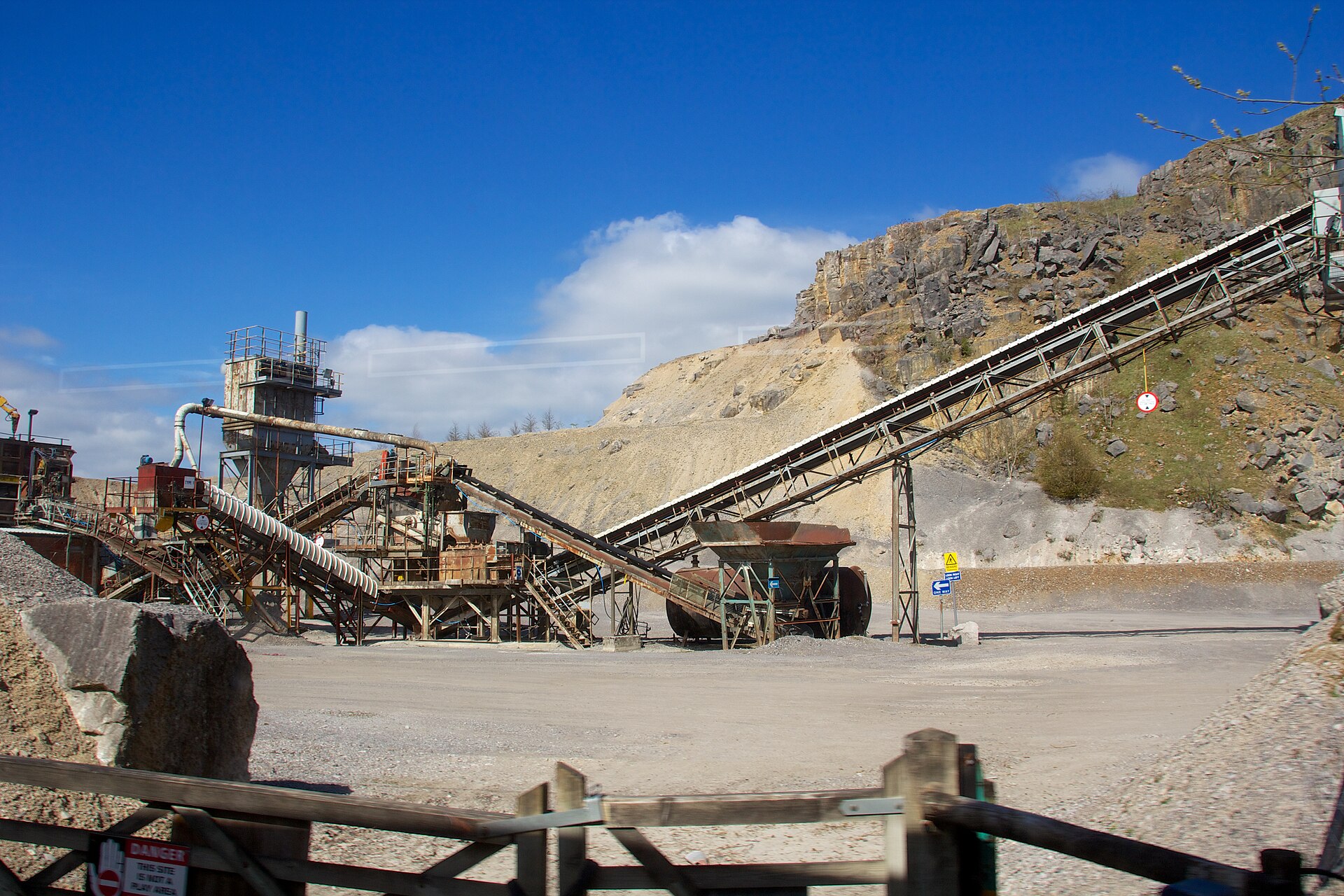
Limestone quarries on Crich Cliff, of which Cliff Quarry is the one that matters. George Stephenson came to Crich in 1840 to plan the quarrying of limestone and the railway to carry it: building the North Midland Railway he had found coal at Clay Cross, and he saw that local coal and Crich limestone together could make burnt lime for agriculture, distributed by his own railway. The mineral line to the kilns at Ambergate carried six million tons over 116 years before closing with the quarry in 1957. Two years later the Tramway Museum Society found the site and made it the National Tramway Museum.
History
Crich was already well known for the quality of its limestone when George Stephenson arrived in 1840 to plan the quarrying of Cliff Quarry and the railway to take the stone away. He had been building the North Midland Railway from Derby to Rotherham and Leeds, had found rich coal seams around Clay Cross, and saw a business in putting the two together: local coal to burn local limestone into agricultural lime, and the new railway to distribute it. The Crich Mineral Railway was built to carry limestone from Cliff Quarry down to a battery of limekilns at Ambergate. It was metre gauge — apparently the first metre-gauge railway in the world — and Stephenson superintended its construction himself; it included two tunnels and two self-acting inclines. Around 1841 Messrs Linacre and Jowett built twelve limekilns for Stephenson at a cost of £20,000, using former stone railway sleeper blocks, and a further eight were added immediately afterwards. Over 116 years of operation the line carried six million tons of limestone. By mid-1957 Cliff Quarry had closed along with the mineral railway. In 1959 the Tramway Museum Society found the site and chose it for a tramway museum. Quarrying at Crich did not stop there: the ground has expanded northwards over time, and the part worked today is shown on late nineteenth and early twentieth-century maps as fields with old shafts and an old lead mine.
Geology
Carboniferous limestone at Crich Cliff, an inlier of limestone rising through the surrounding gritstone and shale — which is why there is good stone here at all, well east of the main limestone country of the White Peak. The same inlier carries lead: the ground now quarried at the northern end of the site is marked on older maps with old shafts and an old lead mine, so the quarry has advanced across an earlier mining field.
Workings
Open quarrying on the cliff, with the stone taken out by Stephenson’s metre-gauge mineral railway of 1841 — two tunnels and two self-acting inclines down to the limekilns at Ambergate, where twelve kilns were built for £20,000 and eight more added at once. The quarry has migrated: its original nineteenth-century extent was at the southern end of the site, where Crich Tramway Village now stands, and working has encroached steadily northwards since.
Closure
Cliff Quarry and its mineral railway both closed by mid-1957, after 116 years and six million tons. The site’s second life began almost immediately: the Tramway Museum Society found it in 1959 and selected it as suitable for a tramway museum.
What remains
The southern end of the site, the original nineteenth-century quarry, is Crich Tramway Village, home of the National Tramway Museum; a tramway extends north from it, running at least partly along the former mineral railway route, and at its Wakebridge terminus on the western edge of the former quarry stands a collection of mining relics brought in from threatened sites across the Derbyshire orefield. Quarrying continues at the northern end of the site.
The quarry faces themselves, the route of the Crich Mineral Railway now partly used by the museum tramway, and the assembled Derbyshire orefield mining relics at the Wakebridge terminus.
Nearby mines
- Wingfield Manor Colliery — 2.6 miles (4.2 km) E
- Long Sough Entrance — 3.4 miles (5.4 km) W
- Shirland Colliery — 3.5 miles (5.6 km) NE
- Bage Mine — 3.5 miles (5.7 km) W
- Riber Mine — 3.5 miles (5.7 km) NW
Straight-line distance, within 9 miles (15 km). Show on the map.
What's uncertain
Points where sources disagree or the record could not be settled; both accounts are kept. All open questions in the archive.
- Stephenson constructed a metre gauge line — apparently the first metre gauge railway in the world — and superintended the construction himself; it included two tunnels and two self-acting inclines. (uncertain) 1
Recorded claims
Individual factual claims, each attached to the source(s) that support it below. Where sources disagree, both are kept.
- In 1840 Stephenson came to Crich to plan to quarry limestone from Cliff Quarry and the railway to take the material to the lime works. While building the North Midland Railway from Derby to Rotherham and Leeds he had found rich coal seams in the Clay Cross area, and he saw that he could use the local coal and limestone to produce burnt lime for agricultural purposes and use the new railway to distribute it. 1
- Cliff Quarry was linked in 1841 by George Stephenson’s mineral railway to the limekilns at Ambergate; the line was in operation until 1957. 2
- Stephenson constructed a metre gauge line — apparently the first metre gauge railway in the world — and superintended the construction himself; it included two tunnels and two self-acting inclines. (uncertain) 1
- About 1841 Messrs Linacre and Jowett built twelve limekilns for Stephenson at a cost of £20,000, using former stone railway sleeper blocks, and a further eight kilns were added immediately afterwards. 1
- Over the 116 years of operation until its closure in 1957, the line carried six million tons of limestone. 1
- By mid-1957 Cliff Quarry was closed along with the small mineral railway, and in 1959 the Tramway Museum Society discovered the site at Crich and selected it as suitable for a Tramway Museum. 1
- Comparison of modern mapping with OS maps from the late 19th and early 20th centuries shows the site to have expanded northwards over time. The area currently quarried at the north is shown on those older maps as fields with "Old Shafts" and an "Old Lead Mine"; the original extent of the quarry was at the southern end of the site, where Crich Tramway Village is located today. 2
- At the Wakebridge terminus of the museum tramway, on the western edge of the former quarry, is a collection of mining relics removed from various threatened sites in parts of the Derbyshire orefield and brought there. 2
Photographs & further reading
The county record: the 1841 mineral railway link to Ambergate, the quarry’s northward migration across an older lead-mining field, and the Derbyshire orefield relics collected at Wakebridge.
View sourceThe museum’s account of why Stephenson came to Crich, the metre-gauge line with its tunnels and self-acting inclines, the twenty limekilns at Ambergate, and the six million tons carried before 1957.
View sourceSources
- (secondary) Following in the Footsteps of George Stephenson — National Tramway Museum
- (primary) MDR7885 — Cliff Quarry, Crich Cliff, Crich — Derbyshire Historic Environment Record
- (secondary) Crich — Wikipedia
Record created: 8 September 2026 · Last researched: 8 September 2026