 MineArchive
Clintsfield Colliery
| Location | Clintsfield, Tatham, near Wennington, Lancashire — 54.1225, -2.5681 (approximate) |
|---|---|
| Commodity | Coal |
| Type | Coal |
| Worked | Leased 1772–1856 |
| Maximum depth | Estimated at about 70 m at the engine shaft, from the dip of the coal. |
| Operators | John Martin and Company (1772–1789), Arthur Cort (1834–1839), Hornby Roughsedge (1839–1853), George Sergeantson (1845–?), Sewart and Handley (1853–1856) |
Overview
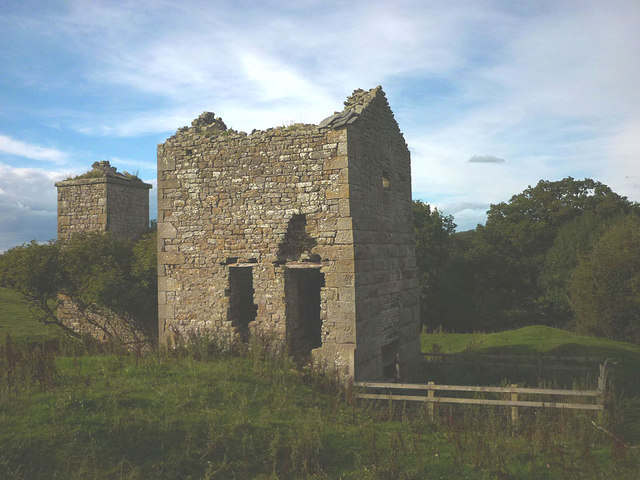
A small colliery in the Lune valley working coal barely two feet thick, leased from 1772 and finished by 1856. Its roofless engine house, built to hold a beam engine for pumping, still stands among the shaft mounds and gin circles, an arrangement — steam for water, horses for coal — that survives here because the pit never became worth the cost of steam winding.
History
The earliest record of mining at Clintsfield is a lease of 1772, renewed in 1782, between Lord Charteris, lord of the manor of Hornby, and four men of the district: John Martin of Arkholme and John Addinson of Littledale, yeomen, and Edward Martin and William Storrs of Tatham, colliers. Land tax records between 1781 and 1832 give the owner of the colliery as the Gerards of Robert Hall, absentee landowners whose main estates lay around Wigan, and John Martin and Company appear as tenants until 1789. Yates's map of Lancashire in 1786 shows four coal pits here and a waterwheel, most likely a pumping gin. From May 1834 Arthur Cort of Lowgill held a fourteen-year lease at £70 a year; he went bankrupt in November 1839, the lease having passed in August to Hornby Roughsedge of Bentham, who owned the Bentham flax mills and wanted the colliery to fuel them. Roughsedge tried to let it: George Sergeantson of the Ingleton collieries turned it down in 1842 rather than take the machinery at £2,500, and when he did take it in June 1845 he stopped the colliery working and supplied the Bentham trade from his own pits. By 1855 it was reported to have stood closed for several years through flooding. James Wearing Sewart and George Handley took the lease in November 1853 for £65 a year, Sewart finding the capital, and the mine reopened in March 1855 after what the advertisements called a great outlay. It did not last: in April 1856 Sewart's affairs were put in the hands of trustees for his creditors, the colliery closed that September, and the plant was auctioned at Bentham in October. By 1861 the engine house had been given an extra floor and hearths and was lived in by a young agricultural labourer and his family.
Geology
The coal is interbedded with the Accerhill Sandstone of the Lonsdale Fells basin and is only 16 to 24 inches thick, lying above the horizon worked at the larger Tatham Colliery nearby. The beds dip about 20 degrees to the north-east, and the area that could be worked was severely limited by a network of large faults that cut the coal out; a second, thinner coal lies beneath in the Silver Hills Sandstone and was only ever worked in shallow diggings elsewhere in the township.
Workings
Twenty pits have been located on the site, five of them already marked as old on the first Ordnance Survey of 1847–50 and all of them old by 1890. Coal was got from levels driven in the seam and worked up-dip, the levels doubling as haulage ways to the pit bottom; when a level was worked out or met a fault a new pit was sunk further down the dip. The engine house, built of sandstone in the early 19th century, held the pumping engine — documents of 1839 record an engine of five horse power with a boiler and a pump — and stood over the main shaft, with an attached boiler house and a stone chimney about 6 m tall. Three small reservoirs with dams lie on the eastern side, one of them feeding a leat that runs past the engine house and is thought to have supplied water for the boiler. A roadway links three of the shaft mounds.
Closure
The colliery closed in September 1856 when the trustees of the bankrupt lessee gave it up, and the plant was sold the following month. Attempts to find a new tenant failed the next year, and although there were efforts to reopen workings in the area in 1863 and an advertisement of 1873 implies some working of the upper seam, no rent for the colliery appears in the landowner's accounts again.
What remains
The engine house survives largely to its original height, roofless, with a partly blocked doorway and the partly blocked round-headed aperture through which the engine beam projected over the shaft; the site is a scheduled monument and the engine house is listed at Grade II. The shaft mounds, gin circles, roadway, reservoirs and water-management earthworks survive undisturbed, the field never having been ploughed or built on since the 1860s.
The engine house with its attached boiler house and chimney, a circular earthwork read as a gin circle to its north, further shaft mounds with a second small gin circle at the south end of the site, a roadway linking three of them, and three reservoirs with their dams and leat.
Redevelopment
The engine house was converted into a dwelling soon after the colliery closed and was occupied in 1861, but stood empty by the next census and has been a ruin since.
Nearby mines
- Meal Bank Quarry — 7.7 km NE, North Yorkshire
Straight-line distance, within 15 km. Show on the map.
What's uncertain
Points where sources disagree or the record could not be settled; both accounts are kept. All open questions in the archive.
- A circular earthwork north of the engine house is considered to be the site of a gin circle for horse-powered winding. (disputed) 2
- Only hand-powered windlasses are mentioned in the sale of the colliery's equipment in 1856. (disputed) 1
Recorded claims
Individual factual claims, each attached to the source(s) that support it below. Where sources disagree, both are kept.
- The earliest record of mining at Clintsfield is a lease of 1772, renewed in 1782, from Lord Charteris of Hornby to John Martin, John Addinson, Edward Martin and William Storrs. 1
- The coal is 16 to 24 inches thick, interbedded with the Accerhill Sandstone, and the workable area was severely limited by faulting. 1
- Documentary sources indicate that in 1839 the engine house held an engine of five horse power with a boiler and a pump. 2
- A circular earthwork north of the engine house is considered to be the site of a gin circle for horse-powered winding. (disputed) 2
- Only hand-powered windlasses are mentioned in the sale of the colliery's equipment in 1856. (disputed) 1
- The colliery reopened in March 1855 after a great outlay by James Wearing Sewart, closed again in September 1856, and its equipment was auctioned that October. 1
Photographs & further reading
A detailed local history of the colliery from leases, land tax records, diaries and newspaper advertisements, with a geological section and field observations made in 2015.
View sourceSources
- (secondary) Clintsfield Colliery and Engine House — Tatham History Society
- (primary) Clintsfield Colliery, Tatham (List entry 1018920) — Historic England
Record created: 22 September 2026 · Last researched: 22 September 2026