 MineArchive
Buriton Chalk Pit
| Also known as | Buriton Lime Works, Buriton Chalk Pits, Forders Lime Works |
|---|---|
| Location | Kiln Lane, Buriton, near Petersfield, Hampshire — 50.9729, -0.9545 (exact) |
| Commodities | Chalk, Limestone |
| Type | Quarry |
| Worked | c. 1860–1939 |
| Maximum depth | Faces about 60 feet high; an open quarry, so no shaft depth applies. |
| Operators | B. J. Forder (1860–?), Keeble Brothers (1899–?), British Portland Cement Manufacturers (1927–1939) |
Overview
A chalk quarry and lime works on the north scarp of the South Downs, worked for some eighty years from about 1860 until 1939. Three pits — known as France, Germany and the White pit — fed a set of kilns beside Kiln Lane, and the burnt lime went out by rail from Buriton Sidings for mortar, cement, plaster and agriculture. It employed around forty men, and up to a hundred in the summer building season, in a village whose cricket team was drawn largely from its workforce. The site is now Buriton Chalk Pit, a 5.7-hectare Local Nature Reserve.
History
The works are believed to have been started by B. J. Forder in about 1860, when he came from Winchester to live at Berriton Court. What made them possible was the Portsmouth–London railway, opened early in 1859, which brought coal to Petersfield; without fuel there was no lime burning. Forder worked two pits, one each side of the road then known as Halls Hill, under lease from John Bonham Carter, and the 1871 census records him as a limeburner employing twenty men and four boys. A lease of November 1878 records that a new lime kiln had recently been built. By 1899 the lease for digging chalk had passed to Keeble Brothers of Peterborough. When Lothian Bonham Carter died in 1927 the works were leased to the British Portland Cement Company and the estate sale catalogue described them as providing a substantial annual income; the cement company bought the site in that sale. It had hoped to turn the quarry into a cement works, but this did not prove possible, and the works closed in 1939. The village felt it. Percy Legg, recalling the closure in the 1960s, said it "made a lot of difference to the village" and remembered forty men coming home for lunch like men leaving a factory. The cricket team had drawn heavily on them; the season often opened with a match between the limeworks and the men from the farm and the estate.
Geology
Upper Chalk on the north-facing scarp of the South Downs above Buriton. The chalk was not uniform, and the works exploited the difference: the France and Germany pits held chalk with a higher clay impurity, grey in the ground and burning to a creamy powder, which made mortar and in later years a good waterproof cement. The White pit, further south on Head Down, gave a clean white chalk sold for plaster and for gas and water purifying. Waste from either was ground for agricultural lime.
Workings
Three main open pits — France on War Down, Germany across the road south and east of Kiln Lane, and the White pit further south on Head Down. Maps of 1870 show a relatively small area of quarrying; by 1897 France and Germany are both clear, each with kilns, and by 1932 the workings are much more extensive and take in the White pit. The faces stood about sixty feet high. Work began by stripping the callow — the mix of broken chalk and earth at the lip — so it would not contaminate the stone. Long iron bars were then used to prise chalk from the bottom of the face, and the resulting overhang blasted down: shot holes were drilled, water poured in and the sludge raked out with a miniature rake, and the black powder rammed home with a wooden pole tipped with copper, so that a stray flint could not strike a spark. If a piece of the face "dripped", the men stood back and waited for it to fall. Broken stone was loaded by gravel fork into trucks holding about a ton and a half. A complex internal network of three-foot-gauge railways and inclines carried the chalk to the kilns: horses drew the trucks to the head of an incline, from where they ran down by gravity, a man riding the back with his foot on a brake handle that pressed a wooden shoe against the wheels, and a second man signalling when it was clear to cross Kiln Lane — which the White pit trucks did twice. Spills were not uncommon. Horses returned the empties, about three at a time, until two forty-horsepower Simplex locomotives with Dorman petrol engines took over in 1923; at least one had been used in the First World War to carry supplies to the Allied front. Several kinds of kiln were tried. Large flare kilns stood in France pit and across the road in Germany, probably out of use by about 1920; Germany also held a Hoffmann-type kiln, a circular group of thirteen or fourteen chambers around a 145-foot chimney, in which each chamber pre-heated the next so that burning was continuous — slow, labour-intensive, and only worth it while lime fetched a good price. It too was long out of use by the mid-1920s. Most of the lime in the later years came from a set of four or five continuous draw shaft kilns, their bores welling out to about fifteen feet and narrowing to four feet six inches at the top, with eight firing holes at the widest point. They were charged from a loading floor above, stoked with anthracite breeze from a burning floor below, and drawn from the bottom; the chalk burnt at 1,300 degrees Fahrenheit, and lime could be drawn every few hours through a working week of twenty-four-hour days.
Closure
The works were started in the 1860s and flourished until the 1930s, when cement replaced lime as the building industry’s preferred material; the British Portland Cement Company, which had bought the site in the 1927 estate sale, hoped to convert the quarry into a cement works and found it could not. The Buriton Heritage account puts the closure at 1939. Wikipedia says the quarry was worked up to the end of the Second World War, which is probably a reading of what happened next: the Royal Navy took the pits over as HMS Mirtle and used the quarry bowl to strip explosives out of unexploded ordnance, so the site was busy for years after the lime burning stopped. It was abandoned after the war.
What remains
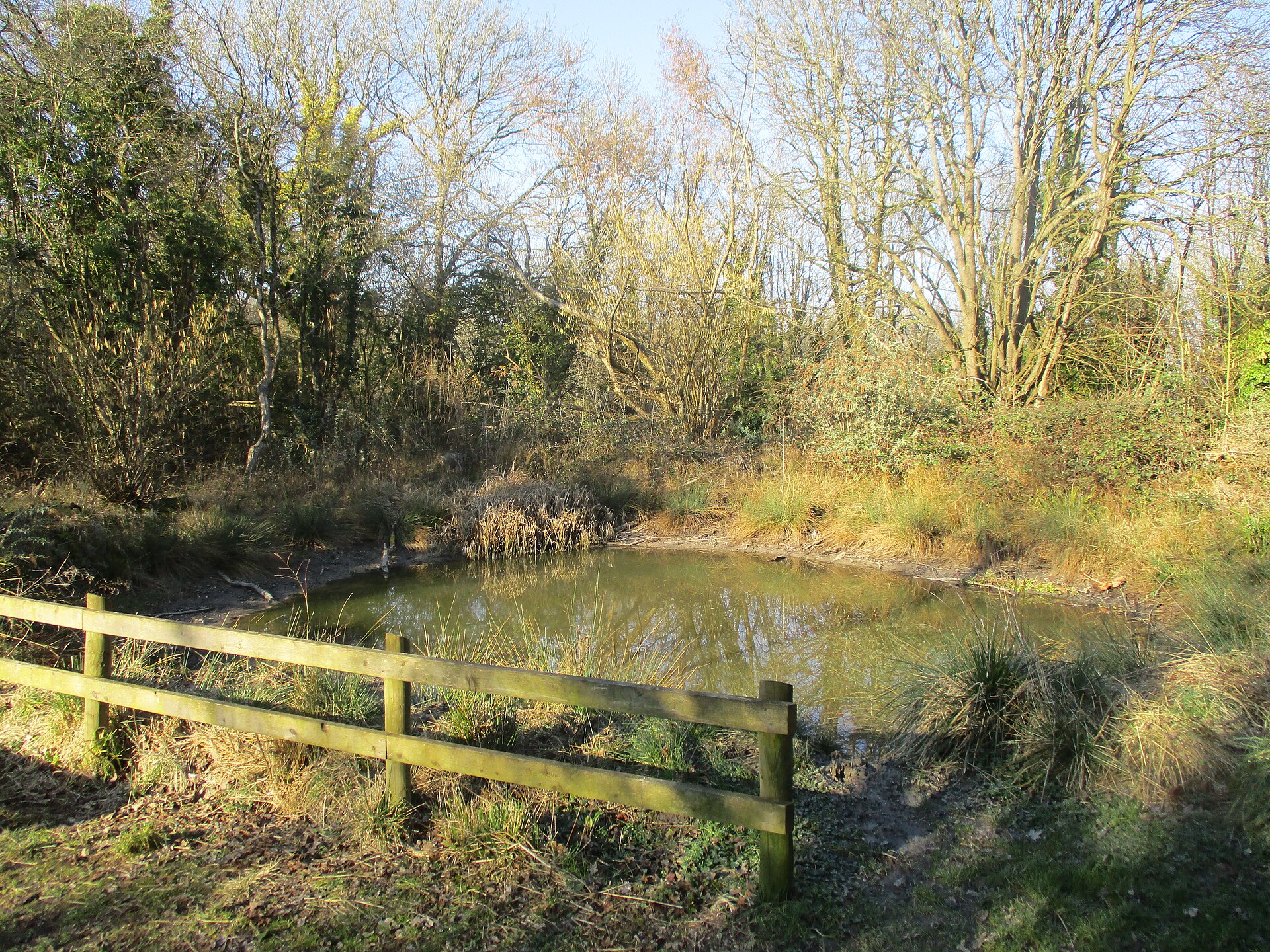
Buriton Chalk Pit is now a 5.7-hectare Local Nature Reserve owned by East Hampshire District Council and managed by Hampshire Countryside Service. It still carries large heaps of spoil, and has grown into a rich chalk-grassland habitat; many of its paths follow the routes of the narrow-gauge lines that carried the chalk and lime. Much of the quarrying, though, is no longer legible: the France pit became the local amenity tip off Kiln Lane, the White pit was taken by Buriton sawmill, and the remains of the kilns have been buried.
Spoil heaps, the graded routes of the three-foot-gauge railway now used as footpaths, and old sleepers still visible in the Germany pit. Several works buildings survive around the main site: the mill, the granary with the carpenter’s shop beneath it, the limeworks office and the stables. Grooves cut into the brickwork corners by the haulage cable that pulled coke wagons up the incline were still visible when the site was recorded. The 145-foot chimney is gone, felled on 14 August 1948.
Redevelopment
The France pit was filled with refuse and became the local amenity tip; the White pit was taken by Buriton Sawmills. After the Admiralty gave up the main works site in Germany pit it passed through a scrap yard, a bakery and a further industrial occupier. From 2007 Buriton Parish Council, East Hampshire District Council, Queen Elizabeth Country Park and the South Downs Joint Committee worked up the Chalk Pits Project, which won a £149,400 Heritage Lottery Fund award in 2010 for scrub clearance, new habitat, path works and a part-time ranger.
Related mines
- Old Burghclere Lime Quarry — Both Hampshire chalk quarries with their own lime kilns, and both ended up in the hands of the same cement combine — the British Portland Cement Company bought Buriton in the 1927 Bonham Carter estate sale, and the same concern owned Old Burghclere. The link is common ownership within one company, not a working connection between the two sites.
Nearby mines
- Cocking Quarry — 9.0 miles (14.5 km) E, West Sussex
Straight-line distance, within 9 miles (15 km). Show on the map.
What's uncertain
Points where sources disagree or the record could not be settled; both accounts are kept. All open questions in the archive.
- The British Portland Cement Company bought the site in the 1927 estate sale and the works were all closed in 1939. (disputed) 1
- The former chalk quarry was worked up to the end of the Second World War. (disputed) 2
- In spite of blasting at faces some sixty feet high, the most serious accident recalled at the works was a broken leg. (uncertain) 1
Recorded claims
Individual factual claims, each attached to the source(s) that support it below. Where sources disagree, both are kept.
- The limeworks are believed to have been started by B. J. Forder in about 1860, when he came from Winchester to live at Berriton Court; the opening of the Portsmouth–London railway early in 1859 made it possible by bringing coal to Petersfield. 1
- The 1871 census records Forder as a limeburner employing twenty men and four boys; in later years the works employed about forty people, and possibly nearer a hundred in the summer months when building demand for lime was greatest. 1
- Three main pits developed — France on War Down, Germany across Kiln Lane, and the White pit on Head Down. France and Germany chalk carried a higher clay impurity and burnt to a creamy powder used for mortar and later a waterproof cement; the White pit gave white chalk sold for plaster and for gas and water purifying. 1
- The British Portland Cement Company bought the site in the 1927 estate sale and the works were all closed in 1939. (disputed) 1
- The former chalk quarry was worked up to the end of the Second World War. (disputed) 2
- A Hoffmann-type kiln in Germany pit consisted of a circular group of chambers around a 145-foot central chimney, long out of use by the mid-1920s; the chimney itself was not demolished until 14 August 1948. 1
- In spite of blasting at faces some sixty feet high, the most serious accident recalled at the works was a broken leg. (uncertain) 1
- Buriton Chalk Pit is a 5.7-hectare Local Nature Reserve owned by East Hampshire District Council and managed by Hampshire Countryside Service; it still has large heaps of spoil, and many of its paths follow the routes of the narrow-gauge railway lines used to move chalk and lime. 2
- The pits have a deep significance for the area, as at one time nearly a quarter of the parish population relied on the lime workings. 3
- The workings were started in the 1860s and flourished until the 1930s, when cement replaced lime as the building industry’s preferred material. 3
- During the Second World War the lime pits were taken over by the Royal Navy and given the name HMS Mirtle, becoming a centre for the removal of explosives from unexploded ordnance, which was brought to the quarry bowl and made safe. The site was abandoned after the war. 3
- The site is recorded on the national planning register as Local Nature Reserve 1009452, Buriton Chalk Pit. 4
- The Chalk Pits Project, begun by Buriton Parish Council when the future ownership of the site was in question, won a confirmed Heritage Lottery Fund award of £149,400 — 81 per cent of project costs — announced on 24 May 2010, paying for scrub clearance, habitat creation, path works and a part-time ranger. 3
Photographs & further reading
The fullest account of the works: the leases and owners, the three pits, the quarrying and blasting method, the gravity railway, each type of kiln, and the men who worked there, written in 2001 from local recollection.
View sourceThe nature reserve that now occupies the quarry: its designation, area and management, and the spoil heaps and railway routes that survive in it.
View sourceThe 2010 grant announcement, which also carries the clearest short account of the site’s arc: a quarter of the parish dependent on the lime workings, the 1930s collapse as cement displaced lime, and the Royal Navy’s wartime bomb-disposal use of the quarry bowl as HMS Mirtle.
View sourceSources
- (secondary) Buriton Lime Works — Buriton Heritage
- (secondary) Buriton Chalk Pit — Wikipedia
- (secondary) Future of Buriton Chalk Pits secure thanks to Heritage Lottery Fund grant — The National Lottery Heritage Fund
- (primary) Buriton Chalk Pit — Local nature reserve 1009452 — Ministry of Housing, Communities and Local Government (planning.data.gov.uk)
Record created: 7 September 2026 · Last researched: 7 September 2026